Veneer vs Solid Wood Construction: What the Difference Means for Rosewood Furniture
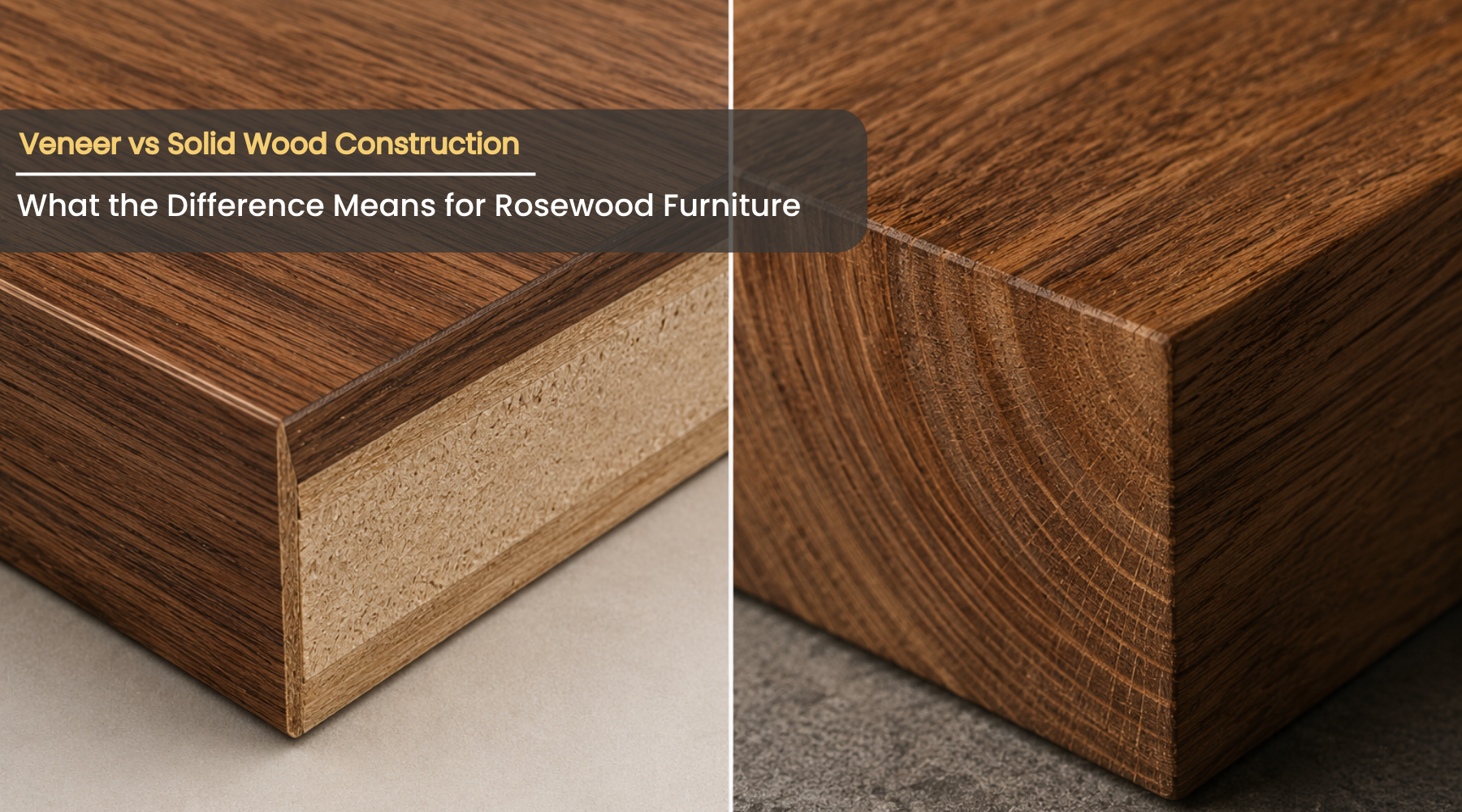
Solid wood rosewood furniture is cut from one continuous piece of timber, weighs noticeably more, and can be sanded and refinished for decades. Rosewood veneer is a slice of the same timber, often under 1mm thick, glued onto a core of MDF, particleboard, or plywood. Both are real wood. The difference sits in what holds the piece up a solid rosewood board carries its own load while a veneered panel relies on a manufactured core underneath the visible surface.
That single structural fact drives almost everything buyers care about, including price, weight, repairability, lifespan and how the piece reacts to a dry winter or a humid summer. With rosewood specifically, the stakes are higher than with oak or pine, because the timber is rare, costly and regulated under international trade law. This guide explains how each construction method works, where each one earns its place and how to tell which you are actually buying.
What rosewood veneer is and how it is made
Veneer starts as a log mounted on a lathe or sliced on a flitch. A blade peels or slices the timber into sheets, most between 0.3mm and 3mm thick. Those sheets get bonded under heat and pressure onto a substrate. The substrate is the part that matters for quality.
Three cores show up most often:
- Particleboard mixes wood chips, sawdust and adhesive pressed into a flat panel. It is the cheapest core and the weakest, prone to swelling if water reaches it.
- MDF (medium-density fibreboard) presses fine wood fibres into a dense, smooth panel. It holds detail well and gives veneer a flat, even bed but it is heavy and water-sensitive at the edges.
- Plywood or plycore glues thin wood layers in alternating grain directions. This core stays dimensionally stable and can match or exceed solid wood for resisting warp, which is why higher-end veneered pieces use it.
For rosewood, veneering does one thing no solid construction can: it stretches a scarce material across far more surface area. A single rosewood log sliced into veneer covers many times the area the same log would yield as solid boards. That is the reason most antique and luxury rosewood pieces from the 19th century were veneered over a cheaper hardwood carcass. The cabinetmakers were not cutting corners. They were rationing a precious timber while showing its figure on every visible face. Rosewood's tight, swirling grain and deep colour read beautifully as veneer and book-matched sheets create mirror-image patterns that solid boards simply cannot produce.
The trade-off is depth. The rosewood you see on a veneered top is the only rosewood in the panel. Everything below the bond line is core material, which sets up the durability questions the next section addresses.
What solid rosewood construction means
Solid rosewood furniture is built entirely from rosewood boards, apart from upholstery, brass or hardware. The leg is rosewood through its full thickness. The tabletop is rosewood from surface to underside. There is no core, no substrate and no bond line waiting to fail.
This matters most with a timber like rosewood, where the grain and tone run all the way through. Chip the edge of a solid rosewood table and you find more rosewood underneath. Chip a veneer and you find the core. Solid construction also allows joinery that veneered panels cannot take: mortise and tenon, dovetailed drawers and dowelled frames that lock the wood together mechanically rather than relying on adhesive to a manufactured board.
Rosewood falls firmly in the hardwood category, denser and more durable than softwoods like pine or cedar. A well-built solid rosewood piece can outlast its first owner. The catch is wood movement. Solid timber expands and contracts with humidity and a craftsman has to design for that with breadboard ends, floating panels and seasonal gaps. Each Boston Mills piece is brought to life by skilled craftsmen, which is what allows that movement to be engineered out rather than ignored. The benefit you keep is repairability. Sand a scratch out of solid rosewood and the colour underneath is identical, because it is the same wood all the way down.
Solid construction costs more both in material and labour. That cost gap is where most buyers start weighing the two methods against each other
Core differences between veneer and solid rosewood
Difference between the two construction methods comes down to six practical measures. Each one behaves differently depending on whether you are buying a dining table, a cabinet or a bed.
Weight. Solid rosewood is heavy. Lift one end of a solid rosewood console and you feel it resist. A veneered piece on particleboard or MDF can feel lighter, though an MDF core is dense enough that weight alone is not always a reliable tell.
Durability. Solid rosewood resists deep damage because there is no thin surface to breach. Veneer protects well against everyday wear but once the surface layer chips or lifts, the core is exposed and vulnerable. Plycore-backed veneer narrows this gap considerably.
Cost. Veneer uses a fraction of the rosewood, so it costs less for the same footprint. Solid rosewood commands a premium that reflects both the volume of rare timber and the joinery skill required.
Repairability. Solid rosewood is the clear winner. Most scratches, dents and ring marks sand out and refinish to match. Veneer rarely survives aggressive sanding because the layer is too thin to lose any thickness, so deep damage often means replacing a panel.
Stability. Here veneer can win. A veneer bonded to plywood or MDF resists the seasonal expansion and warping that solid boards experience. Solid rosewood needs careful construction to manage that movement.
Longevity. Solid rosewood, built correctly, lasts generations and becomes an heirloom. Quality veneer lasts a long time too, but the surface sets a ceiling on how many times the piece can be revived.
None of this makes one method universally better. It makes each one right for different jobs, which is the question to settle next.
Where each method earns its place
Method choice should follow the function of the piece, not a blanket rule that solid is always superior. Both have earned a place in serious furniture making.
Solid rosewood suits surfaces that take daily abuse and benefit from refinishing: dining tabletops, chair frames, bench seats, desk surfaces and anything with load-bearing joinery. These are the pieces you want to repair rather than replace and solid construction is the only one that lets you.
Veneer earns its place on large flat panels where solid boards would crack or cost too much: cabinet sides, wardrobe doors, headboards, drawer fronts and decorative panels. A six-foot solid rosewood cabinet side would be heavy, expensive and prone to splitting. The same panel in plycore-backed rosewood veneer stays flat, costs less and shows the grain just as well. Veneer also makes book-matched and inlaid patterns possible, the kind of figure work that defines high-end rosewood cabinetry.
The honest position is that fine furniture often combines both. A solid rosewood frame with veneered panels uses each material where it performs best. What separates quality from corner-cutting is whether the maker chose the method on purpose or chose veneer purely to cut cost on a cheap core. That difference is exactly what you want to detect before you buy.
How to tell solid rosewood from veneer
Telling the difference takes about a minute of inspection and the checks work on rosewood as well as any other species.
- Check the end grain. On a solid rosewood top, the grain on the surface flows over the edge and continues on the end. If the edge shows a thin band of one wood over a different core or edgebanding glued on, it is veneer.
- Look at the underside. Solid wood shows related grain top and bottom. A veneered top often has a completely different grain or a plain core underneath because no maker wastes rosewood on a hidden face.
- Weigh it. Solid rosewood is dense and heavy. A piece that lifts too easily for its size is likely veneer over a light core, though MDF cores complicate this.
- Feel the grain. Real rosewood grain has subtle ridges and irregularities. A perfectly uniform, repeating pattern can signal veneer or a printed surface.
- Open a drawer. Dovetail or dowelled joints point to solid construction and careful joinery. Stapled or glued butt joints over a manufactured core point the other way.
- Ask the seller. A reputable maker tells you exactly which parts are solid and which are veneered. Vagueness on this question is itself a warning.
One last distinction trips people up constantly, and it is worth settling clearly.
Rosewood veneer is not laminate
Veneer and laminate get confused and the confusion costs buyers money. Veneer is real wood, a genuine slice of rosewood with its own grain, pores and ability to take stain or oil. Laminate is not wood at all. It is usually a plastic or paper surface printed with a wood-look photograph, then bonded to a board. A laminate "rosewood" finish never came near a rosewood tree.
The tell is touch and depth. Real rosewood veneer has the warmth, texture and slight irregularity of timber, and it can be sanded lightly and refinished. Laminate feels smooth and plastic, repeats its pattern exactly, and cannot be refinished at all. If a surface looks like rosewood but feels like glass and repeats perfectly, it is laminate, not veneer, and certainly not solid rosewood.
Why rosewood construction carries extra weight
Rosewood differs from common furniture timbers in one way that changes the whole conversation: supply. True rosewoods in the Dalbergia genus are listed under CITES, the international convention that regulates trade in threatened species. That listing means legitimate rosewood furniture comes with documentation and it explains why genuine rosewood, solid or veneer, costs far more than oak or walnut.
This is where construction method and species intersect. Veneer exists partly to make a rare, regulated, expensive timber go further, which is a sound reason rather than a cheap one. But it also means the word "rosewood" gets attached to laminates and look-alike species that have no Dalbergia in them at all. Boston Mills works in true black rosewood, prized for its signature dark figure and documents its compliance with rosewood trade rules. Knowing whether your piece is solid rosewood, rosewood veneer or a printed imitation is not just a durability question with this species. It is a question of what you are actually paying for.
Is solid rosewood always better than rosewood veneer?
No. Solid rosewood is better for surfaces that need refinishing and load-bearing joinery, such as tabletops and chairs. Rosewood veneer over plycore performs better on large flat panels like cabinet doors, where solid boards would warp or split. The right choice depends on the piece, not a blanket ranking.
Can rosewood veneer be refinished?
Lightly and only once or twice. A quality veneer is thick enough to take a gentle sanding and a fresh coat of oil or finish. It cannot survive the repeated aggressive sanding that solid rosewood tolerates, because the wood layer is too thin to lose thickness. Solid rosewood refinishes many times over its life.
How can I tell if a rosewood table is solid or veneer?
Check the edge and underside. Solid rosewood shows continuous grain that wraps from the top over the edge, with related grain underneath. Veneer shows a thin surface layer over a visibly different core and the underside is often plain or unmatched. Weight and dovetail joinery are supporting clues.
Why is solid rosewood so expensive?
Solid rosewood costs more for two reasons. The timber itself is rare and regulated under CITES, so the raw material is scarce and documented. Solid construction also uses far more of that timber than veneer and demands skilled joinery. Together these push solid rosewood well above common hardwoods.
Does rosewood veneer mean lower quality?
Not by itself. Veneer over particleboard with a thin slice and a poor finish is low quality. Rosewood veneer over a stable plywood core, well bonded and properly finished is a legitimate high-end construction used in fine cabinetry for centuries. The core and the craftsmanship decide quality, not the word "veneer".
Is rosewood laminate the same as rosewood veneer?
No. Veneer is a real slice of rosewood with natural grain that can be finished. Laminate is a printed plastic or paper surface made to imitate rosewood, with no real timber in it. Laminate cannot be refinished and repeats its pattern exactly, while genuine veneer shows natural variation.
Which lasts longer, solid rosewood or veneer?
Solid rosewood lasts longer in practice, often for generations because damage can be sanded out and the piece revived repeatedly. Quality veneer also lasts decades but its thin surface limits how many times it can be restored before the core shows. For heirloom pieces, solid construction has the edge.