Article: Humidity, Cracks & Climate: Protecting Rosewood in Dry vs. Humid Homes
Humidity, Cracks & Climate: Protecting Rosewood in Dry vs. Humid Homes
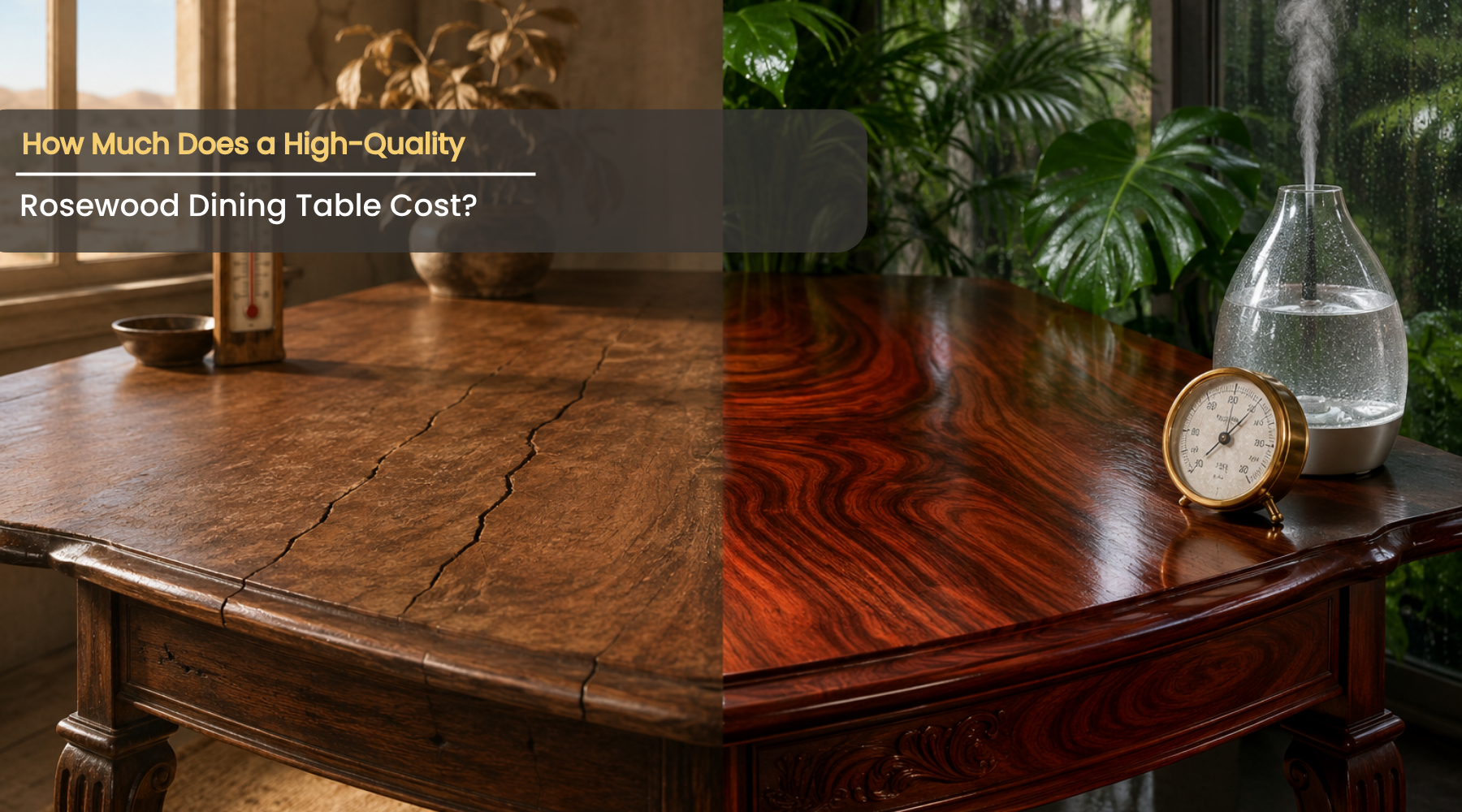
A friend in Tucson once sent me a photo of her rosewood credenza with a fine crack running along the top board, and a friend in New Orleans, the same week, sent me a photo of a stuck drawer in her console. Same wood. Same craftsmanship. Two opposite problems, both written by the climate inside the house. Rosewood lives with the air around it, expanding when the air is damp and contracting when the air is dry and the home you live in decides which direction the wood gets pushed.
A handcrafted piece holds its shape best when the air stays around 70°F to 72°F and relative humidity stays between 50 and 55 percent. That’s the standard we follow at Boston Mills, close to what museums use for centuries-old wooden objects. Anything from 40 to 55 percent sits safely within the band most rosewood can absorb without complaint. Trouble starts when a home sits well below or well above that range for weeks. This guide walks through what dry homes and humid homes each ask of the wood.
Why Rosewood Responds to the Climate You Live In
Wood cells breathe. They take on moisture when the air is humid and release it when the air is dry, and the board changes width slightly each way. Rosewood, with its natural oils and dense grain, breathes more slowly than softer woods like pine or poplar but it still breathes. A Brazilian rosewood tabletop in dry Denver and the same tabletop in humid Houston will sit at different widths through most of the year.
The movement happens almost entirely across the grain not along it. A six-foot dining table might shift a millimetre or two in width while changing almost nothing in length. That’s why hairline gaps tend to show up at the joins between boards. The wood isn’t failing. It’s responding the way every honest hardwood responds to the air it lives in. Quality joinery, the kind that floats panels in frames and breathes through tabletop attachments, is designed for this. Push the climate too far outside that working range for too long, and the wood shows the strain.
The Ideal Range for Indoor Rosewood
Conditions of around 70°F to 72°F and 50 to 55 percent relative humidity are what we recommend at Boston Mills and that’s what we build to. A safe everyday band sits a little wider between 40 and 55 percent, with brief dips and climbs outside it that the wood absorbs without lasting effect.
A small digital hygrometer, the kind that costs under twenty dollars, is the single most useful tool you can keep near a rosewood piece. What counts as extreme depends on duration. Sustained humidity below 30 percent stresses wood toward cracking. Sustained humidity above 65 percent pushes it toward swelling and, in a quiet corner, toward mould.
Living With Rosewood in Dry Homes
Phoenix, Tucson, Albuquerque, Denver, Salt Lake City, Reno, parts of West Texas. Homes in the desert Southwest and the Mountain West routinely sit at relative humidity in the 15 to 30 percent band for months. Northern homes with forced air heat join them every winter. Cold outside air and a hardworking furnace can pull indoor humidity below 20 percent by January, even in a coastal city like Boston.
The signs show up first in the joints. A hairline seam opens between two tabletop boards, narrow enough to slip a sheet of paper through. Panels in cabinet doors shrink and reveal a thin pale line where the panel used to overlap the frame. Drawers that ran tight in July glide easily in February. A faint crack appears along the grain of a wide board. Veneered surfaces sometimes lift at an edge. The wood isn’t breaking. It’s telling you the air is too dry for too long.
The fix is moisture. A whole-house humidifier wired to the furnace gives the steadiest control, holding the home near the target band without daily attention. A portable room humidifier near the rosewood works when a whole-house unit isn’t possible. Aim for 35 to 45 percent through the dry stretch. Higher than that and condensation forms on cold windows.
Placement matters as much as the humidifier. Keep rosewood at least three feet from heating vents and radiators, and well off the wall behind a wood-burning fireplace. Move a piece out of the direct line of an afternoon sunbeam, especially in winter when the low sun reaches deeper into the room.
Living With Rosewood in Humid Homes
Miami, Tampa, New Orleans, Houston, Galveston, Charleston, Savannah. Gulf Coast and Atlantic coastal homes often sit above 65 percent relative humidity through summer and older houses without central air can stay that way for weeks. The Pacific Northwest carries its own wet pattern from October through April.
Drawers begin to stick. A cabinet door rubs the frame on its closing edge. Wide tabletops feel slightly tight against breadboard ends. The finish can take on a cloudy bloom in a kitchen or bathroom where steam rises regularly. In the worst cases, mould spots appear in the dust at the back of an unventilated piece, or a thin black mildew line shows where a cabinet pushes against an exterior wall.
The fix is removal of moisture and movement of air. Central air conditioning pulls humidity out as it cools, which is why summer indoor humidity in an air-conditioned coastal home usually sits below 55 percent. A dehumidifier sized for the room fills in when AC alone can’t pull the number low enough. Aim for 45 to 60 percent through the wet stretch.
Position rosewood with a gap behind it, not flush against an exterior wall. Coastal exterior walls run cooler than interior air, condense moisture on their inside face and feed humidity into the back of pieces pressed against them. Two inches of air space prevents that exchange.
Climates That Swing Both Ways
Most of the United States lives between the two extremes. Dallas, where Boston Mills is based, runs humid summers and dry heated winters in the same calendar year. The Northeast, Midwest, Mid-Atlantic, and Carolinas inland all swing the same way. A rosewood piece in one of these homes faces both pressures across twelve months.
The answer is two pieces of equipment used in their seasons. A humidifier from November through March. An air conditioner or dehumidifier from May through September. A digital hygrometer running year round tells you when to switch. Keep the reading inside the 40 to 55 percent band as much as the year allows.
Tools and Habits That Make the Difference
A handful of simple tools cover most of the climate control a rosewood piece needs:
- A digital hygrometer. Reads relative humidity to within a few percent. Place it near the furniture, not above a radiator or beside a window.
- A humidifier sized for the room or the home. Models with an automatic humidistat hold a target without constant adjustment.
- A dehumidifier for coastal and basement applications, rated for the square footage of the room.
- Felt pads or rubberised feet under heavy pieces. Stops dragging damage and keeps a small air gap from the floor.
- Coasters, placemats, and trivets. Heat and damp from cups, plates, and pots leave rings no climate control will undo.
Daily care stays gentle. Dust every two weeks with a feather duster along the grain, follow with a soft dry cloth. Skip cleaners that contain ammonia, silicone, or wax. Guardsman wood care products are what we recommend at Boston Mills, applied lightly to a microfibre cloth and never sprayed directly onto the wood.
Reading the Early Signs
A small change in the wood is easier to address than a large one. Watch for these:
- Hairline gap at a board joint, late winter, in a dry home. The air has been too dry for too long. Add humidity.
- Stuck drawer or binding door, midsummer, in a humid home. The wood has swelled. Dehumidify and improve airflow.
- Cloudy or hazy finish bloom, often in a kitchen or near a bathroom. Surface moisture. Wipe with a barely damp cloth and reduce ambient humidity.
- Fine crack along the grain of a wide top. Sustained drying. Stabilise humidity first; a professional finisher can address the crack itself later.
- Lifting veneer edge. Glue line is reacting to humidity swings. Call a professional before pressing it back yourself.
Most early symptoms reverse on their own once the climate around the wood comes back into range. Damage that persists after a full season of normal humidity is when a professional restorer earns their fee.
What humidity level is safest for rosewood furniture?
Between 40 and 55 percent relative humidity, year round. The Boston Mills target is 50 to 55 percent, paired with a temperature of 70 to 72 degrees Fahrenheit. Brief dips to 35 percent or climbs to 60 percent rarely cause harm. Sustained readings below 30 or above 65 are where the trouble begins.
Does rosewood crack more easily than other hardwoods?
Less, actually. The natural oils in rosewood slow moisture exchange and the dense grain moves less per unit of humidity change than softer woods. Brazilian and Indian rosewood both handle climate swings better than walnut, cherry or oak of the same dimensions. They can still crack under extreme dryness but the threshold is further out.
Will air conditioning alone keep humid-climate rosewood safe?
Often yes, sometimes no. Central AC removes a lot of moisture as it cools, so summer indoor humidity in an air-conditioned Houston home usually stays under 55 percent. The exception is shoulder seasons, when outdoor temperatures don’t justify cooling but indoor humidity still climbs. A standalone dehumidifier covers those weeks.
How close to a heat vent or fireplace is too close?
Three feet from a vent, six feet from an active fireplace. Heating vents push the driest, hottest air in the house directly at whatever sits in front of them. Wood-burning fireplaces add radiant heat on top of dry air. Both create stress zones that average room humidity readings don’t capture.
I’m moving my rosewood from Phoenix to Miami. What should I do?
Let it acclimatise slowly. Opposite climates in opposite directions is the hardest move for any solid wood piece. If possible, leave the piece in a moderate-humidity environment for two to three weeks before placing it. Once installed, run a dehumidifier through the first summer and monitor with a hygrometer.
Can I keep rosewood furniture in a basement or attic?
Only if the space holds climate. Basements often run 60 to 75 percent humidity in summer; attics often swing from 90 percent humidity to under 20 percent in winter. Both sit outside the safe range. If a basement or attic must store a piece, install a hygrometer first and add humidity control before moving the furniture in.
How often should I check the hygrometer?
Once a week is plenty in stable seasons. Twice a week through November to March and May to September. Most climate problems develop slowly over weeks. A weekly glance catches the trend before the wood starts reacting.
Living With the Climate, Not Against It
The friend in Tucson added a humidifier to her living room in November. The friend in New Orleans pulled her credenza two inches off the exterior wall and runs a dehumidifier on the wettest weeks. Both pieces look the way they did the day they arrived. Rosewood doesn't ask for perfect conditions. It asks for steady ones.
At Boston Mills, our pieces are designed for the long climb through generations. The construction floats panels, breathes through joints and accommodates the small movements any natural material makes. French polished finishes slow the moisture exchange. Brass inlays sit in routed channels that let the wood beneath them move. Each piece is designed through our Dallas World Trade Center showroom, brought to life by skilled craftsmen and carefully inspected by our team before it reaches your home. From our Dallas showroom, where summers run damp and winters run dry, we know the climate question intimately.
Caring for rosewood isn't about fighting where you live. It's about knowing the air your home keeps, watching the wood respond and reaching for the humidifier or the dehumidifier when the number drifts. Do that, and the piece you bought becomes the piece your grandchildren argue over.