Rosewood vs Walnut vs Mahogany: Which Hardwood Is Right for Your Living Room?
A solid rosewood coffee table from Boston Mills weighs more than the same piece in walnut and roughly twice the same piece in genuine mahogany. That weight comes from density, and density is where these three hardwoods stop being interchangeable. Rosewood sits at around 53 pounds per cubic foot with a Janka hardness near 2,440 lbf. Walnut runs about 38 pounds per cubic foot and 1,010 lbf. Genuine mahogany lands at 800 to 900 lbf and 34 to 40 pounds per cubic foot.
The numbers shape everything: how each wood holds a carved leg, how it ages under sunlight, how it absorbs the dent of a dropped phone, and how much you pay. This guide compares rosewood, walnut, and mahogany on hardness, color, grain, cost, and sustainability so you can choose the right one for your living room. Boston Mills has hand-built furniture in Dallas since 2014, and the comparisons below draw on what we see on the workshop floor.
Quick Comparison: Rosewood vs Walnut vs Mahogany
Quick reference for the three woods at a glance:
|
Property |
Rosewood |
Walnut (Juglans) |
Mahogany (Swietenia) |
|
Janka hardness |
~2,440 lbf |
~1,010 lbf |
800 to 900 lbf |
|
Density |
~53 lb/ft³ |
~38 lb/ft³ |
34 to 40 lb/ft³ |
|
Color |
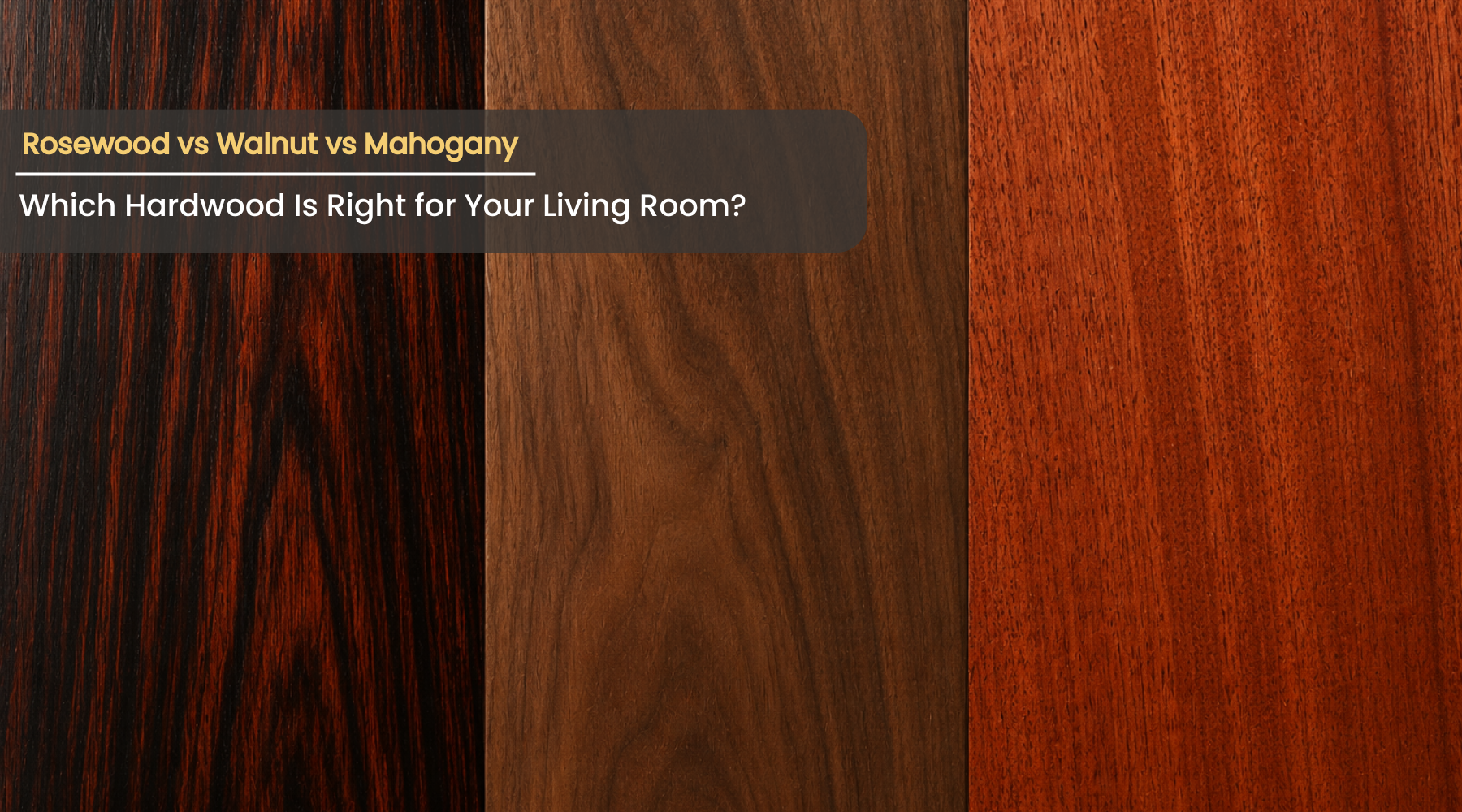
Golden orange to greenish-black with dark streaks |
Light brown to dark chocolate, sometimes purple cast |
Pale pinkish brown to deep reddish brown |
|
Grain |
Bold, ribbon-like, interlocked or straight |
Straight, occasional waves and swirls |
Tight, generally straight |
|
Cost |
Highest of the three |
Mid to high |
Lowest of the three |
|
Best fit |
Heirloom statement pieces |
Mid-century, transitional, contemporary |
Traditional, classic, formal |
|
Sourcing |
South Asia, CITES regulated |
North America (Black Walnut), domestic in US |
Central and South America, FSC for genuine |
Rosewood: The Densest of the Three
Rosewood refers to species in the Dalbergia genus, with the major commercial varieties being Brazilian rosewood (Dalbergia nigra), East Indian rosewood (Dalbergia latifolia), and Indian rosewood (Dalbergia sissoo). At Boston Mills, every Heritage Collection piece uses solid Dalbergia Sissoo from South Asia, where the species is unendangered and air-dried for an average of 16 to 20 months before the carving begins.
The wood looks unlike anything else in the hardwood category. The heartwood ranges from golden orange to greenish-black, broken up by darker streaks that give the surface a ribbon-like flow. Bookmatched panels read almost as artwork. Rosewood also carries enough natural oil to resist root disease and termite attack without preservative treatment.
Two facts about rosewood are easy to underestimate. First, it grows slowly: a tree takes around 300 years to produce a piece five inches thick. Second, it sinks in water. That density translates to furniture that rarely shows a scratch even after a decade of use. The trade-off is weight. A solid rosewood console table is a two-person lift.
Rosewood is the most regulated wood of the three. CITES (the Convention on International Trade in Endangered Species) controls all rosewood movement across borders, regardless of country of origin. Boston Mills imports under permit and publishes a separate Rosewood Compliance note for buyers who want to verify the chain of custody.
Walnut: The Versatile Middle Choice
Walnut covers several species in the Juglans genus. The dominant variety in North American furniture is Black Walnut (Juglans nigra), which grows across the Midwest and Eastern US. English Walnut (Juglans regia) shows a slightly lighter, more figured grain and turns up in European pieces. Claro Walnut (Juglans hindsii) is the prized live-edge wood with swirling figure.
Color is where walnut earns its versatility. Heartwood ranges from light golden brown to deep chocolate, sometimes with a purple undertone. The grain runs mostly straight, with occasional waves that give carved details an organic feel. Walnut takes finish well and develops a soft, warm patina over years rather than darkening dramatically.
Hardness sits at about 1,010 lbf on the Janka scale. That puts it ahead of mahogany for resisting dents and well below rosewood. Walnut also holds dimensional stability in normal indoor humidity, so a coffee table built in dry winter air won't crack when summer humidity rolls in.
Domestic sourcing matters here. Black Walnut from US forests carries a lower transport footprint than imported tropical hardwoods, which is why it's often the first hardwood specified on LEED-aware projects. Walnut tends to cost more than mahogany because supply runs tighter, and the market values the grain. Boston Mills uses walnut in selected Contempo Collection 2025-26 designs by Creative Director James Hughes, where lighter wood tones suit modern interiors.
Mahogany: The Traditional Reference Point
Mahogany covers three commercially important species in the Swietenia genus: Swietenia mahagoni (Cuban mahogany), Swietenia macrophylla (Honduran or genuine mahogany), and Swietenia humilis. African mahogany (Khaya genus) is a related but distinct group sold under the same trade name.
The color most people associate with antique furniture is mahogany. Pale pinkish brown when freshly milled, deepening over decades into the deep reddish brown that defined Chippendale, Sheraton, and Federal-period pieces. The grain runs tight and generally straight, which is why master carvers favor mahogany for ornate legs, mouldings, and inlay work. Tear-out is rare. Stains absorb evenly.
On the Janka scale, genuine mahogany measures 800 to 900 lbf, the lowest of the three woods compared here. That number sounds modest, but mahogany compensates with exceptional dimensional stability. It barely shrinks or swells with humidity changes, and it carries strong natural resistance to rot and termites. That stability is one reason it built the British Admiralty's ships and now builds heirloom dining tables.
Genuine mahogany faces the heaviest sustainability scrutiny. Honduran mahogany sat under CITES Appendix II protection for years due to overharvesting. Buyers should ask for FSC certification or documented plantation sourcing. African mahogany is more widely available but offers a slightly different working character.
Hardness and Durability: What the Janka Numbers Mean
Hardness comes from the Janka test, which measures the force in pounds-force needed to press a steel ball halfway into the wood. Higher numbers mean better resistance to dents, scratches, and the daily punishment a living room delivers.
Across the three:
- Rosewood sits near 2,440 lbf for East Indian Dalbergia. Brazilian rosewood pushes higher.
- Walnut averages 1,010 lbf, with some species reaching 1,200.
- Mahogany measures 800 to 900 lbf for genuine Honduran.
In a living room context, rosewood handles pet claws, dropped books, and toddler crashes without showing it. Walnut takes the same abuse but will pick up the occasional dent. Mahogany dents more easily but ages with character: small marks become part of the patina rather than damage. Stability flips the order. Mahogany is the most stable in shifting humidity. Walnut is close behind. Rosewood, despite its density, can develop fine surface checks if a piece swings between bone-dry winter heating and humid summer air.
Real-world durability also depends on construction. A solid wood frame with mortise-and-tenon joinery outlasts a veneered MDF carcass regardless of which species sits on top. Boston Mills builds every Heritage piece from solid stock with hand-cut joinery, which is why pieces from 2014 still look new.
Color, Grain, and Visual Character
Aesthetic fit drives most living room choices. Each wood reads differently in a room.
- Rosewood runs dramatic. Golden orange shifts to deep purple-brown across a single board, with dark streaks creating ribbon patterns. It looks painted rather than grown. Best in rooms where the furniture is meant to be the focal point.
- Walnut runs warm and quiet. The chocolate-to-purple range pairs with most upholstery and reads contemporary, mid-century, or transitional depending on the silhouette. It rarely competes with art on the wall.
- Mahogany runs classic. The reddish-brown deepens with age and pairs naturally with brass hardware, leather, and traditional textiles. Period rooms and formal settings are its native register.
Grain pattern reinforces the differences. Rosewood is bold and high-contrast, often with interlocked figure that catches light from multiple angles. Walnut runs mostly straight with subtle waves and the occasional burl. Mahogany stays tight and uniform, which is why it carves so cleanly. If you've ever seen a Federal-period highboy with applied rosettes, that crispness is mahogany doing what walnut and rosewood can't quite match.
Finish choice changes the conversation. Rosewood resists oil finishes because it's already oily, so most makers lacquer or use French polish. Boston Mills applies hand-rubbed French polish to expose the grain depth. Walnut takes oil, wax, or lacquer beautifully. Mahogany stains evenly and accepts everything from a satin wax to a high-gloss French polish.
Cost: What You're Actually Paying For
Pricing for furniture-grade lumber moves with availability, certification, and grade. Approximate ranges:
- Genuine mahogany runs cheapest of the three, partly because plantation supply has stabilized. African mahogany undercuts Honduran further.
- Black Walnut ranges from $10 to $20 per board foot in furniture grade, with figured Claro pushing higher.
- Rosewood sits at the top. CITES paperwork, the 300-year growth cycle, and limited legal supply combine to make rosewood the most expensive of the three by a wide margin.
For finished furniture, the gap multiplies. A solid mahogany coffee table from a quality maker might start around $1,500. The same design in walnut runs noticeably higher. The same design in solid rosewood, hand-carved, can run several thousand: Boston Mills' MIRA rosewood coffee table starts at $2,795, and the BLOC at $3,795. Free white-glove delivery applies on orders over $3,500.
The premium isn't only material. It reflects labor (16 to 20 months of air-drying and hand-carving for rosewood), provenance (CITES-permitted import), and rarity. What you're buying when you choose rosewood is an heirloom. Walnut sits in the middle: not heirloom rare, but built to outlast the buyer. Mahogany is the value pick of the three, and the right pick when traditional aesthetics matter more than maximum density.
Sustainability and Sourcing
Each wood faces a different sustainability story. The honest answer matters because furniture lasts for decades, and the sourcing decision compounds over that lifespan.
Walnut carries the strongest local-sourcing story for North American buyers. Black Walnut grows across the US, transport distances stay short, and the species isn't endangered. FSC-certified walnut is widely available.
Mahogany has a recovery story. Decades of overharvesting put genuine Honduran mahogany on CITES Appendix II in 2003. FSC-certified plantation supply has expanded since, and African mahogany offers an alternative without the same regulatory weight. Always ask for documented sourcing on any mahogany purchase.
Rosewood is the most regulated and the most carefully sourced. All rosewood, regardless of origin, requires a CITES permit to cross borders. Boston Mills imports only Dalbergia Sissoo from professionally managed forests in South Asia, with priority access to dead or fallen trees. The CITES permitting process is slow and expensive, which is part of what keeps rosewood furniture rare. The Rosewood Compliance page on bostonmills.net documents the chain of custody.
Which Wood Fits Your Living Room?
Match the wood to the room, the way you live, and the years you want the piece to last.
Pick rosewood if: You want a generational piece. The room has space for one statement object and you'd rather have one carved rosewood console than three lighter pieces. You appreciate dramatic grain and don't mind paying for rarity. You have pets, kids, or a heavy-use household where the hardness pays off daily.
Pick walnut if: Your interior leans mid-century, transitional, or contemporary. You want a hardwood that pairs with most colors and styles without dominating. Domestic sourcing matters to you. Budget allows premium hardwood without hitting the rosewood tier.
Pick mahogany if: The room reads traditional, formal, or classic. You're matching existing antiques or period architecture. You appreciate carved detail and rich reddish-brown tones. Stability through humidity swings matters because you live in a climate that fluctuates seasonally.
There's also the mixed approach. Many Boston Mills clients pair a rosewood coffee table or sideboard with walnut or upholstered seating. The rosewood anchors the room. The lighter woods fill in around it without competing.
Is rosewood harder than walnut and mahogany?
Yes. Rosewood measures around 2,440 lbf on the Janka scale for East Indian Dalbergia, well above walnut at 1,010 lbf and mahogany at 800 to 900 lbf. That hardness translates to better dent and scratch resistance, which is why rosewood holds up under heavy daily use.
Why does rosewood cost so much more than the other two?
Three reasons. Growth time: a rosewood tree takes about 300 years to produce a board five inches thick. Regulation: CITES controls all international rosewood movement, which adds permit cost and time. Density: every cubic foot weighs roughly 53 pounds, which means more material per piece and more labor in the workshop.
Is mahogany still endangered?
Genuine Honduran mahogany sits on CITES Appendix II, meaning trade is regulated rather than banned. FSC-certified plantation mahogany and African mahogany are widely available without those restrictions. Always ask for sourcing documentation when buying.
Which wood is best for a living room with kids and pets?
Rosewood resists dents and scratches better than the other two thanks to its density. Walnut is a strong second choice with similar stability. Mahogany dents more easily but develops a softer patina that absorbs minor wear into its character.
Can I mix these three woods in the same room?
Yes, with care. Walnut and mahogany clash slightly because walnut carries purple undertones and mahogany carries red ones. Rosewood, with its golden-to-dark range, bridges both. A common approach is a rosewood centerpiece (coffee table or sideboard) with walnut accent furniture, or mahogany built-ins with rosewood freestanding pieces.
How long does each wood last as furniture?
All three are heirloom-grade hardwoods that outlast their owners with proper care. Solid construction matters more than species choice. A well-built mahogany piece from 1850 still functions today; the same is true of period walnut and rosewood. Veneered MDF in any species fails in a fraction of the time.
Do these woods need different care?
Yes. Rosewood's natural oil resists most finishes except lacquer or French polish: don't oil it, since the surface goes blotchy. Walnut takes oil, wax, or lacquer well and benefits from occasional rewaxing. Mahogany accepts most finishes and stains evenly. All three should be kept out of direct sunlight, which fades color over years.
Is walnut sustainable in the US?
Black Walnut grows domestically across the Midwest and Eastern states, which gives it a low transport footprint and steady supply. FSC-certified walnut is straightforward to source. For US buyers prioritizing local materials, walnut is the most sustainable of the three.
What does Boston Mills make from each of these woods?
The Heritage Collection centers on solid Dalbergia Sissoo rosewood with brass inlay and French polish finishes. Selected Contempo Collection 2025-26 pieces designed by Creative Director James Hughes pair rosewood with walnut and other woods. The Dallas showroom and trade program offer material samples for designers specifying for client projects.