Rosewood vs Oak: Why Premium Furniture Buyers Choose Rosewood
Oak builds barns, barrels and farmhouse kitchens. Rosewood builds heirlooms. Both are hardwoods, both can last 100 years with care, but the buyers who pay for solid rosewood furniture aren't choosing between two equivalent materials. They're choosing density, figure and rarity over availability and price. East Indian rosewood (Dalbergia latifolia) measures around 2,440 lbf on the Janka hardness scale and weighs roughly 53 pounds per cubic foot. White oak measures 1,360 lbf at about 47 pounds per cubic foot. Red oak comes in at 1,290 lbf and 44 pounds per cubic foot. The numbers explain the price gap: rosewood costs $40 to $70 per board foot at premium grades; oak runs $5 to $12. This guide covers what separates the two woods on hardness, color, grain, sustainability and finished value, and why Boston Mills builds the entire Heritage Collection from solid Dalbergia Sissoo rather than the cheaper, more abundant alternative.
Quick Comparison: Rosewood vs Oak
The two woods at a glance:
|
Property |
Rosewood (Dalbergia) |
Oak (Quercus) |
|
Janka hardness |
1,780 to 2,790 lbf depending on species |
1,290 (red) to 1,360 lbf (white) |
|
Density |
~53 lb/ft³ |
37 to 47 lb/ft³ |
|
Color |
Golden orange to deep purple-brown with dark streaks |
Pale gold to medium reddish brown |
|
Grain |
Bold, ribbon-like, interlocked |
Tight with prominent rays, open pores |
|
Cost (board foot, premium) |
$40 to $70 |
$5 to $12 |
|
Sourcing |
South Asia, CITES regulated |
North America and Europe, abundant |
|
Typical use |
Heirloom statement furniture |
Floors, cabinets, casual furniture, barrels |
|
Buyer profile |
Premium and luxury |
Mass market to mid-premium |
That's the snapshot. The detail follows.
Why Premium Buyers Choose Rosewood
The premium hardwood market is small. Most buyers cap out at oak, walnut or maple because those species cover 95 percent of furniture sold in North America. The buyers who go further (clients commissioning solid rosewood pieces, designers specifying for high-end residential or hospitality projects, collectors building a multi-decade investment) cite the same handful of reasons.
Hardness translates to longevity. A rosewood coffee table at 2,440 lbf takes the daily abuse of pet claws, dropped phones and toddler crashes without showing it. Oak at 1,360 lbf takes the same abuse and shows it.
Figure translates to character. Rosewood's heartwood ranges from golden orange to greenish-black, broken by darker streaks that read like ribbons. Bookmatched panels look painted. Oak grain is tight and consistent, with prominent ray flecks in quartersawn boards, but it doesn't deliver the same dramatic figure.
Rarity translates to value retention. Oak grows across 500-plus species in the Northern Hemisphere. Rosewood grows slowly across a handful of regulated Dalbergia species. A rosewood piece from 1850 still trades at full antique value. An oak piece from the same era trades at far lower multiples.
Provenance translates to trust. All rosewood requires CITES paperwork to cross borders. That paperwork costs makers time and money and it filters out anyone unwilling to do it correctly. Buyers who care about chain of custody find rosewood's regulatory weight reassuring.
Rosewood: The Premium Hardwood for Indoor Furniture
Rosewood covers several species in the Dalbergia genus. Brazilian rosewood (Dalbergia nigra), East Indian rosewood (Dalbergia latifolia) and Indian rosewood or Sheesham (Dalbergia sissoo) are the three with commercial weight. Boston Mills uses solid Dalbergia Sissoo from South Asia, where the species is unendangered and air-dries every batch for an average of 16 to 20 months before any carving begins.
A few facts about rosewood worth flagging:
- A rosewood tree takes around 300 years to produce a board five inches thick.
- Rosewood is one of the few woods that sinks in water. The density carries through to finished pieces that absorb daily impact without showing wear.
- The wood's natural oil resists root disease and termite attack without preservative treatment.
- Bookmatched panels and figured boards take French polish with a depth that lacquer can't match.
The Heritage Collection at Boston Mills runs entirely on solid Dalbergia Sissoo: the MIRA coffee table, the BLOC, the BECRUX sideboard, the OASIS desk, the ALIVE dining table, the PEGASUS armchair set. Every piece carries hand-cut joinery, brass inlay accents and hand-rubbed French polish applied by traditional methods. The Contempo Collection 2025-26, designed by Creative Director James Hughes, extends the rosewood language into modern silhouettes while keeping the material constant.
Oak: The Hardwood Workhorse
Oak refers to species in the Quercus genus, with more than 500 species across the Northern Hemisphere. The two with commercial furniture weight in the US are White Oak (Quercus alba) and Red Oak (Quercus rubra). English Oak (Quercus robur) shows up in European antiques.
Oak earned its workhorse reputation honestly. It's strong, abundant, takes stain well, mills cleanly and costs a fraction of any premium hardwood. White oak's closed cellular structure makes it watertight enough for whiskey barrels and ship hulls. Red oak's open grain takes finishes evenly and dominates American kitchen cabinets. Both species mill into reliable furniture-grade lumber at scale.
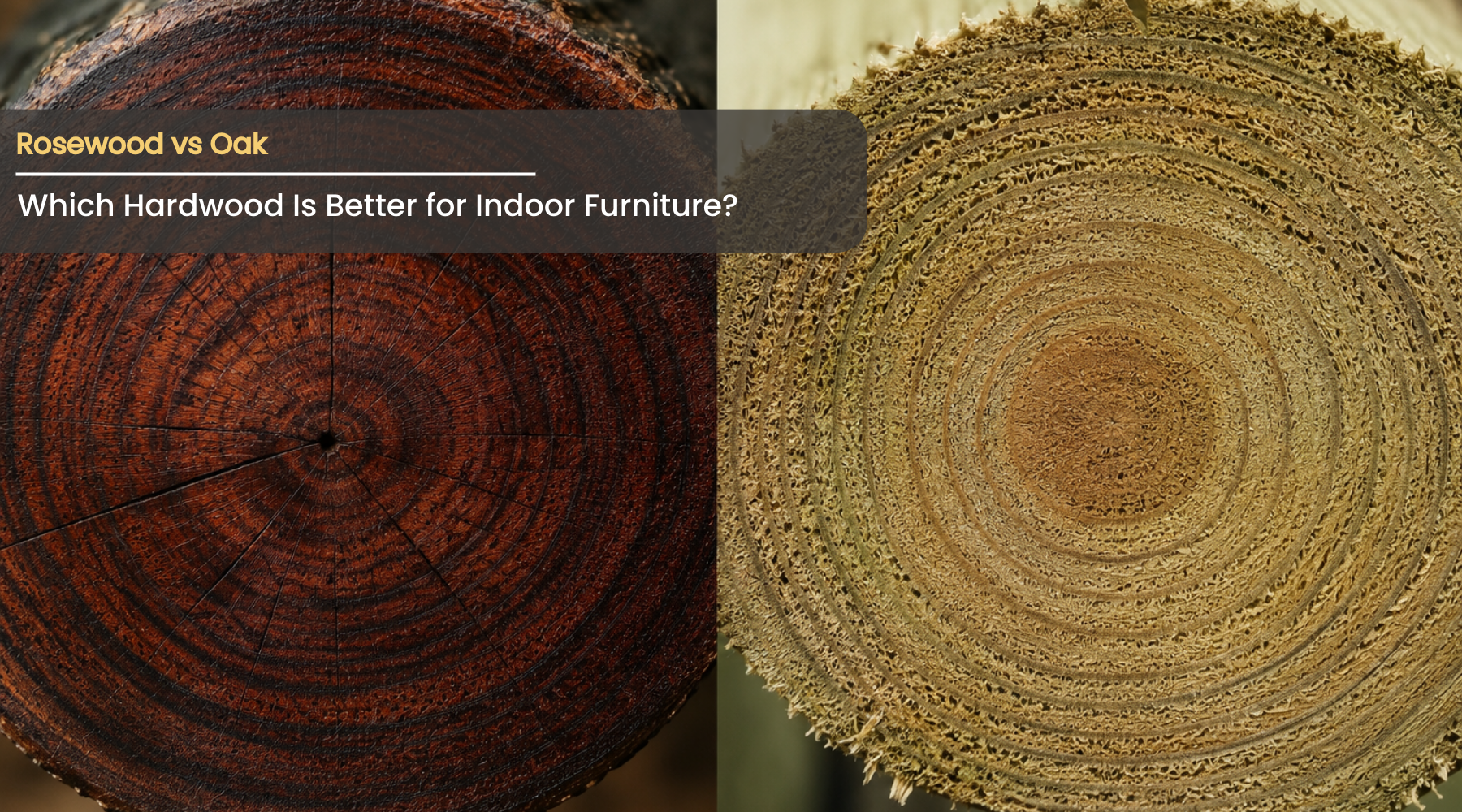
Janka hardness lands at 1,290 lbf for Red Oak and 1,360 lbf for White Oak. Density ranges from 44 to 47 pounds per cubic foot for White Oak, with Red Oak slightly lighter. Color runs pale gold to medium reddish brown, deepening over years. Grain pattern is tight with prominent ray flecks, especially in quartersawn boards, where the rays produce the famous "tiger" or "flake" figure prized in Mission and Craftsman furniture.
The trade-off is what oak doesn't do. The grain reads honest rather than dramatic. The hardness sits below rosewood by about 1,000 lbf. And the abundance that makes oak affordable also makes it ubiquitous: oak floors, oak cabinets, oak dining sets, oak barrels are everywhere, which works against the rarity premium buyers pay for.
Hardness and Density: The Margin That Separates Premium From Mass Market
Janka hardness measures the force needed to press a steel ball halfway into the wood. Higher numbers mean better resistance to dents, scratches and the daily contact a piece of furniture takes.
The comparison breaks down clearly:
- East Indian rosewood: ~2,440 lbf
- Brazilian rosewood: ~2,790 lbf
- Indian rosewood (Sheesham): ~1,780 lbf
- White Oak: 1,360 lbf
- Red Oak: 1,290 lbf
- English Oak: ~1,120 lbf
The gap between premium rosewood and premium oak runs about 1,000 lbf. In daily use that translates to a measurable difference in dent resistance: a rosewood surface shrugs off impacts that mark oak. Density tells the same story. Rosewood weighs 53 pounds per cubic foot. White oak weighs 47. Red oak weighs 44. The denser wood absorbs impact, holds carved detail with crisper edges and feels heavier under the hand, which buyers consistently associate with quality.
Oak's strength sits in tension and outdoor durability, not surface hardness. A white oak boat hull or whiskey barrel uses properties rosewood doesn't have, but those properties don't translate into living-room benefits. For indoor furniture facing daily contact, dent resistance is the relevant metric.
Color, Grain, and Visual Impact
Color and grain decide whether furniture anchors a room or sits quietly in it. The two woods read differently:
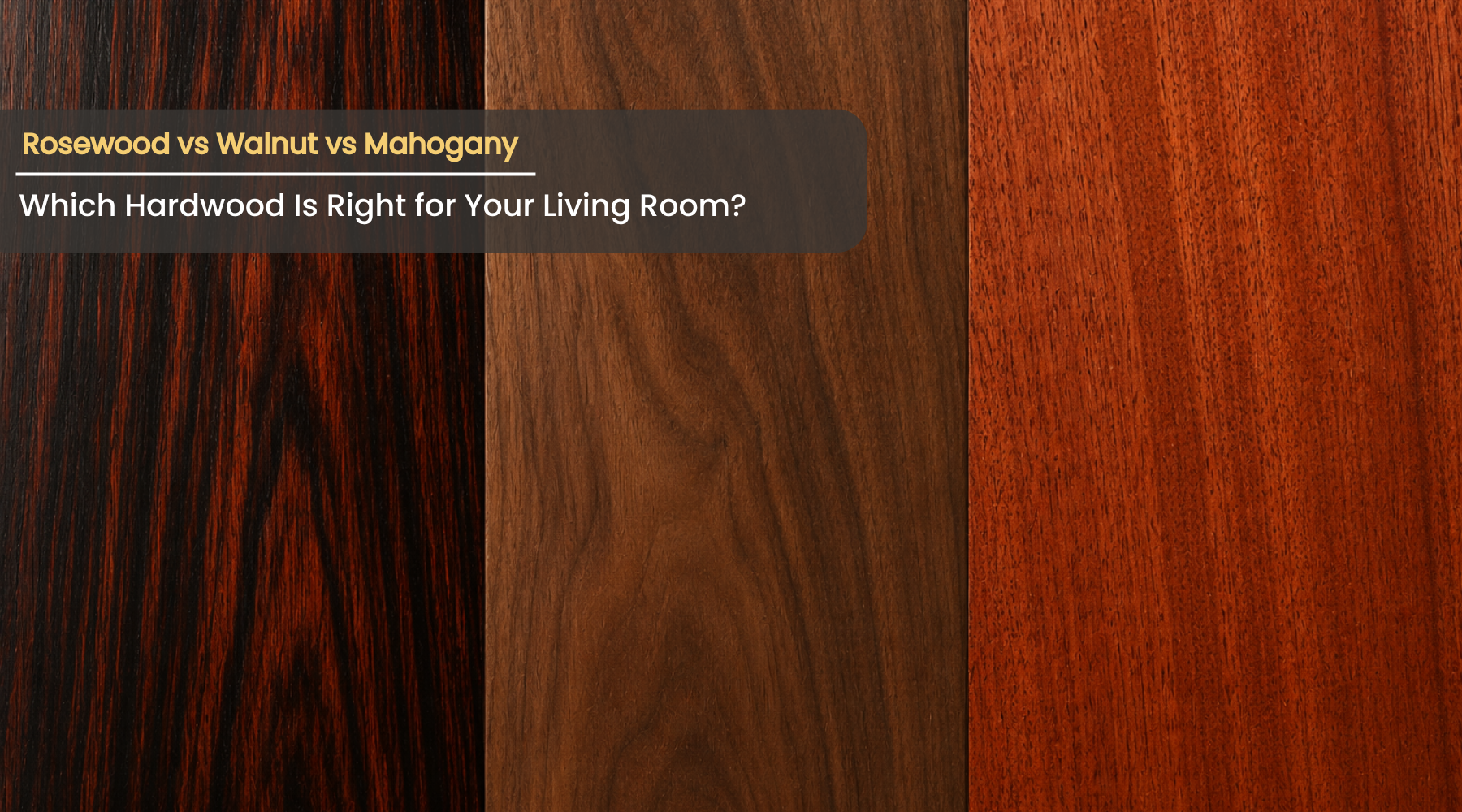
- Rosewood runs dramatic. Heartwood shifts from golden orange to deep purple-brown across a single board. Dark streaks create ribbon patterns. Bookmatched panels look almost painted. Best when the furniture is meant to be the focal point.
- Oak runs honest and traditional. Pale gold to medium reddish brown stays consistent across boards, with prominent ray flecks in quartersawn cuts. Reads farmhouse, Mission, Craftsman or transitional depending on the silhouette.
Grain texture follows the same split. Rosewood is bold, high-contrast, often with interlocked figure that catches light from multiple angles. Oak grain is tight but the open pores show through any finish, giving the surface a textural quality you can feel as well as see. Premium buyers who want furniture to read as art rather than utility reach for rosewood. Buyers who want furniture to read as solid, dependable and traditional reach for oak.
Finish behavior also differs. Rosewood resists oil finishes because the wood is already oily; most makers wipe it down with acetone first, then lacquer or apply French polish. Boston Mills uses hand-rubbed French polish, which exposes grain depth across multiple light passes and develops a subtle glow as it cures. Oak takes virtually any finish: oil, wax, lacquer, polyurethane or stain. The flexibility is part of why oak dominates mass production. It also means oak doesn't develop the unique surface character of a single traditional finishing method applied by hand.
Cost: What You're Paying For at Each Tier
Pricing for furniture-grade lumber moves with grade, certification, and provenance. Approximate ranges for premium boards:
- Red Oak: $5 to $8 per board foot
- White Oak: $7 to $12 per board foot, higher for quartersawn
- Indian rosewood (Sheesham): $25 to $40 per board foot
- East Indian rosewood: $40 to $60 per board foot
- Brazilian rosewood: up to $70 per board foot, when available legally
The lumber gap multiplies into finished furniture. A solid oak coffee table from a quality maker starts around $800 to $1,500. A solid rosewood coffee table at the same craftsmanship tier runs several thousand. Boston Mills' MIRA rosewood coffee table starts at $2,795. The BLOC starts at $3,795. The PEGASUS armchair set starts at $3,555. Free white-glove delivery applies on orders over $3,500.
The premium isn't only material cost. Rosewood takes longer to season (16 to 20 months of air-drying), longer to cut, longer to sand, and longer to finish. The wood's density wears tooling faster. Hand-cut joinery and hand-rubbed French polish add weeks to the build. What you pay for in a rosewood piece is the combination of rare material, regulated provenance, and traditional methods that keep the piece looking new after a decade. Oak furniture at the same price point exists, but the value proposition shifts: you're paying for designer markup, not material rarity.
Sustainability and Sourcing
Both woods can be sourced responsibly. The paperwork looks different.
Rosewood is the most regulated commercial furniture wood. CITES (the Convention on International Trade in Endangered Species) controls all rosewood movement across borders, regardless of origin. Boston Mills imports Dalbergia Sissoo only from professionally managed forests in South Asia, where the species is unendangered, with full CITES paperwork on every shipment. Boston Mills also has priority access to dead and fallen trees, which avoids new logging entirely. The Rosewood Compliance page on bostonmills.net documents the full chain of custody.
Oak is abundant and largely sustainable. White Oak and Red Oak grow across the eastern US, supply is steady and FSC-certified oak is widely available. The species isn't endangered. European oak from managed forests in France and Germany is also FSC-certified at scale.
The honest comparison: oak is easier to source responsibly because nothing is regulated. Rosewood is harder to source responsibly because everything is regulated and the regulation forces makers to prove what they're doing. Premium buyers reading the paperwork find rosewood's CITES discipline reassuring.
Why Boston Mills Builds in Rosewood
Boston Mills started in Dallas in 2014 with a clear material commitment: solid rosewood, crafted by skilled craftsmen, finished by traditional methods. Designed through the Dallas World Trade Center showroom, the Heritage Collection runs entirely on Dalbergia Sissoo. The Contempo Collection 2025-26, designed by Creative Director James Hughes, extends the language into modern silhouettes without changing the material.
The choice isn't only aesthetic. Rosewood holds carved detail with crisper edges than softer hardwoods, takes French polish with a depth lacquer can't reach and develops surface character over decades rather than wearing out. The MIRA, BLOC, BECRUX sideboard, CYLE console and OASIS desk all use solid rosewood with brass inlay accents and hand-rubbed French polish.
Trade clients including WeWork, Houzz and Chairish specify Boston Mills pieces for projects where the furniture has to anchor the room. For premium clients, the value is straightforward: a Boston Mills rosewood piece replaces three lifetimes of oak furniture. The Dallas design team develops every piece and offers material samples for designers through its trade program.
Each Boston Mills piece is designed through our Dallas World Trade Center showroom, brought to life by skilled craftsmen and carefully inspected by our team before it reaches your home.
Is rosewood really better than oak for furniture?
For premium and heirloom indoor furniture, yes. Rosewood is roughly twice as hard as White Oak (2,440 lbf versus 1,360 lbf), denser, more visually dramatic and rarer. Oak handles utility furniture and architectural use (floors, cabinets, barrels) better and at a fraction of the cost. The choice depends on whether you're buying a workhorse or an heirloom.
Why does rosewood cost five to ten times more than oak?
Three reasons. Growth time: a rosewood tree takes 300 years to produce a board five inches thick, versus 60 to 80 years for furniture-grade oak. Regulation: CITES controls all rosewood imports, which adds permit cost and time. Density: rosewood is harder to cut, sand and finish, so workshop hours per piece run higher.
Is oak strong enough for premium furniture?
Yes, but the visual register is different. Solid white oak with hand-cut joinery makes excellent traditional, Mission or Craftsman furniture and lasts generations. The reason premium buyers still reach for rosewood is figure and rarity, not raw structural performance. Oak builds dependable furniture; rosewood builds statement furniture.
Does rosewood need different care than oak?
Yes. Don't oil rosewood; its natural oil makes added oil go blotchy. Wax or French polish reapplied every five to ten years is enough. Oak takes oil, wax, lacquer and polyurethane equally well, so care depends on the finish chosen. Both woods need protection from direct sunlight, which fades color over years.
Is rosewood furniture legal to buy?
Yes, when sourced through proper channels. All rosewood requires a CITES permit to cross borders, regardless of country of origin. Reputable makers like Boston Mills carry CITES paperwork on every shipment and can provide chain-of-custody documentation. Brazilian rosewood is harder to source legally; East Indian and Indian rosewood (Sheesham) are widely available with proper documentation.
How long does rosewood furniture last compared to oak?
Both can last 100-plus years with solid construction. Rosewood pieces from the 19th century still trade at full antique value. High-quality oak furniture from the same period also survives, often as collectible Mission or Arts and Crafts pieces. The longevity gap between the two is smaller than the price gap suggests; the value gap is mostly about figure, rarity and provenance rather than raw durability.
What does Boston Mills offer in rosewood?
The full Heritage Collection. Coffee tables (MIRA, BLOC), console tables (CYLE), sideboards (BECRUX), dining tables (ALIVE, POTIRI), seating (PEGASUS, ATLAS, LACERTA), beds (KURVI) and desks (OASIS), all built from solid Dalbergia Sissoo with brass inlay and hand-rubbed French polish. The Contempo Collection 2025-26 by Creative Director James Hughes extends the rosewood language into modern silhouettes. Free white-glove delivery applies on orders over $3,500.
Should I mix rosewood and oak in the same room?
Carefully. The two woods sit in different aesthetic registers, and pairing them can read inconsistent unless the design is intentional. A rosewood centerpiece (coffee table or sideboard) with oak architectural elements (built-ins, flooring) often works because the architectural oak recedes. Pairing rosewood and oak freestanding furniture in the same room usually reads as compromise rather than coherence.