Rosewood vs Teak: Which Hardwood Is Better for Indoor Furniture?
Teak earned its reputation outdoors, on yacht decks and patio sets, where its silica content and oil reserves shrug off rain and salt spray. Rosewood earned its reputation indoors, on Mid-Century cabinets, Victorian inlays, and the heirloom dining tables that families pass down. The two woods solve different problems. For indoor living rooms, dining rooms, bedrooms, and offices, rosewood is the stronger choice.
East Indian rosewood (Dalbergia latifolia) measures around 2,440 lbf on the Janka scale and packs about 53 pounds per cubic foot. Burmese teak measures around 1,000 to 1,155 lbf and roughly 41 pounds per cubic foot. The numbers shape the room. This guide compares the two woods on hardness, color, grain, finish, cost, and care, and explains why Boston Mills builds the Heritage Collection from solid Dalbergia Sissoo rosewood air-dried for 16 to 20 months.
Quick Comparison: Rosewood vs Teak for Indoor Use
Snapshot of the two woods at a glance:
|
Property |
Rosewood (Dalbergia) |
Teak (Tectona grandis) |
|
Janka hardness (East Indian / Burmese) |
~2,440 lbf |
1,000 to 1,155 lbf |
|
Density |
~53 lb/ft³ |
~41 lb/ft³ |
|
Color |
Golden orange to deep purple-brown with dark streaks |
Golden brown, ages to honey or silver-grey |
|
Grain |
Bold, ribbon-like, interlocked |
Straight, occasional waves, even texture |
|
Best use |
Indoor heirloom furniture, statement pieces |
Outdoor furniture, marine, decking |
|
Natural oil |
Moderate, retains color indoors |
Very high, weatherproof |
|
CITES status |
Regulated worldwide |
Plantation supply unrestricted |
|
Cost (board foot, premium grades) |
$40 to $70 |
$20 to $30 |
Rosewood: The Indoor Hardwood Built for Generations
Rosewood covers several species in the Dalbergia genus. The three with commercial weight are Brazilian rosewood (Dalbergia nigra), East Indian rosewood (Dalbergia latifolia), and Indian rosewood or Sheesham (Dalbergia sissoo). Boston Mills uses solid Dalbergia Sissoo from South Asia, where the species is unendangered and air-dries naturally for an average of 16 to 20 months before any carving begins.
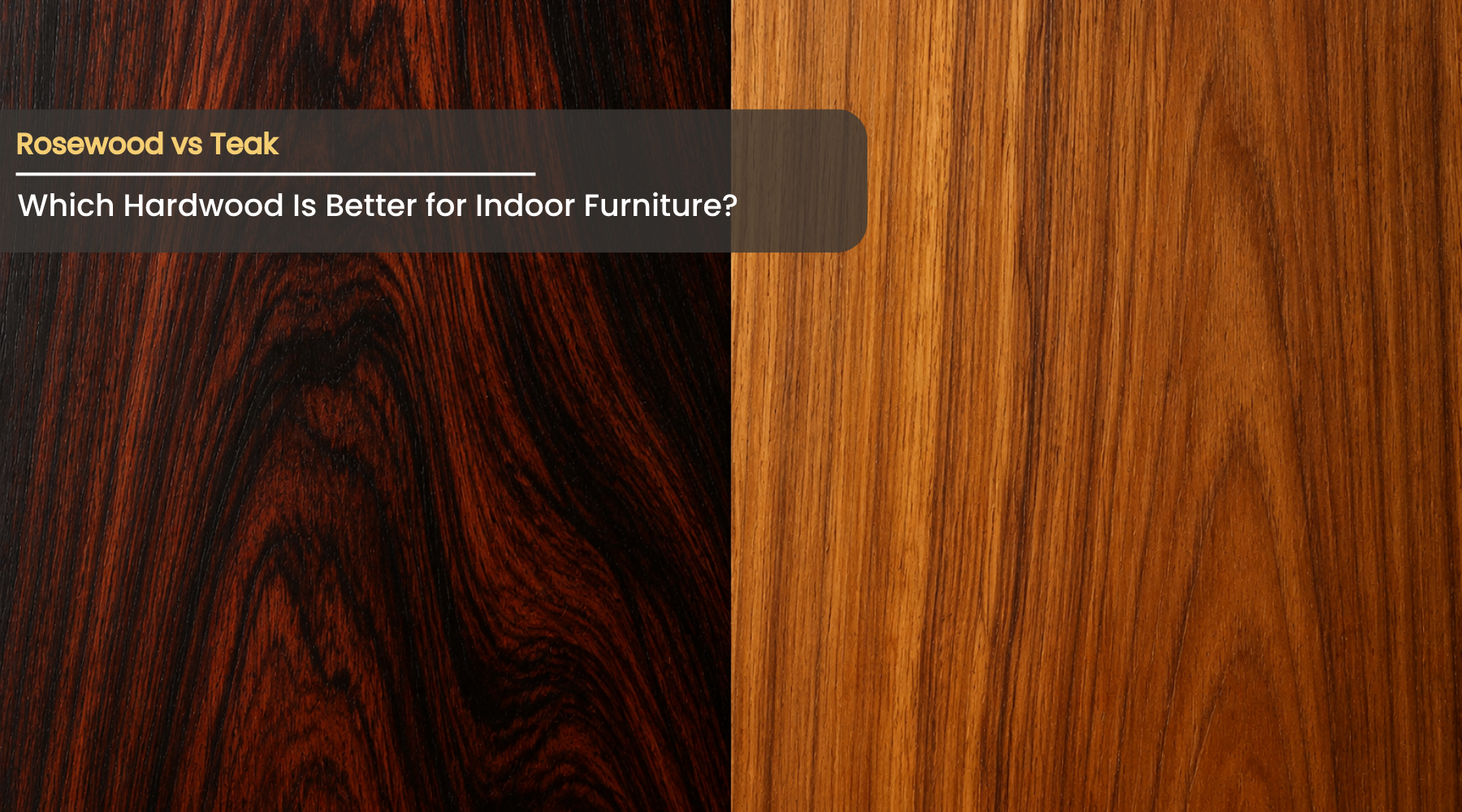
Visually, rosewood sits in a category of one. Heartwood ranges from golden orange to greenish-black, with darker streaks running through the surface in ribbon-like patterns. Bookmatched panels read almost like artwork. The grain interlocks or runs straight depending on the cut, and figured boards catch light from multiple angles as you move around the room. Most hardwoods need stain to develop character. Rosewood needs only French polish to expose what's already there.
A few facts about rosewood are worth flagging up front:
- A rosewood tree takes around 300 years to produce a board five inches thick.
- Rosewood is one of the few woods that sinks in water. Density translates to a piece that absorbs daily impact without showing it.
- The wood's natural oil resists root disease and termite attack without preservative treatment.
- Rosewood's hardness places it well above teak indoors: 2,440 lbf versus roughly 1,000 lbf for Burmese teak.
That hardness pays off in living rooms with kids, pets, and hard-use households. A solid rosewood coffee table won't pick up the dent of a dropped phone or the scratch of a pet claw the way softer hardwoods do.
Teak: The Outdoor Specialist That Came Indoors
Teak refers to one species: Tectona grandis. It's native to tropical Southeast Asia, with major commercial supply from Myanmar (Burmese teak, the premium grade), India, Indonesia, and Malaysia. Plantation teak now grows across Africa and Latin America to keep pace with demand.
Teak's defining feature is its oil and silica content. Cut a fresh board and you'll smell a leathery aroma. Run a finger across the surface and you'll feel a slightly slick texture. Those natural oils protect the wood from moisture, fungi, mold, rot, and insects without any treatment. That's why teak built ships for the British Admiralty, why it dominates yacht decks, and why teak patio furniture survives a decade of weather without refinishing.
Indoors, teak still performs well. The Janka hardness sits at roughly 1,000 to 1,155 lbf for Burmese, with Brazilian teak (technically Cumaru) running far higher. Color leans golden brown, sometimes with yellow undertones, and the wood lightens slightly with age unless oiled. Grain runs mostly straight with occasional waviness.
The trade-off indoors is twofold. Grain reads quieter than rosewood, which is good if you want furniture that recedes and bad if you want furniture that anchors. And teak's oil content, the same property that makes it weatherproof outdoors, complicates indoor finishing. Most makers leave teak unfinished or use a penetrating oil. French polish or lacquer can struggle to bond.
Hardness and Density: Why the Numbers Matter Indoors
Janka hardness measures the force in pounds-force needed to press a steel ball halfway into the wood. Higher numbers mean better resistance to dents, scratches, and the daily contact a piece of indoor furniture takes.
The comparison breaks down clearly:
- East Indian rosewood: ~2,440 lbf
- Brazilian rosewood: ~2,790 lbf
- Burmese teak: 1,000 to 1,155 lbf
- Brazilian teak (Cumaru): ~3,540 lbf (technically a different species)
For genuine teak, rosewood is more than twice as hard. That's the difference between a coffee table that picks up a faint scratch from a metal cup and one that doesn't. Density tells the same story. Rosewood weighs around 53 pounds per cubic foot. Burmese teak weighs about 41. The denser wood absorbs impact, holds carved detail with crisper edges, and feels heavier under the hand, which buyers consistently associate with quality.
Teak's strength sits in modulus and outdoor endurance, not surface hardness. It bends without splintering, which matters on a boat deck. Indoors, the metric that matters is dent resistance, and that belongs to rosewood.
Color, Grain, and Aesthetic Fit
Color and grain decide whether a piece anchors a room or fades into it. The two woods read differently:
- Rosewood runs dramatic. The heartwood shifts from golden orange to deep purple-brown across a single board. Dark streaks create ribbon patterns, and bookmatched panels look almost painted. Best in rooms where the furniture is meant to be the focal point.
- Teak runs quiet. Golden brown stays consistent across boards, with even grain dispersal that reads modern, Scandinavian, or transitional. Best in rooms where the furniture supports rather than dominates.
Grain texture follows the same split. Rosewood is bold, high-contrast, often with interlocked figure that catches the eye. Teak grain runs straight and dispersed evenly. Mid-Century Danish makers reached for rosewood when they wanted statement cabinets and teak when they wanted utility seating.
Finish behavior also differs. Rosewood resists oil finishes because it's already oily; most makers wipe it down with acetone first, then lacquer or apply French polish. Boston Mills uses hand-rubbed French polish to expose grain depth across multiple light passes. Teak typically takes a penetrating oil, since lacquer struggles to bond with its natural oil content. Rosewood's polished surface develops a depth that catches light, while oiled teak reads matte and warm.
Indoor vs Outdoor: Where Each Wood Earns Its Place
Teak's natural oil is its core advantage outdoors. Salt air, rain, humidity swings: teak handles all three without rotting, swelling, or feeding pests. Indoor moisture exposure is dramatically lower, so teak's marine credentials don't translate into an indoor benefit. They translate into a finishing complication.
Rosewood, by contrast, is built for indoor performance. The wood prefers stable humidity. It rewards French polish with depth no other hardwood reaches. It carries weight that anchors furniture in a room. And it resists the damage indoor furniture actually faces: dents from dropped objects, scratches from pet claws, surface marks from daily contact. For a living room, dining room, bedroom, or home office, rosewood's hardness, color, and finish behavior outperform teak across almost every metric except cost.
Cost and Value: What You're Paying For
Pricing for furniture-grade lumber varies with grade, certification, and provenance. Approximate ranges for premium boards:
- Burmese teak: $20 to $30 per board foot
- East Indian rosewood: $40 to $60 per board foot
- Brazilian rosewood: up to $70 per board foot, when available legally
Rosewood costs more for three reasons. The 300-year growth cycle limits how fast supply replenishes. CITES paperwork adds time and cost to every cross-border shipment. And density means more material per piece, which translates to more workshop hours. A rosewood console table is heavy, slow to cut, slow to sand, and slow to finish.
For finished furniture, the gap shows up in pricing. Boston Mills' MIRA rosewood coffee table starts at $2,795. The BLOC starts at $3,795. The PEGASUS armchair set starts at $3,555. Free white-glove delivery applies on orders over $3,500. The premium reflects what goes into the piece: solid Dalbergia Sissoo, hand-cut joinery, French polish applied by hand, and a 16-to-20-month build timeline.
Teak indoor furniture at quality makers runs lower per piece, partly because plantation supply has stabilized and partly because teak is faster to work. The value question is which wood justifies the asking price for the use case at hand. For indoor heirloom furniture meant to outlast the buyer, rosewood's combination of hardness, figure, and finish depth is what the premium buys.
Care and Maintenance for Indoor Pieces
Both woods reward simple care, but the routines differ.
Rosewood care:
- Dust weekly with a soft, dry cloth. Avoid feather dusters that can catch on grain.
- Don't apply oil. Rosewood's natural oil makes added oil go blotchy.
- Use coasters and felt pads under hot or wet items.
- Keep out of direct sunlight, which fades color over years.
- Maintain stable indoor humidity (30 to 50 percent) to prevent surface checks.
- Reapply French polish or wax every five to ten years for high-traffic surfaces.
Teak care indoors:
- Dust regularly and wipe with a barely damp cloth when needed.
- Apply teak oil every six to twelve months to prevent the wood from drying out indoors.
- Keep away from direct heat sources, which can lift the natural oil.
- Use coasters and mats to prevent water rings.
For both woods, sunlight is the long-term enemy. Position pieces away from south-facing windows or use UV-filtering window film. Solid wood construction with hand-cut joinery outlasts veneered alternatives by decades. Boston Mills builds every Heritage piece from solid stock, which is why pieces from 2014 still look new.
Sustainability and Sourcing
Honesty matters here because furniture lasts decades, and the sourcing decision compounds across that lifespan.
Rosewood is the most regulated wood in commercial furniture. CITES (the Convention on International Trade in Endangered Species) controls all rosewood movement across borders, regardless of origin. Boston Mills imports Dalbergia Sissoo only from professionally managed forests in South Asia, where the species is unendangered. Every shipment carries a CITES permit confirming chain of custody and absence of transshipping. Boston Mills also has priority access to dead and fallen trees, avoiding new logging entirely. The Rosewood Compliance page on bostonmills.net documents the full process.
Teak has a clearer plantation story. Burmese teak from old-growth forests faces sustainability concerns, but plantation teak from Indonesia, India, and Latin America has expanded substantially. FSC-certified teak is widely available. Reclaimed teak, salvaged from old buildings or boats, carries a strong environmental profile.
Both woods can be sourced responsibly. The question is whether the supplier shows the paperwork. Rosewood requires a CITES permit by law. Teak should carry FSC certification or documented plantation provenance.
Why Boston Mills Builds in Rosewood
Boston Mills started in Dallas in 2014 with a clear material commitment: solid rosewood, hand-built, finished by traditional methods. The Heritage Collection centers on Dalbergia Sissoo across coffee tables, console tables, dining tables, sideboards, beds, seating, and cabinets. The Contempo Collection 2025-26, designed by Creative Director James Hughes, extends the language into modern silhouettes while keeping rosewood at the core.
The choice isn't only aesthetic. Rosewood holds carved detail with crisper edges than softer hardwoods, takes French polish with a depth lacquer can't reach, and develops surface character over decades rather than wearing out. The MIRA, BLOC, BECRUX sideboard, and OASIS desk all use solid rosewood with brass inlay and hand-rubbed French polish. Trade clients including WeWork, Houzz, and Chairish specify Boston Mills pieces for projects where the furniture has to anchor the room. The Dallas showroom and trade program offer material samples for designers.
Is rosewood better than teak for indoor furniture?
Yes, for most indoor uses. Rosewood is roughly twice as hard as Burmese teak, holds carved detail with crisper edges, takes French polish with greater depth, and reads more dramatic in a room. Teak's outdoor advantages (oil content, moisture resistance) don't translate into indoor benefits. For living rooms, dining rooms, bedrooms, and offices, rosewood is the stronger choice.
Why is rosewood harder than teak?
Density. Rosewood weighs about 53 pounds per cubic foot. Burmese teak weighs around 41. The denser wood resists dents and scratches better, which matters for indoor furniture that takes daily contact. East Indian rosewood measures 2,440 lbf on the Janka scale; Burmese teak measures 1,000 to 1,155 lbf.
Does rosewood furniture need different care than teak?
Yes. Don't oil rosewood; its natural oil makes added oil go blotchy. Wax or French polish reapplied every five to ten years is enough. Teak indoors benefits from teak oil every six to twelve months to prevent drying. Both woods need protection from direct sunlight and stable humidity.
Is rosewood endangered or illegal to buy?
No, when sourced correctly. All rosewood requires a CITES permit to cross borders, regardless of country of origin. Boston Mills imports Dalbergia Sissoo from South Asia, where the species isn't endangered, with full CITES paperwork on every shipment. Brazilian rosewood is harder to source legally; East Indian and Indian rosewood are widely available with proper documentation.
Why does rosewood cost more than teak?
Three reasons. Growth time: a rosewood tree takes about 300 years to produce a board five inches thick. Regulation: CITES paperwork adds cost and time. Density: more material per piece and more workshop hours. Premium rosewood runs $40 to $70 per board foot; premium Burmese teak runs $20 to $30.
Can teak be used indoors and rosewood outdoors?
Teak yes, rosewood no. Teak performs well indoors but doesn't justify its outdoor cost premium for indoor-only use. Rosewood lacks teak's moisture resistance and shouldn't sit on a covered patio or deck where humidity swings are extreme. Match the wood to the environment.
How long does rosewood furniture last?
Generations, with care. Solid rosewood with hand-cut joinery routinely lasts 100-plus years. The wood's density resists wear, and French polish can be refreshed without stripping. Rosewood pieces from the 19th century still trade in antique markets at full value. Boston Mills builds every Heritage piece from solid stock.
What does Boston Mills make from rosewood?
The full Heritage Collection. Coffee tables (MIRA, BLOC), console tables (CYLE), sideboards (BECRUX), dining tables (ALIVE, POTIRI), seating (PEGASUS, ATLAS, LACERTA), beds (KURVI), and desks (OASIS), all built from solid Dalbergia Sissoo with brass inlay and hand-rubbed French polish. The Contempo Collection 2025-26 by Creative Director James Hughes extends the rosewood language into modern silhouettes.