
Rosewood vs Sheesham: Are They the Same Wood, and Which Should You Buy?
Sheesham (Dalbergia sissoo) is Indian rosewood, a member of the same Dalbergia genus that defines all true rosewood, which means the honest answer to "rosewood vs sheesham" starts with a twist: sheesham is a type of rosewood, not a rival to it. The real comparison sits between sheesham and the denser premium rosewood species, chiefly East Indian rosewood (Dalbergia latifolia) and Brazilian rosewood (Dalbergia nigra). Sheesham carries a Janka hardness around 1,200 to 1,400 lbf, while those premium species reach 2,440 to 2,550 lbf. Both make excellent furniture, but they differ in density, figure, availability, price and the kind of piece each one is built to become.
Naming is where buyers get lost. "Sheesham," "shisham" and "sissoo" are regional names for the same wood, Dalbergia sissoo, native to the Indian subcontinent. North American furniture stores often label it simply "rosewood" or "Indian rosewood," which is technically correct and commercially convenient, since rosewood sounds more exotic than sheesham. That marketing blur leaves unsure whether they are comparing two different woods or two names for one.
The botany settles it. Sheesham is one species within the Dalbergia genus of the Fabaceae family; the premium rosewoods are other species in that same genus. Most of them sit under CITES Appendix II, so legitimate premium rosewood furniture moves with permits and documented sourcing. Sheesham, being more abundant and faster growing, is more widely available and less restricted — which is exactly why it dominates the furniture market while the premium species stay rare and expensive.
At Boston Mills, a brand designing solid rosewood furniture through our Dallas World Trade Center showroom since 2014, these differences show up in every piece our craftsmen bring to life, so this comparison reflects hands-on experience rather than catalog copy. Below, we cover the shared botany, density and hardness numbers, grain and color differences, durability and termite resistance, finishing behavior, price and availability, and which pieces suit sheesham versus premium rosewood. The FAQ answers the naming and purchase questions furniture buyers ask most, so you leave knowing exactly what you are paying for.
What Is Sheesham?
Sheesham is the common name for Dalbergia sissoo, a deciduous hardwood native to the Indian subcontinent and southern Iran. Regionally it goes by sheesham, shisham, sissoo, tahli and several other names, but they all point to the same species. Because it belongs to the Dalbergia genus, sheesham is genuinely a rosewood — specifically North Indian or Indian rosewood — and it is the second most cultivated timber tree in India after teak.
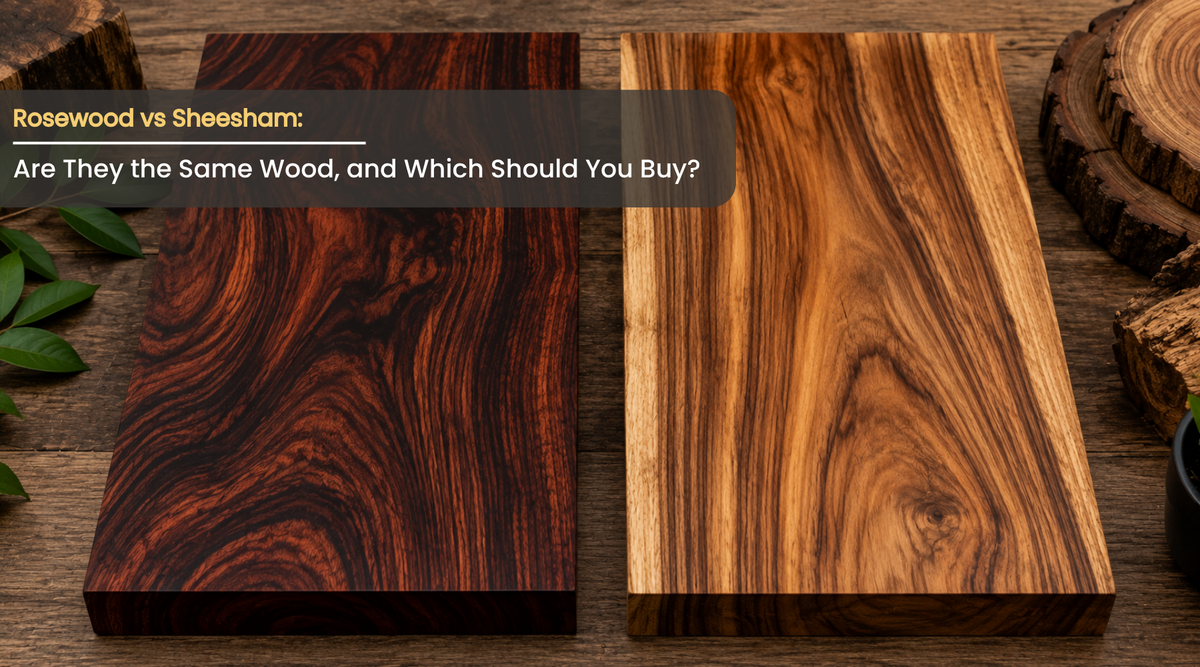
Color runs from golden brown to a deeper reddish brown in the heartwood, usually with distinctive darker streaks that give sheesham its recognizable two-tone grain. The sapwood is pale, almost straw colored. The grain is often interlocked and can show attractive figure, though it reads more restrained than the wild drama of premium rosewood. Janka hardness lands around 1,200 to 1,400 lbf depending on the sample — hard and strong enough for heavy-use furniture while remaining workable for carving.
That hardness is only half the reason sheesham lasts. The heartwood strongly resists dry-wood termites and natural decay, which is why it has furnished Indian homes for generations. It works, glues and finishes well, takes stain nicely and resists warping, making it a reliable choice for cabinets, beds, dining sets and carved pieces. One caveat: the sapwood is prone to wood-boring beetles, so well-made sheesham furniture uses properly seasoned heartwood.
What Is Premium Rosewood?
Premium rosewood refers to the denser, more figured Dalbergia species prized for high-end furniture and instruments. The most important are East Indian rosewood (Dalbergia latifolia) and Brazilian rosewood (Dalbergia nigra), with Honduran rosewood (Dalbergia stevensonii) prized mainly for marimba bars and fine detail work. These share sheesham's genus but push every property further.
Color spans deep reddish brown through chocolate to purple-brown, crossed by dramatic dark streaks and a chatoyant, interlocked figure that shifts under light. Density is far higher than sheesham: East Indian rosewood reaches roughly 2,440 lbf on the Janka scale and Brazilian rosewood around 2,550 lbf, so these woods resist dents and wear at a level sheesham cannot match and they feel noticeably heavier in hand.
Premium rosewood is also very oily, which gives it a smooth, waxy surface and lets it polish to a lustre and depth few furniture timbers reach. That same density blunts tools faster and demands more skill at the bench. These species suit statement dining tables, carved cabinets, fine seating and musical instruments, where density, figure and tonal quality justify the price. Most are CITES-listed, so legal supply is limited and fully documented
Density and Hardness: The Janka Comparison
The clearest difference between sheesham and premium rosewood is density, and the Janka scale shows it plainly. Sheesham measures roughly 1,200 to 1,400 lbf — solidly hard and well suited to furniture. Premium rosewood measures 2,440 lbf for East Indian and 2,550 lbf for Brazilian, close to double sheesham's figure.
In practice, premium rosewood resists dents, scratches and surface wear more effectively. A premium rosewood table shrugs off decades of daily use with minimal marking. Sheesham is durable and holds up well to heavy household use but it will show wear sooner than the denser species under the same conditions.
Weight follows density. Premium rosewood feels substantial enough that moving a large piece takes two people, which is part of its heirloom presence. Sheesham is heavy too — heavier than mango and many common furniture woods — but easier to handle than the top-tier species. If maximum hardness and a lifetime of dent resistance are the goal, premium rosewood leads. If strong, dependable furniture at a friendlier weight and price is the goal, sheesham delivers.
Color and Grain: Restrained Versus Dramatic
Both woods are handsome, but they present differently, and the gap guides many buying decisions.
Sheesham reads warm and characterful. Golden brown to reddish-brown heartwood, clear darker streaks, and an interlocked grain that gives each piece a distinct two-tone personality without overwhelming a room. It suits homes that want visible natural grain and warmth in a versatile, liveable form, and it pairs comfortably with many décor styles.
Premium rosewood reads dramatic. Deeper, darker fields of reddish-brown to purple-brown, bolder high-contrast streaks, and a chatoyant figure that catches light and shifts as you move. It looks luxurious and commands attention, which is why it anchors statement pieces meant to be the focal point of a formal room.
Grain sums the difference. Sheesham is figured but restrained, warm, and approachable. Premium rosewood is figured and theatrical, dark, and bold. One wood brings friendly natural character. The other brings unmistakable luxury.
Durability and Termite Resistance
Durability is a family strength, and both woods inherit it, with premium rosewood extending the lead.
Sheesham heartwood strongly resists dry-wood termites and natural decay, which is a major reason it became a staple furniture wood across India. It stays dimensionally reliable in moderate conditions, does not warp or slip easily, and handles the wear of dining sets, beds, and cabinets well. Its one weakness is the pale sapwood, which wood-boring beetles can attack, so quality sheesham furniture is built from seasoned heartwood.
Premium rosewood is even denser and more wear-resistant, with high natural oil content that adds decay resistance. Its density makes it exceptionally durable for high-end applications and heavy daily contact. Like sheesham, it can move in extreme humidity swings, so both woods prefer reasonably stable indoor conditions and benefit from avoiding direct radiator heat and harsh sun.
The verdict: both woods are durable and termite-resistant thanks to shared Dalbergia chemistry, but premium rosewood's greater density gives it the edge in dent resistance and heirloom longevity, while sheesham offers excellent everyday durability at a more accessible level.
Finishing: How Each Wood Takes a Polish
Finish behavior tracks oil content and density, and here the two diverge.
Premium rosewood is very oily and dense, so it resists oil finishes, because the wood is already saturated. Applied oil dries unevenly. The right treatment is lacquer or, for the deepest result, French polish built up in many thin hand-rubbed shellac layers, sometimes after wiping the surface with solvent to remove oily buildup so the finish bonds. Boston Mills applies hand-rubbed French polish to rosewood to expose the grain depth, producing a mirror finish no spray can match.
Sheesham is more forgiving. It is less oily than the premium species, so it takes stain nicely and accepts a wider range of finishes, glues, and machining. It finishes to a smooth, lustrous surface and works well with lacquer or wax. When left unlacquered, sheesham benefits from periodic waxing with a soft cloth and beeswax, buffed to a warm glow. Its cooperative nature is part of why it is such a popular, practical furniture wood.
In short: premium rosewood demands a finish that respects its oils and rewards the effort with unmatched depth, while sheesham accepts finishes more readily and takes stain the premium species often refuse.
Price and Availability
This is where the two woods separate most sharply, and it drives much of the market.
Sheesham is more available and more affordable. Dalbergia sissoo grows relatively fast, is widely cultivated across the Indian subcontinent, and is less restricted than the premium rosewoods, so sheesham furniture is easier to find and gentler on the budget. That accessibility, combined with genuine durability, is why sheesham dominates the mid-to-high furniture market in South Asia and exports widely.
Premium rosewood is scarcer, pricier, and more regulated. Most Dalbergia species used for high-end work sit under CITES Appendix II, so legal furniture requires permits and documented sourcing, and slow growth keeps legal supply limited. Prices sit at the top of the hardwood range. Boston Mills imports rosewood under permit and publishes a Rosewood Compliance note so buyers can verify the chain of custody.
For the budget-conscious buyer who wants real rosewood character, sheesham is the accessible entry into the Dalbergia family. For the buyer seeking maximum density, dramatic figure, and heirloom investment, premium rosewood justifies its higher cost, provided the sourcing is documented.
Which Furniture Pieces Suit Each Wood
The woods' properties point to different uses.
Choose sheesham for: everyday dining sets, beds, cabinets, sideboards, carved decorative pieces, and versatile living-room furniture where genuine rosewood-family durability, warm grain, and a friendly price matter most. Sheesham is the practical, characterful choice for furniture used daily across many rooms.
Choose premium rosewood for: statement dining tables, fine carved cabinets and credenzas, headboards, accent seating, and desks meant to be the visual anchor of a formal room and to hold heirloom value across generations. In a climate-controlled interior, premium rosewood's density, dramatic figure, and French-polished depth make it the collector's choice.
Because both belong to the same family, they coordinate naturally, and a home can pair sheesham's everyday warmth with premium rosewood's showpiece drama without any clash of character.
How to Buy With Confidence
Buying either wood well starts with understanding the label. If a piece is sold as "rosewood," ask which species: sheesham (Dalbergia sissoo) and premium rosewood (Dalbergia latifolia or nigra) are both rosewood but differ in density, price, and figure. For premium species, ask for CITES documentation and a compliance statement. For sheesham, confirm it is built from seasoned heartwood, not beetle-prone sapwood. Solid wood construction, cut from continuous timber rather than veneer, is what lets a piece be refinished for decades.
At Boston Mills, every rosewood piece is handcrafted in Dallas, cut from documented solid timber, finished with hand-rubbed French polish, and accented with custom brass hardware. White-glove delivery and assembly are free on orders over $3,500. To ask about a specific piece, a custom order, or sourcing documentation, call (214) 666-6647 or email info@bostonmills.net.
Is sheesham the same as rosewood?
Sheesham is a type of rosewood, not a separate wood. It is Dalbergia sissoo, a member of the Dalbergia genus that defines all true rosewood, and it is commonly called Indian or North Indian rosewood. The difference is that sheesham is one specific species, while "rosewood" also covers denser premium species like East Indian and Brazilian rosewood.
Which is harder, sheesham or premium rosewood?
Premium rosewood is considerably harder. Sheesham rates roughly 1,200 to 1,400 lbf on the Janka scale, while East Indian rosewood reaches about 2,440 lbf and Brazilian rosewood about 2,550 lbf. Premium species resist dents and wear better and feel heavier, though sheesham is still hard enough for durable everyday furniture.
What does Dalbergia sissoo mean?
Dalbergia sissoo is the botanical name for sheesham, also called shisham or sissoo. Dalbergia is the genus shared by all true rosewoods, and sissoo is the species native to the Indian subcontinent and Southern Iran. The name confirms that sheesham is genuinely a rosewood, specifically Indian rosewood, within the wider Dalbergia family.
Why do stores sell sheesham as rosewood?
Stores label sheesham as rosewood because it is accurate and appealing. Sheesham is Dalbergia sissoo, a real rosewood species, so calling it "Indian rosewood" or simply "rosewood" is technically correct. The term also sounds more premium than sheesham, which helps marketing, so shoppers should ask exactly which Dalbergia species a piece uses.
Which rosewood species are the premium ones?
The premium rosewoods are the denser, more figured Dalbergia species: East Indian rosewood (Dalbergia latifolia), Brazilian rosewood (Dalbergia nigra), and Honduran rosewood (Dalbergia stevensonii). They reach Janka ratings of 2,440 to 2,550 lbf, show dramatic dark grain, and mostly sit under CITES protection, which separates them from the more abundant sheesham.
Is sheesham furniture durable?
Yes. Sheesham heartwood strongly resists dry-wood termites and natural decay, does not warp or slip easily, and handles heavy household use in dining sets, beds, and cabinets. Its only weakness is the pale sapwood, which beetles can attack, so quality sheesham furniture is built from properly seasoned heartwood for lasting durability.
Is premium rosewood worth the higher price over sheesham?
It depends on your goal. Premium rosewood is worth it for maximum hardness, dramatic figure, and heirloom investment in a formal, climate-controlled room, with documented sourcing. Sheesham is the better value for durable, warm, everyday furniture at a friendlier price. Both are genuine rosewood, so the choice is about density, drama, and budget.
How can I tell sheesham from premium rosewood?
Compare color, contrast, and weight. Sheesham shows golden brown to reddish-brown heartwood with clear but restrained streaks and a moderate weight. Premium rosewood shows deeper reddish-brown to purple-brown color with bolder, high-contrast interlocked figure and feels noticeably heavier. Premium species also polish to a deeper lustre thanks to higher oil and density.
Is sheesham more sustainable than premium rosewood?
Generally yes. Sheesham grows relatively fast, is widely cultivated, and is less restricted, so it is the more accessible responsible choice. Premium rosewood species are mostly CITES-listed and slow growing, so legal supply is limited and requires documented chain of custody, which a reputable maker should provide before you purchase.
Does sheesham take finishes better than premium rosewood?
In some ways, yes. Sheesham is less oily, so it accepts stain and a wider range of finishes and glues more readily. Premium rosewood is so oily and dense that it resists oil finishes and usually needs lacquer or French polish, sometimes after solvent cleaning. Sheesham is more cooperative; premium rosewood rewards effort with greater depth.
Can I mix sheesham and premium rosewood furniture?
Yes. Both belong to the same Dalbergia family and share warm reddish-brown tones, so they coordinate naturally. Let premium rosewood serve as the dramatic focal point and sheesham fill the everyday supporting pieces, keeping finishes and styling consistent so the combination reads as a considered, cohesive whole.
Is sheesham good for carved furniture?
Yes. Sheesham works and carves well thanks to its balance of hardness and pliability, and it has a long tradition of intricate hand-carved work across India. It holds detail cleanly and finishes smoothly, making it a favorite for decorative pieces, while its termite resistance keeps carved furniture durable over many years.
The Bottom Line
Rosewood and sheesham are not rivals so much as relatives. Sheesham (Dalbergia sissoo) is Indian rosewood, a genuine member of the Dalbergia family, with a Janka hardness around 1,200 to 1,400 lbf, warm golden-to-reddish-brown grain, strong termite resistance, and a friendly price that makes it the practical choice for durable everyday furniture. Premium rosewood (Dalbergia latifolia and nigra) pushes every property further, reaching 2,440 to 2,550 lbf, showing dramatic dark figure, polishing to French-polished depth, and commanding a heirloom price backed by CITES-documented sourcing.
Match the wood to your goal. Choose sheesham for warm, dependable, well-priced furniture used daily across the home. Choose premium rosewood where the piece lives indoors, takes daily contact, and is meant to anchor a formal room and hold value across generations. Ask which Dalbergia species you are buying, insist on solid wood construction, and either choice brings the durability and character the rosewood family is known for.
To see handcrafted solid rosewood pieces, ask about a custom project, or verify sourcing documentation, call Boston Mills at (214) 666-6647 or email info@bostonmills.net.
%20is%20Indian%20rosewood,%20a%20member%20of%20the%20same%20Dalbergia%20genus%20that%20defines%20all%20true%20rosewood,%20which%20means%20the%20honest%20answer%20to%20%22rosewood%20vs%20sheesham%22%20starts%20with%20a%20twist:%20she...)