
Article: Rosewood vs Teak Furniture: Which Hardwood Belongs in Your Home?
Rosewood vs Teak Furniture: Which Hardwood Belongs in Your Home?
Rosewood (genus Dalbergia) is a dense, oil-rich hardwood prized for deep reddish-brown to purple-brown color, dramatic grain, and a Janka hardness near 2,440 lbf, which places it among the hardest furniture timbers on earth. Teak (Tectona grandis) is a golden-brown tropical hardwood with high silica and natural oil content, a Janka rating closer to 1,000 to 1,155 lbf, and a reputation built on weather resistance. Both are true hardwoods. Both last for generations. But they were built by nature for two different jobs, and choosing between them for your furniture comes down to where the piece will live and what you want it to say about the room.
The confusion is understandable. Furniture showrooms often shelve the two woods side by side, describe both as "premium," and leave the buyer guessing. The differences that matter are physical: density, oil chemistry, color, grain, how each wood takes a finish, and how each responds to moisture and sunlight. Teak carries the natural oils and silica that let it shrug off rain, salt air, and humidity, which is why it dominates outdoor and marine use. Rosewood carries a density and grain depth that reward French polish and anchor a formal interior, which is why it has furnished palaces, concert halls, and heirloom dining rooms for centuries.
Named authorities shape this decision more than most shoppers realize. The Convention on International Trade in Endangered Species (CITES) lists most Dalbergia rosewood species under Appendix II, so legitimate rosewood furniture moves with permits and documented sourcing. The Forest Stewardship Council (FSC) certifies plantation teak, which is why teak supply is more stable. At Boston Mills, a Dallas workshop that has handcrafted solid rosewood furniture since 2014, every piece is cut from documented timber and finished by hand, so this comparison draws on real bench experience rather than catalog copy.
This guide walks through the botanical origins of each wood, the density and durability numbers, the color and grain differences, moisture and climate behavior, finishing chemistry, price and sustainability, and the specific rooms and pieces each wood suits best. By the end you will know which hardwood matches your home, your climate, and your intentions, and the FAQ section answers the practical questions buyers ask before they commit.
What Is Rosewood?
Rosewood names a group of tropical hardwoods in the Dalbergia genus, part of the Fabaceae family. The commercially important species include East Indian rosewood (Dalbergia latifolia), Brazilian rosewood (Dalbergia nigra), and Honduran rosewood (Dalbergia stevensonii). The name comes from the faint rose-like scent the freshly cut wood releases, an aroma that lingers in older pieces.
Color runs from a warm reddish-brown through chocolate to a deep purple-brown, almost always crossed by darker streaks that swirl and interlock. That figure is the wood's signature. No two boards match, and the contrast between light and dark grain is what gives rosewood its bold, sculptural presence. Density sits high: East Indian rosewood measures roughly 2,440 lbf on the Janka scale, Brazilian rosewood closer to 2,550 lbf, so the wood resists dents, scratches, and daily wear better than almost any alternative. That same density makes rosewood heavy, which is why a rosewood credenza feels planted the moment it lands in a room.
Rosewood carries natural oils that give it a smooth, almost waxy surface and superb polishing behavior. The wood takes French polish to a mirror depth no other furniture timber reaches. Woodworkers prize it for high-end cabinets, dining tables, seating, and musical instruments, where its density doubles as tonal quality.
What Is Teak?
Teak comes from the Tectona grandis tree, native to the monsoon forests of South and Southeast Asia, including India, Myanmar, Thailand, and Indonesia. It is the benchmark outdoor hardwood, and the reason is chemistry. Teak's heartwood holds a high concentration of natural oils and silica that repel water, resist rot, and deter termites and marine borers without any applied treatment.
Color starts as a warm golden-brown and, left untreated outdoors, weathers to a silver-gray patina over months of sun exposure. The grain is mostly straight, occasionally wavy, with an even texture that feels faintly oily to the touch. Janka hardness lands around 1,000 to 1,155 lbf, softer than rosewood but backed by exceptional dimensional stability, which means teak barely moves as humidity swings.
That stability and weather resistance made teak the traditional choice for ship decks, garden benches, patio sets, and bathroom furniture. It also earns a place indoors in mid-century modern designs, where its lighter tone and clean grain suit understated forms. Because much teak now grows on managed plantations certified by the FSC, supply is steadier and prices, while high, are more predictable than rosewood's.
Density and Durability: The Hardness Numbers
Durability splits into two questions: resistance to physical damage and resistance to the environment. The two woods win different halves.
For physical hardness, rosewood dominates. Its Janka rating of roughly 2,440 lbf for East Indian and 2,550 lbf for Brazilian towers over teak's 1,000 to 1,155 lbf. In plain terms, rosewood resists dents from dropped objects, scratches from pet claws, and the surface marks of daily life far better than teak. A rosewood dining table absorbs decades of plates, glasses, and elbows and keeps its surface intact.
For environmental durability, teak wins. Its natural oils and silica make it nearly impervious to rain, humidity, rot, and insects, so it survives outdoors where rosewood would degrade. Teak furniture left on an open patio through years of weather stays structurally sound. Rosewood, despite its density, prefers stable indoor humidity and can develop fine surface checks if it swings between bone-dry winter heating and damp summer air.
So the honest verdict reads: rosewood is harder, teak is more weatherproof. A rosewood piece indoors will outlast a teak piece indoors in surface condition. A teak piece outdoors will outlast a rosewood piece outdoors by a wide margin. Match the wood to the environment and both deliver a lifetime of service.
Color and Grain: Two Very Different Looks
The visual gap between these woods is the fastest way to tell them apart and often the deciding factor.
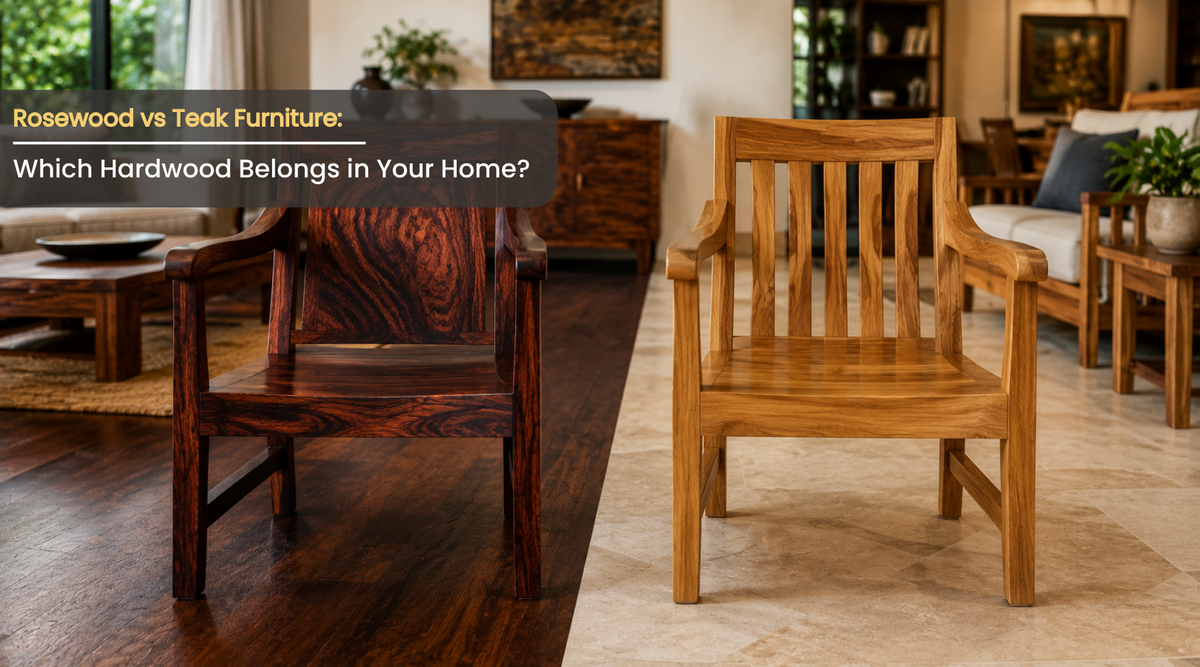
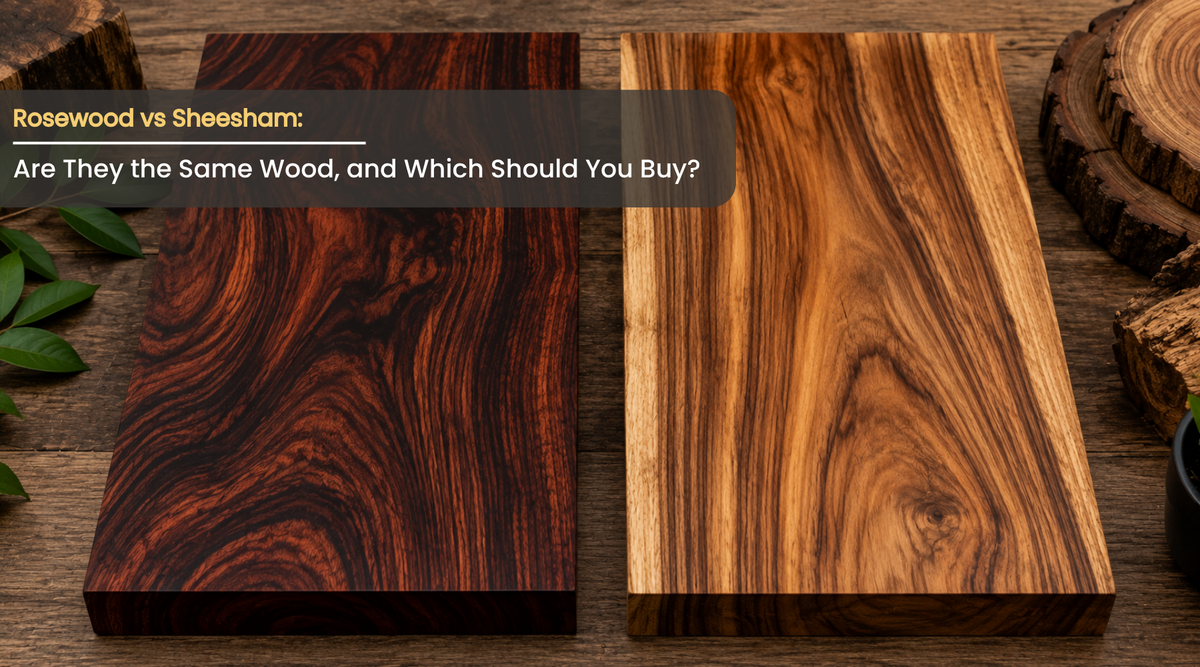
Rosewood reads dramatic. Deep reddish-brown to purple-brown fields, dark ribbon streaks, interlocked figure that catches light and shifts as you move around the piece. It looks painted rather than grown. Rosewood suits rooms where the furniture is meant to be the focal point: a statement dining table, a carved cabinet, a headboard that anchors the bedroom.
Teak reads calm. Even golden-brown, straight grain, fine and uniform texture, a warm and understated surface that ages to silver-gray outdoors or holds its honey tone indoors when sealed. Teak suits rooms where the furniture supports rather than dominates, and it pairs naturally with the clean lines of mid-century and Scandinavian design.
Grain texture follows the same divide. Rosewood is bold, high-contrast, and complex. Teak is straight, subtle, and consistent. One wood announces itself. The other settles in quietly.
Moisture, Climate, and Where Each Wood Belongs
This is the practical heart of the comparison. Teak's oils were built for water, so salt air, rain, and humidity swings leave it unbothered. It does not rot, swell, or feed pests outdoors, which is why boat builders and patio manufacturers reach for it first.
Indoor moisture exposure is dramatically lower than outdoor, so teak's marine credentials do not translate into an indoor advantage. Indoors, teak's oil content becomes a finishing complication rather than a benefit, because the surface resists films and stains that would otherwise deepen the color.
Rosewood is built for indoor performance. The wood prefers stable humidity and rewards a controlled interior climate with a surface that only grows richer. It resists the damage indoor furniture actually faces: dents, scratches, and daily surface contact. In a climate-controlled home, rosewood is the more rewarding choice. In a Tucson-dry or Gulf-Coast-humid room without climate control, either wood benefits from steady humidity, and rosewood in particular should avoid direct radiator heat and harsh sun.
The rule that serves most buyers: teak for anything exposed to weather, rosewood for anything that lives in a conditioned interior and is meant to impress.
Finishing: How Each Wood Takes a Polish
Finish behavior separates these woods as sharply as color does, and it shapes the final look.
Rosewood is oily and dense, which makes it resist oil finishes, because the wood is already saturated with its own oils. Applied oil sits on the surface and dries unevenly. The right approach is lacquer or, for the deepest result, French polish, a labor-intensive shellac technique applied in many thin hand-rubbed layers. Boston Mills applies hand-rubbed French polish to rosewood specifically to expose the grain depth, and the mirror finish that results is impossible to fake with a spray gun.
Teak takes finishing differently. Outdoors, many owners leave teak unfinished and let it silver naturally, then sand lightly to restore the golden tone when they want it back. Indoors, teak can be sealed, oiled with teak-specific products, or lacquered, though its oil content means any film finish needs a clean, de-oiled surface to bond. Teak's straight grain looks handsome under a simple satin finish and does not demand the theatrical depth that rosewood invites.
In short: rosewood is finished to glow, teak is finished to protect or left to weather. The processes reflect what each wood is for.
Price and Sustainability
Both woods sit at the premium end, but for different reasons, and the sourcing rules differ sharply.
Rosewood is the more expensive and the more restricted. Most Dalbergia species are listed under CITES Appendix II, so legal rosewood furniture requires permits and documented chain of custody. The trees grow slowly, sometimes over a century, and legal supply is limited, which pushes prices to the top of the hardwood range. Boston Mills imports rosewood under permit and publishes a separate Rosewood Compliance note so buyers can verify sourcing before they purchase.
Teak is expensive but more available. Plantation teak certified by the FSC gives buyers a renewable, traceable option, and that steadier supply keeps teak pricing high but predictable. Illegal logging remains a concern in some regions, so certification still matters, but sourcing sustainable teak is generally easier than sourcing sustainable rosewood.
For the eco-conscious buyer, certified plantation teak is the simpler sustainable choice, while responsibly sourced rosewood carries a heavier paperwork burden that a reputable maker should handle transparently. Ask any seller for documentation. A maker who cannot produce it should give you pause.
Which Furniture Pieces Suit Each Wood
The woods' strengths map cleanly onto specific pieces and rooms.
Choose teak for: outdoor dining sets, garden benches, patio loungers, poolside furniture, bathroom fittings, and mid-century indoor pieces where a lighter tone and understated grain fit the design. Anywhere moisture, sun, or weather is a factor, teak is the safer long-term investment.
Choose rosewood for: formal dining tables, statement cabinets and credenzas, headboards, accent chairs, desks, and any interior centerpiece meant to draw the eye and hold value across generations. In a climate-controlled home, rosewood's density, color, and French-polished depth make it the heirloom choice.
Many homes use both. Teak on the terrace, rosewood in the dining room. The two woods do not compete so much as cover different territory, and a room can even pair them if the design intent is deliberate.
How to Buy With Confidence
Buying either wood well comes down to verification and craftsmanship. Confirm the species and the sourcing. For rosewood, ask for CITES documentation and a compliance statement. For teak, ask for FSC certification or plantation provenance. Solid wood construction, cut from continuous timber rather than veneer over particleboard, is what lets a piece be sanded and refinished for decades, so ask how the piece is built.
At Boston Mills, every rosewood piece is handcrafted in Dallas, cut from documented solid timber, finished with hand-rubbed French polish, and accented with custom brass hardware. White-glove delivery and assembly are free on orders over $3,500. To ask about a specific piece, a custom order, or sourcing documentation, call (214) 666-6647 or email info@bostonmills.net.
Is rosewood harder than teak?
Yes. Rosewood is significantly harder than teak. East Indian rosewood rates about 2,440 lbf on the Janka scale and Brazilian rosewood about 2,550 lbf, while teak measures roughly 1,000 to 1,155 lbf. That gap means rosewood resists dents and scratches far better, which is why it excels for indoor surfaces that take daily contact.
Is teak better than rosewood for outdoor furniture?
Teak is clearly better for outdoor furniture. Its natural oils and silica repel water, resist rot, and deter insects without any treatment, so it survives rain, sun, and humidity for decades. Rosewood, despite being harder, prefers stable indoor humidity and can develop surface checks outdoors, so it belongs indoors.
What is French polish, and why does rosewood need it?
French polish is a hand-applied shellac finish built up in many thin, hand-rubbed layers to a deep, mirror-like shine. Rosewood benefits from it because the wood is too oily to accept ordinary oil finishes evenly, and French polish showcases rosewood's grain depth better than any sprayed coating.
Which woods count as rosewood?
Rosewood covers several species in the Dalbergia genus, chiefly East Indian rosewood (Dalbergia latifolia), Brazilian rosewood (Dalbergia nigra), and Honduran rosewood (Dalbergia stevensonii). All share high density, oil content, and dramatic grain, though color and figure vary from reddish-brown to deep purple-brown across the species.
Why is rosewood furniture so expensive?
Rosewood costs more because most Dalbergia species are protected under CITES Appendix II, legal supply is limited, and the trees grow slowly over decades or longer. Legitimate rosewood furniture also requires permits and documented sourcing, and its density makes it labor-intensive to work and finish, all of which raise the price.
Can teak and rosewood furniture be used in the same room?
Yes. Teak's warm golden tone and rosewood's deep reddish-brown can complement each other when the design intent is deliberate. Keep the styling coherent, let one wood lead as the focal point, and use the other in a supporting role so the contrast reads as considered rather than accidental.
How can I tell rosewood from teak?
Look at color, grain, and weight. Rosewood shows deep reddish-brown to purple-brown color with dark, high-contrast interlocked streaks and feels notably heavy. Teak shows an even golden-brown with straight, uniform grain and weighs less. Rosewood also carries a faint rose scent when freshly worked, while teak feels slightly oily to the touch.
Is teak more sustainable than rosewood?
Teak is generally the easier sustainable choice. Plantation teak certified by the FSC is renewable and traceable, so supply is steadier. Rosewood sourcing is more restricted under CITES and demands documented chain of custody, which a reputable maker should provide, but sourcing sustainable rosewood is more complex than sourcing certified teak.
Which wood is easier to maintain?
Teak is easier to maintain, especially outdoors, where regular cleaning with mild soap and water is usually enough. Rosewood needs more attention indoors: dust it regularly, keep it out of direct sunlight and away from radiators, and refresh the polish periodically to protect the finish and preserve the grain depth.
Does rosewood or teak hold value better over time?
Rosewood typically holds value better as an heirloom, because its rarity, density, and French-polished depth make it a lasting investment, particularly in restricted species with documented sourcing. Teak holds value well too, especially certified vintage mid-century pieces, but rosewood's scarcity gives it a stronger long-term collectible edge.
Will rosewood crack in a dry or humid climate?
Rosewood can develop fine surface checks if it swings between very dry and very humid conditions, so stable indoor humidity matters. Keep rosewood furniture away from radiators, heating vents, and direct sun, and maintain a reasonably steady interior climate. In a climate-controlled home, cracking is rarely an issue.
Do I need documentation to buy rosewood furniture?
Yes, you should expect it. Because most rosewood is protected under CITES, legitimate furniture moves with permits and a documented chain of custody. Ask any seller for sourcing paperwork or a compliance statement. A maker who imports under permit, as Boston Mills does, can show you exactly where the timber came from.
The Bottom Line
Rosewood and teak are both true hardwoods that last generations, but they were built by nature for different rooms. Rosewood (Dalbergia) brings a Janka hardness near 2,440 lbf, deep reddish-brown to purple-brown color, dramatic interlocked grain, and a density that rewards hand-rubbed French polish, which makes it the heirloom choice for climate-controlled interiors and statement pieces. Teak (Tectona grandis) brings natural oils and silica, a golden-brown tone, straight uniform grain, and unmatched weather resistance, which makes it the standing choice for outdoor and high-moisture settings.
Match the wood to the environment and the intent. Put teak where weather is a factor and understated warmth suits the design. Put rosewood where the furniture lives indoors, takes daily contact, and is meant to draw the eye and hold value across decades. Verify sourcing either way, insist on solid wood construction, and both woods will serve you for a lifetime.
To see handcrafted solid rosewood pieces, ask about a custom project, or verify sourcing documentation, call Boston Mills at (214) 666-6647 or email info@bostonmills.net.
%20is%20a%20dense,%20oil-rich%20hardwood%20prized%20for%20deep%20reddish-brown%20to%20purple-brown%20color,%20dramatic%20grain,%20and%20a%20Janka%20hardness%20near%202,440%20lbf,%20which%20places%20it%20among%20the%20hardest%20...)