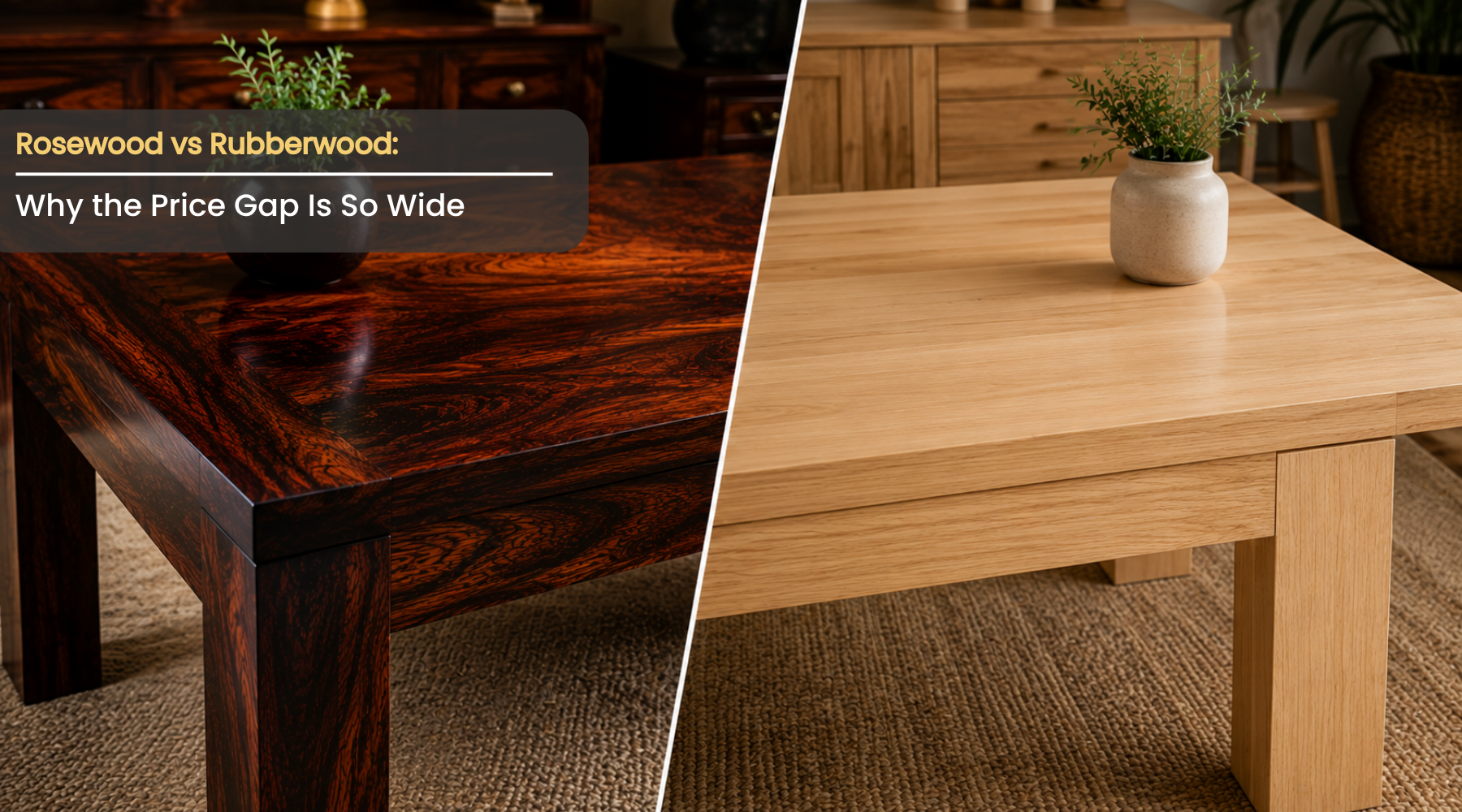
Rosewood vs Rubberwood: Why the Price Gap Is So Wide
Rubberwood is a byproduct. Rosewood is a crop that takes decades. That single sentence explains most of the price difference between the two, and everything else in this comparison is detail underneath it.
Rubberwood comes from Hevea brasiliensis, the Pará rubber tree, grown across Thailand, Malaysia, and Indonesia for latex rather than lumber. Plantations tap each tree for roughly 25 to 30 years, and once latex yield falls the tree is felled and replanted. The timber is what remains after the real product has already been harvested, which is why it also trades as parawood, plantation hardwood, and Malaysian oak.
Rosewood is the trade name for timbers in the Dalbergia genus, grown slowly for the wood itself. Indian rosewood (Dalbergia latifolia) records a Janka hardness of 2,440 lbf at 52 lbs/ft³, against rubberwood’s 960 lbf at 37 lbs/ft³. Rosewood is roughly two and a half times harder and carries natural oils that resist decay and dry-wood termites, while rubberwood is rated perishable and must be chemically treated within days of felling or it stains and rots.
This guide covers what rubberwood actually is, what rosewood is, the five structural reasons the prices diverge, how the two compare on hardness and weight, how each is built into furniture, what durability and pest treatment mean in practice, what lifespan each offers, where rubberwood genuinely makes sense, and how to identify it under a dark stain.
What rubberwood actually is
Hevea brasiliensis is native to the Amazon basin and belongs to Euphorbiaceae, the spurge family, which puts it nowhere near rosewood botanically. It was moved to Southeast Asia in the nineteenth century for latex production, and those plantations now cover millions of acres.
The economics run in one direction. A rubber tree earns its keep through tapping, and the wood is a disposal problem turned into a revenue stream. For decades the felled trunks were burned. Modern preservative treatment made the timber commercially usable, and rubberwood became one of the most widely used furniture woods on the planet.
Its physical character reflects that history. The wood is pale cream to light blonde, straight-grained, medium-textured, and comes from small knotty logs that were never grown for lumber quality. Rosewood comes from the opposite kind of tree.
What rosewood is by comparison
Dalbergia is a genus of roughly 250 tropical hardwoods in the legume family, grown or harvested specifically for timber. Dalbergia latifolia grows slowly through southern India and the Western Ghats, laying down dense heartwood over decades, and Dalbergia sissoo grows faster across northern India while still producing a hard, oily, durable wood at 1,660 lbf.
Regulation surrounds the genus. Every Dalbergia species sits on CITES Appendix II, with Brazilian rosewood on Appendix I, and Dalbergia latifolia carries vulnerable status on the IUCN Red List. Rubberwood carries no conservation listing whatsoever, because plantations replant continuously as part of the latex cycle.
Two timbers, two entirely different supply models. The price gap follows from five specific structural differences.
The five reasons the price gap is so wide
The wood is a byproduct, not the product
Rubberwood’s cost basis starts near zero. The plantation has already earned its return through latex across 25 to 30 years of tapping, so the timber arrives as salvage from a tree that was going to be felled regardless. Rosewood plantations and forests earn nothing until the timber is cut, which means decades of land cost, management, and risk are priced into every board.
Growth cycles differ by decades
Rubber trees are replanted on a fixed rotation tied to latex yield, so supply is predictable and continuous. Dalbergia latifolia needs far longer to build usable heartwood, and slow-grown stock cannot be accelerated to meet demand. Scarcity in a slow crop compounds every year.
Log quality determines yield
Rubber logs are small, knotty, and irregular, yielding short clear sections rather than wide boards. Rosewood logs yield wider, longer clear stock, which means less waste and more usable furniture from the same volume. Yield differences alone move the price per finished piece substantially.
Treatment and regulation add cost differently
Rubberwood requires immediate preservative treatment against fungal stain and insect attack, an added processing step on every log. Rosewood needs no treatment because its extractives do the job, but every shipment carries CITES paperwork and compliance overhead. Both costs are real, and they land on opposite sides of the ledger.
Construction methods diverge
Rubberwood is glued into finger-jointed panels on production lines. Rosewood is worked as solid boards with traditional joinery, requiring board selection, matching, and skilled labor. You are buying different quantities of work, and that work shows up in the hardness figures too.
Hardness and density compared
Density predicts how a surface survives daily contact:
|
Timber |
Janka hardness |
Dried weight |
|
Indian rosewood (Dalbergia latifolia) |
2,440 lbf |
52 lbs/ft³ |
|
Sheesham (Dalbergia sissoo) |
1,660 lbf |
48 lbs/ft³ |
|
Red oak, for reference |
1,220 lbf |
45 lbs/ft³ |
|
Rubberwood (Hevea brasiliensis) |
960 lbf |
37 lbs/ft³ |
Rubberwood sits below red oak and well below both rosewoods, which places it among the softer hardwoods in furniture use. It is not weak, and it performs adequately for cabinet frames, bed slats, and low-contact surfaces. It simply dents where rosewood does not.
Weight follows hardness. A rubberwood dresser is noticeably easier to lift than a rosewood one of the same size, which is convenient during a move and revealing about how much material is actually there. How that material is assembled matters just as much.
How each wood is built into furniture
Rubberwood is nearly always finger-jointed and glued into panels, because the logs cannot produce wide clear boards. Short strips are edge-glued and end-jointed into tops, sides, and legs, then stained. That method is stable across wide spans and efficient in the factory, and it is honest furniture when disclosed.
The limitation is depth. Glue lines run through the panel, so sanding exposes them, and a top can realistically take one light refinish before the joints show. Damage repairs are patch jobs rather than restorations.
Rosewood worked as solid stock behaves differently. There is thickness to sand back, no glue lines through the surface, and traditional joinery that a restorer can knock apart and reglue. That difference decides which pieces are worth repairing in twenty years, and it connects directly to how each wood handles decay and pests.
Durability, treatment, and pests
Rubberwood is rated perishable. Freshly cut logs are highly susceptible to fungal staining and insect attack, particularly powderpost beetles, because the wood carries starch and no protective extractives. Mills treat it with boron or similar preservatives within days of felling, and properly treated stock is stable indoors.
Untreated or poorly treated rubberwood is a different story. It stains blue-grey, attracts insects, and degrades quickly in damp conditions. That risk is why rubberwood should never be used in bathrooms, laundry rooms, or outdoors.
Rosewood needs no such intervention. Dalbergia heartwood contains oils and extractives that make it durable against decay fungi and unattractive to dry-wood termites, and that protection is built in rather than applied. Treatment is only half the processing story, though, because drying decides just as much.
Moisture content and why cheap rubberwood warps
Drying quality explains most rubberwood complaints. Furniture stock should reach 8 to 12 percent moisture content before assembly, matched to the destination climate. Rubberwood is often kiln-dried fast to keep costs down, and stock that leaves the kiln above that range keeps shrinking after assembly, which opens finger joints and cups panels within a season or two.
Rosewood is not immune to the same failure. Rushed drying produces cupped tops and creeping joints in any species, and the surface looks identical either way on a showroom floor. The difference is what happens next: a solid rosewood panel can be flattened and refinished, while a delaminated rubberwood panel usually cannot.
This is why moisture content is worth asking about regardless of budget. It costs nothing to ask, it exposes workshops that build to a delivery date, and it predicts far more about the next ten years than the species name does.
What lifespan each wood offers
Solid rosewood furniture lasts 50 to 100 years with ordinary indoor use, and museum examples exceed four hundred. Density, natural oils, and repair depth all contribute, and joinery quality decides where within that range a piece falls.
Rubberwood serves well in the shorter term. Treated, properly dried, and kept indoors away from damp, it holds up for years of normal use in bedrooms, dining chairs, and cabinet carcasses. What it does not offer is a second life, since finger-jointed panels resist meaningful refinishing and glue-line failure is difficult to repair invisibly.
That distinction reframes the price comparison. One purchase is furniture for now, the other is furniture that can be passed on. Both are legitimate, and rubberwood earns its place in several situations.
Where rubberwood genuinely makes sense
Buying rubberwood is a rational choice in specific circumstances:
- Furnishing a first apartment where budget matters more than longevity.
- Kitting out rentals and student housing where pieces get replaced regularly.
- Filling children’s rooms where furniture will be outgrown before it wears out.
- Building cabinet interiors and frames that never take direct contact.
- Choosing sustainability on volume, since the timber uses a genuine waste stream.
That last point deserves fair treatment. Rubberwood diverts a byproduct from burning, requires no additional land, and carries no conservation listing, which makes its environmental case strong on its own terms.
What buyers should avoid is paying rosewood prices for stained rubberwood, and the arithmetic behind that mistake is worth spelling out.
The total cost of a purchase, not the ticket price
Furniture cost is a rate, not a number. A rubberwood dining table replaced twice over twenty years costs more than its ticket price suggests, and delivery, disposal, and the disruption of replacing it all belong in that total. A solid rosewood table bought once and refinished once occupies the other end of the same calculation.
Neither outcome is automatic. A well-treated, properly dried rubberwood piece kept away from damp can serve far longer than a badly built rosewood one, because construction quality outranks species in almost every failure. What density and repair depth buy is a higher ceiling, not a guarantee.
The honest way to compare two quotes is to ask how long each piece is meant to last and what happens when it is damaged. That question usually needs the species answered first, which is where identification comes in.
How to spot rubberwood under a stain
Dark stain hides a lot. Four checks cut through it:
- Look for finger joints on undersides, drawer sides, and inside cabinet frames, where the interlocking zigzag pattern is rarely concealed.
- Lift a corner and judge the weight, since 37 lbs/ft³ feels obviously lighter than 52.
- Check unstained interior surfaces for the pale cream color that rubberwood cannot disguise.
- Ask for the botanical name, because Hevea brasiliensis and Dalbergia are impossible to confuse on paper.
Trade names are the warning sign. Parawood, plantation hardwood, Asian hardwood, and Malaysian oak all describe rubberwood without saying so. Boston Mills builds in solid rosewood, and asking any seller for the botanical name and the construction method settles the question in one question.
Is rubberwood a real hardwood?
Yes. Rubberwood is a genuine hardwood from Hevea brasiliensis, measuring 960 lbf on the Janka scale. It sits below red oak in density, which makes it a softer hardwood rather than an engineered substitute.
Why is rubberwood so cheap?
The timber is a byproduct of latex production. Plantations have already earned their return through 25 to 30 years of tapping, so the wood arrives with a near-zero cost basis and in continuous supply.
Is rubberwood the same as rosewood?
No, and they are not related. Rubberwood belongs to Euphorbiaceae and rosewood to the legume family, with rosewood measuring roughly two and a half times harder and carrying natural decay resistance rubberwood lacks.
What are the other names for rubberwood?
It sells as parawood, plantation hardwood, Asian hardwood, and Malaysian oak. None of those names indicates rosewood or oak, so the botanical name is the only reliable check.
Does rubberwood furniture last?
It lasts for years indoors when treated and kept dry, though not for generations. Finger-jointed panels resist refinishing, so damage tends to end the piece rather than start a repair.
Does rubberwood get woodworm?
Untreated rubberwood is highly vulnerable, because it contains starch and no protective extractives. Mills apply boron treatment within days of felling, and properly treated stock is stable indoors.
Can rubberwood be used in a bathroom?
No. Rubberwood is rated perishable and degrades in sustained damp, so bathrooms, laundry rooms, and outdoor use are all unsuitable. Rosewood should also stay out of wet rooms, though for finish reasons rather than rot.
Is rubberwood environmentally friendly?
Yes, on its own terms. It uses a genuine waste stream from existing latex plantations, requires no additional land, and carries no conservation listing, unlike Dalbergia species under CITES Appendix II.
Can rubberwood furniture be refinished?
Barely. One light sanding is realistic before glue lines from the finger joints become visible. Solid rosewood tolerates several full refinishing cycles across its lifetime.
Why does rubberwood furniture feel lighter?
Because it is. At 37 lbs/ft³ against rosewood’s 52, there is substantially less material in the same volume, which is why weight is one of the fastest ways to tell them apart.
Is rubberwood stronger than pine?
Generally yes. Rubberwood is harder than most softwood pine species and more stable once treated and dried, though it remains softer than oak, sheesham, and rosewood.
Is rosewood worth the extra cost over rubberwood?
For furniture expected to last decades, yes. Rosewood offers roughly two and a half times the hardness, built-in decay and termite resistance, and the repair depth that makes restoration possible. For temporary or low-contact furniture, rubberwood is the more rational purchase.
The price gap between rosewood and rubberwood is not a markup. It is the sum of five structural differences: a byproduct versus a purpose-grown crop, a fixed replant cycle versus decades of slow growth, small knotty logs versus wide clear stock, mandatory preservative treatment versus built-in extractives, and factory panels versus solid boards with traditional joinery.
Both woods answer a real question. Rubberwood furnishes a room now at low cost with a defensible environmental story. Rosewood furnishes it for fifty years, resists the wear that ends cheaper pieces, and can be repaired rather than replaced. Decide which question you are answering, then check the botanical name before you pay. Browse the solid rosewood range at bostonmills.net, and ask for the species and the construction method on any piece you shortlist.