
Rosewood vs Mahogany Furniture: Which Fine Hardwood Deserves Your Investment?
Rosewood (genus Dalbergia) is a dense, oil-rich tropical hardwood with deep reddish-brown to purple-brown color, dramatic interlocked grain, and a Janka hardness near 2,440 lbf. Mahogany (genus Swietenia) is a warm, even reddish-brown hardwood with straight, uniform grain, superb workability, and a softer Janka rating in the 800 to 900 lbf range. Both have furnished the world's finest rooms for centuries. Both age beautifully. But they solve different problems: rosewood delivers density, bold figure, and heirloom permanence, while mahogany delivers stability, classic elegance, and a grain that carvers and finishers love to work.
Buyers confuse the two because both are reddish-brown, both are called luxury woods, and both appear in antique and high-end furniture. The differences that decide a purchase are physical and practical: hardness, grain pattern, dimensional stability in changing humidity, how each wood takes a finish, price, and sourcing rules. Rosewood is harder and heavier, with a wild, high-contrast figure that makes furniture the focal point of a room. Mahogany is more stable and more uniform, with a refined, warm consistency that has defined traditional cabinetmaking since the 1700s.
Named authorities frame this comparison. Most Dalbergia rosewood species sit under CITES Appendix II, so legitimate rosewood furniture moves with permits and documented sourcing. Genuine mahogany, Swietenia macrophylla, is listed under CITES Appendix II as well, and true Honduran mahogany has grown scarce enough that much of today's market uses African mahogany (genus Khaya) or plantation-grown stock. At Boston Mills, a Dallas workshop handcrafting solid rosewood furniture since 2014, both woods are worked and finished by hand, so this guide reflects bench experience rather than catalog language.
This article covers the botanical origins of each wood, the hardness and density numbers, grain and color differences, dimensional stability across seasons, finishing behavior, price and sustainability, and the specific pieces each wood suits best. The FAQ section closes with the practical questions buyers ask before choosing between two of the most respected timbers in furniture making.
What Is Rosewood?
Rosewood names a group of tropical hardwoods in the Dalbergia genus. The species that matter for furniture include East Indian rosewood (Dalbergia latifolia), Brazilian rosewood (Dalbergia nigra), and Honduran rosewood (Dalbergia stevensonii). The name traces to the rose-like scent the freshly cut wood gives off.
Color spans warm reddish-brown to deep chocolate to purple-brown, nearly always crossed by dark, dramatic streaks that swirl and interlock. That high-contrast figure is rosewood's calling card, and no two boards repeat. Density runs high: East Indian rosewood measures around 2,440 lbf on the Janka scale and Brazilian rosewood around 2,550 lbf, so the wood resists dents, scratches, and daily wear better than almost any furniture timber. The same density makes rosewood heavy, giving a rosewood cabinet a planted, substantial presence.
Rosewood carries natural oils that produce a smooth, waxy surface and exceptional polishing behavior. It takes French polish to a depth no other furniture wood matches. Makers reach for it for statement dining tables, carved cabinets, seating, and musical instruments, where its density adds tonal quality on top of visual drama.
What Is Mahogany?
Mahogany comes from the Swietenia genus, native to the Americas. Genuine mahogany is sourced from three species: Swietenia mahagoni (Cuban or West Indian mahogany), Swietenia macrophylla (Honduran or big-leaf mahogany), and Swietenia humilis. Native ranges cover the Caribbean, Central America, and South America. Because true mahogany has been heavily exploited, much of today's furniture uses African mahogany (genus Khaya), a close relative with a similar look.
Color is a warm, even reddish-brown that deepens and reddens as it ages, developing a rich patina over years. The grain is typically straight, fine, and uniform, sometimes showing an attractive interlocked ribbon figure, but far calmer and more consistent than rosewood. Janka hardness lands around 800 to 900 lbf, softer than rosewood, which is precisely what makes mahogany a joy to carve and shape.
Mahogany's defining practical trait is dimensional stability. It moves very little as humidity rises and falls, which is why it survives centuries in antique furniture without cracking or warping. Mahogany trees grow large, so cabinetmakers can cut wide, continuous boards from a single trunk, ideal for tabletops and case pieces made without seams. It holds stain evenly, takes every finish from satin wax to high-gloss French polish, and has been the traditional cabinet wood of choice for 300 years.
Hardness and Density: The Janka Numbers
Durability starts with hardness, and rosewood wins that measure decisively. Its Janka rating of roughly 2,440 lbf for East Indian and 2,550 lbf for Brazilian far exceeds mahogany's 800 to 900 lbf. Rosewood resists dents, scratches, and surface wear better, so a rosewood dining table takes decades of daily use and keeps its surface intact.
Mahogany is softer, but softness is not weakness here. It is a strong, stable structural wood that has held together fine furniture for centuries. Its lower hardness is exactly what allows the crisp, detailed carving that defines traditional mahogany pieces, and its stability means it resists the seasonal cracking that can trouble harder, denser woods.
The trade-off reads clearly: rosewood is harder and more wear-resistant, mahogany is softer and easier to work and carve. For a surface that shrugs off daily impact, rosewood leads. For intricate detail and long-term dimensional calm, mahogany earns its reputation.
Color and Grain: Drama Versus Refinement
The visual difference is the quickest way to separate these woods and often the deciding factor.
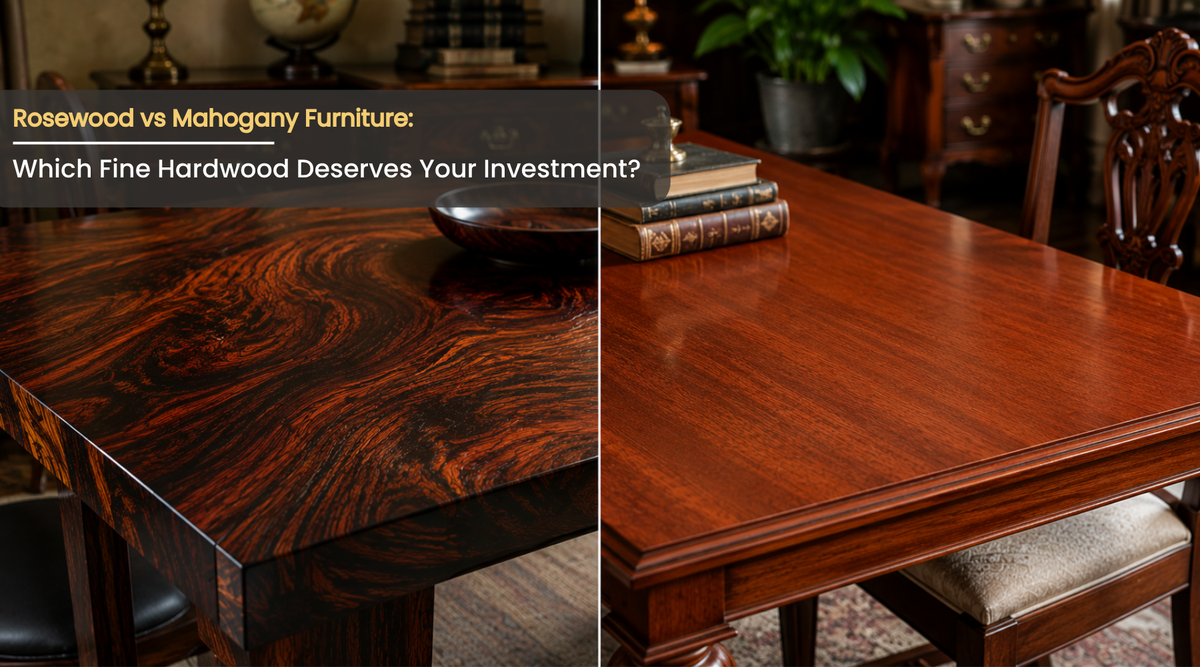
Rosewood reads bold. Deep reddish-brown to purple-brown fields, dark ribbon streaks, interlocked figure that shifts as you move around the piece. It looks painted rather than grown. Rosewood suits rooms where the furniture is the star: a statement table, an ornate cabinet, a headboard that commands the bedroom.
Mahogany reads refined. A warm, even reddish-brown with straight, fine, uniform grain and an occasional subtle ribbon shimmer. It ages into a deeper, richer red over time. Mahogany suits rooms that call for classic, understated elegance, and it has anchored formal libraries, dining rooms, and studies for generations.
Grain sums up the divide. Rosewood is complex, high-contrast, and dramatic. Mahogany is straight, smooth, and consistent. One wood announces itself. The other carries quiet, timeless authority.
Dimensional Stability: How Each Wood Handles the Seasons
This is where mahogany quietly pulls ahead, and it matters more than shoppers expect. Mahogany is one of the most dimensionally stable furniture hardwoods available. It expands and contracts very little as indoor humidity shifts between dry winter heating and humid summer air, which is why antique mahogany survives centuries without splitting.
Rosewood, despite its density, can develop fine surface checks if a piece swings between bone-dry and damp conditions. The wood prefers stable indoor humidity and rewards a controlled interior climate. In a climate-controlled home the difference rarely shows, but in a room with wide seasonal humidity swings, mahogany is the more forgiving wood.
For buyers in challenging climates, that stability is a real advantage. Mahogany tolerates variation that would stress denser woods, which partly explains why it became the workhorse of fine cabinetmaking across so many regions and centuries.
Finishing: How Each Wood Takes a Polish
Finish behavior separates these woods and shapes the final look.
Rosewood is oily and dense, so it resists oil finishes, because the wood is already saturated with its own oils. Applied oil dries unevenly and sits on the surface. The right treatment is lacquer or, for the deepest result, French polish built up in many thin hand-rubbed shellac layers. Boston Mills applies hand-rubbed French polish to rosewood to expose the grain depth, and the resulting mirror finish cannot be sprayed.
Mahogany is the finisher's dream by contrast. It accepts stain evenly, takes every finish cleanly, and moves smoothly from a soft satin wax to a high-gloss French polish without fuss. Its even grain absorbs color uniformly, so mahogany can be finished light or dark, matte or mirror, with predictable results. This versatility is a large part of why mahogany dominated traditional cabinetmaking.
In short: rosewood demands a finish that respects its oils and rewards the effort with unmatched depth, while mahogany accepts almost anything and looks refined under all of it.
Price and Sustainability
Both woods sit at the premium tier, but pricing and sourcing differ, and both carry CITES restrictions.
Rosewood is the more expensive and more restricted. Most Dalbergia species fall under CITES Appendix II, so legal rosewood furniture requires permits and documented chain of custody. The trees grow slowly, sometimes over a century, and limited legal supply pushes prices to the top of the range. Boston Mills imports rosewood under permit and publishes a Rosewood Compliance note so buyers can verify sourcing.
Mahogany's story is nuanced. Genuine Honduran mahogany (Swietenia macrophylla) is CITES Appendix II listed and has grown scarce, so true mahogany can command high prices when available. But African mahogany (Khaya) and plantation-grown stock have stabilized supply for the broader market, which is why furniture-grade mahogany often runs cheaper than rosewood. On a rough per-board-foot basis, genuine mahogany usually sits below rosewood, with African mahogany undercutting Honduran further and rosewood resting at the top of the price ladder.
For the sustainability-minded buyer, plantation-grown or certified African mahogany is a more accessible responsible choice, while rosewood carries a heavier documentation requirement that a reputable maker should handle openly. Either way, ask for sourcing paperwork before you buy.
Which Furniture Pieces Suit Each Wood
The woods' strengths point to specific uses.
Choose rosewood for: statement dining tables, carved cabinets and credenzas, headboards, accent chairs, and desks meant to be the visual anchor of a room and to hold heirloom value across generations. In a climate-controlled interior, rosewood's density, dramatic figure, and French-polished depth make it the collector's choice.
Choose mahogany for: traditional dining sets, library and office furniture, detailed carved pieces, wide seamless tabletops, and classic case goods where refined uniform color and dimensional stability matter more than maximum hardness. Mahogany is the timeless pick for formal, understated interiors.
Some rooms use both, letting rosewood lead as the focal point while mahogany fills the supporting classical pieces. The two woods share a heritage of fine craftsmanship even as they express it differently.
How to Buy With Confidence
Buying either wood well comes down to species verification, sourcing documentation, and construction quality. For rosewood, ask for CITES paperwork and a compliance statement. For mahogany, confirm whether it is genuine Swietenia, African Khaya, or plantation stock, and ask for provenance. Solid wood construction, cut from continuous timber rather than veneer over particleboard, is what allows a piece to be refinished for decades, so ask how it is built.
At Boston Mills, every rosewood piece is handcrafted in Dallas, cut from documented solid timber, finished with hand-rubbed French polish, and accented with custom brass hardware. White-glove delivery and assembly are free on orders over $3,500. To ask about a specific piece, a custom order, or sourcing documentation, call (214) 666-6647 or email info@bostonmills.net.
Is rosewood harder than mahogany?
Yes, and by a wide margin. Rosewood rates roughly 2,440 lbf (East Indian) to 2,550 lbf (Brazilian) on the Janka scale, while mahogany sits around 800 to 900 lbf. Rosewood resists dents and scratches far better, though mahogany's softer, stable wood is exactly what makes it easier to carve and shape.
Which is better for furniture, rosewood or mahogany?
Neither is universally better; each wins different priorities. Rosewood is better for maximum hardness, dramatic figure, and heirloom permanence in climate-controlled rooms. Mahogany is better for dimensional stability, refined uniform color, detailed carving, and traditional elegance. Match the wood to your climate, your style, and the role the piece will play.
What is the difference between genuine mahogany and African mahogany?
Genuine mahogany comes from the Swietenia genus, chiefly Swietenia macrophylla and Swietenia mahagoni, native to the Americas. African mahogany comes from the Khaya genus and is a close relative with a similar warm reddish-brown look. Genuine mahogany has grown scarce and pricier, so African mahogany fills much of the market at a lower cost.
Why does mahogany resist cracking better than rosewood?
Mahogany is one of the most dimensionally stable furniture hardwoods, so it expands and contracts very little as humidity changes, which prevents seasonal cracking. Rosewood is denser but can develop fine surface checks if it swings between very dry and very humid conditions, so it prefers stable indoor humidity to stay flawless.
Which woods count as rosewood?
Rosewood covers several Dalbergia species, chiefly East Indian rosewood (Dalbergia latifolia), Brazilian rosewood (Dalbergia nigra), and Honduran rosewood (Dalbergia stevensonii). All share high density, natural oils, and dramatic interlocked grain, though color ranges from reddish-brown to deep purple-brown depending on the species.
Is mahogany cheaper than rosewood?
Usually, yes. Furniture-grade mahogany, especially African mahogany or plantation-grown stock, generally costs less per board foot than rosewood, because mahogany supply has stabilized while rosewood remains scarce and heavily restricted. Genuine Honduran mahogany can still command high prices, but rosewood sits at the top of the hardwood price ladder.
How can I tell rosewood from mahogany?
Look at grain, contrast, and weight. Rosewood shows deep reddish-brown to purple-brown color with dark, high-contrast interlocked streaks and feels heavy and dense. Mahogany shows a warmer, more even reddish-brown with straight, fine, uniform grain and feels lighter. Rosewood also carries a faint rose scent when freshly worked.
Can rosewood and mahogany furniture be mixed in one room?
Yes. Both are warm reddish-brown woods with a shared heritage of fine craftsmanship, so they coordinate well when the styling is deliberate. Let rosewood serve as the dramatic focal point and mahogany fill the classical supporting pieces, keeping finishes and design language consistent so the pairing looks intentional.
Is mahogany more sustainable than rosewood?
Mahogany is often the more accessible responsible choice, because plantation-grown and certified African mahogany have stabilized supply. Genuine Honduran mahogany is CITES-listed and scarce, so it needs documentation too. Rosewood is more heavily restricted under CITES and requires a documented chain of custody, which a reputable maker should provide.
Which wood ages better over time?
Both age beautifully, in different ways. Mahogany deepens into a richer, redder patina and stays dimensionally stable for centuries, which is why antique mahogany survives so well. Rosewood develops even greater depth under French polish and resists wear thanks to its density, making it a superb heirloom in a climate-controlled home.
Does mahogany take carving better than rosewood?
Yes. Mahogany's softer, even, stable grain carves crisply and predictably, which is why traditional carved furniture so often uses it. Rosewood can be carved too, but its density and interlocked grain make it harder to work and more demanding on tools, so intricate detail is easier to achieve in mahogany.
Do I need documentation to buy rosewood or mahogany furniture?
For rosewood, yes, expect it, because most species are CITES-protected and legitimate furniture moves with permits and a documented chain of custody. For mahogany, genuine Swietenia macrophylla is also CITES-listed, so ask about provenance. A maker who imports under permit, as Boston Mills does, can show you exactly where the timber came from.
Which wood holds resale value better?
Rosewood typically holds resale value better as an heirloom, thanks to its rarity, density, and French-polished depth, especially in restricted species with documented sourcing. Mahogany holds value strongly too, particularly genuine antique pieces, but rosewood's scarcity gives it a firmer long-term collectible edge in most markets.
The Bottom Line
Rosewood and mahogany are both revered fine hardwoods, but they express that heritage differently. Rosewood (Dalbergia) brings a Janka hardness near 2,440 lbf, deep reddish-brown to purple-brown color, dramatic interlocked grain, and a density that rewards hand-rubbed French polish, which makes it the heirloom choice for climate-controlled interiors and statement pieces. Mahogany (Swietenia) brings a softer 800 to 900 lbf hardness, warm even color, straight refined grain, outstanding dimensional stability, and superb workability, which makes it the timeless choice for traditional, carved, and classically elegant furniture.
Match the wood to your climate, your style, and the role the piece will play. Choose rosewood where the furniture lives indoors, takes daily contact, and is meant to dominate the room and hold value across decades. Choose mahogany where refined uniform color, seasonal stability, and detailed craftsmanship matter most. Verify sourcing either way, insist on solid wood construction, and both woods will reward you for a lifetime.
To see handcrafted solid rosewood pieces, ask about a custom project, or verify sourcing documentation, call Boston Mills at (214) 666-6647 or email info@bostonmills.net.
%20is%20a%20dense,%20oil-rich%20tropical%20hardwood%20with%20deep%20reddish-brown%20to%20purple-brown%20color,%20dramatic%20interlocked%20grain,%20and%20a%20Janka%20hardness%20near%202,440%20lbf.%20Mahogany%20(genus%20Swi...)