
Rosewood vs Cherry: Which Ages Better in a Living Room?
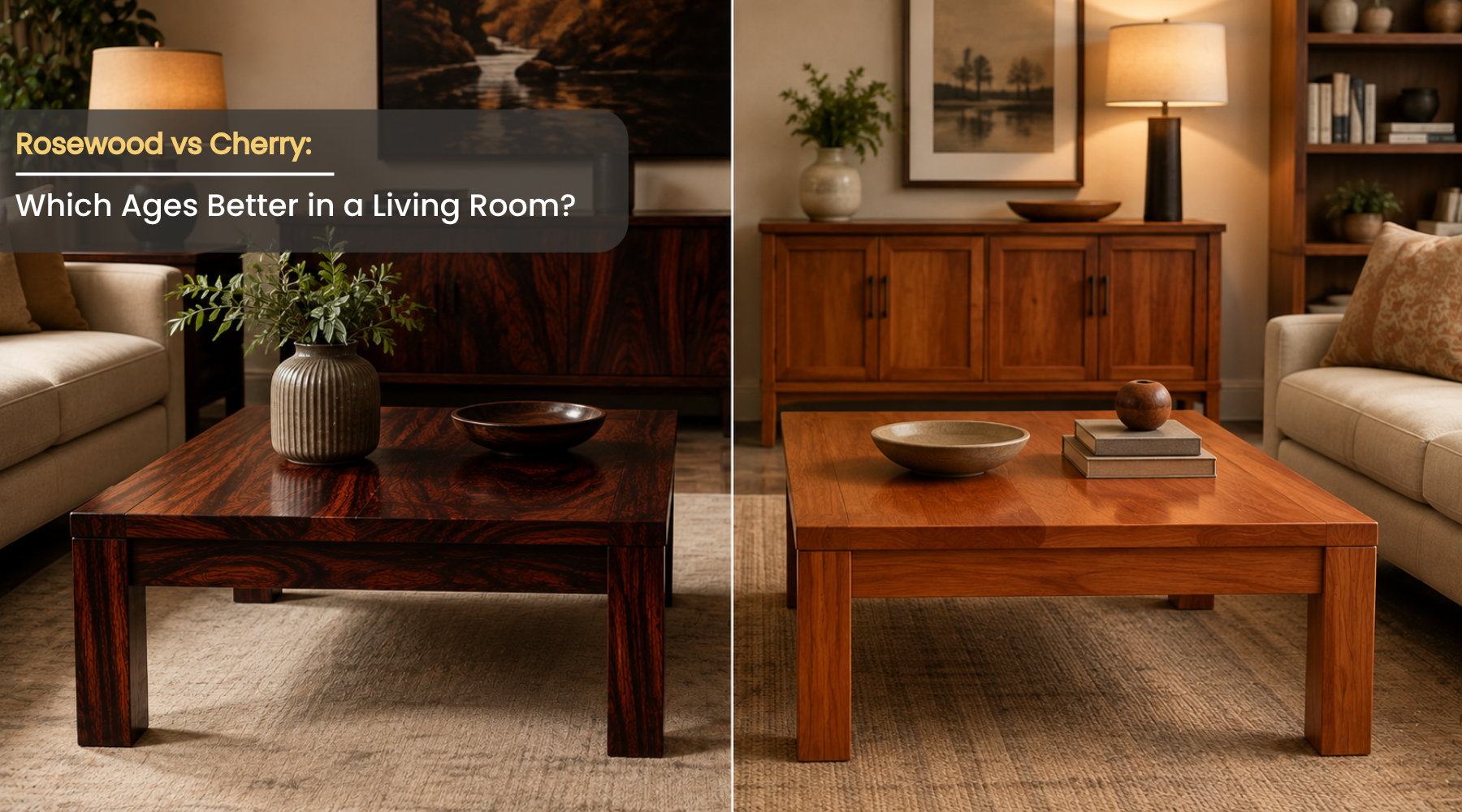
Cherry changes more. Rosewood changes better. American black cherry (Prunus serotina) is the most reactive furniture hardwood in common use, shifting from pale pinkish tan to deep reddish brown within the first year of light exposure. Rosewood, the trade name for timbers in the Dalbergia genus, arrives dark and moves slowly, deepening through oxidation while ultraviolet light pulls its purple tones toward flat brown.
The physical gap is wide. Indian rosewood (Dalbergia latifolia) records a Janka hardness of 2,440 lbf at 52 lbs/ft³, while cherry records 950 lbf at 35 lbs/ft³. Rosewood is roughly two and a half times harder and half again as heavy, which decides how each survives a coffee table’s daily life.
Living rooms complicate both. This is the room with the largest windows, the most uneven light, and the most objects left sitting in one place for months. Cherry records that history permanently in its color. Rosewood records it more slowly, and in the opposite direction.
This guide covers the short answer on aging, how cherry’s patina develops, how rosewood shifts over the same period, how the two compare on hardness and weight, how to manage living room light, how their grain and color suit different styles, what each costs and where it comes from, how care routines differ, and which timber ages better for which household.
The short answer on aging
Both woods improve with age. They simply improve on different timelines and in different directions, so the better choice depends on whether you want the finished look immediately or want to watch it develop.
Cherry does most of its changing in the first six to twelve months. A new cherry cabinet looks pale and slightly pink, and buyers who expected the rich furniture-showroom tone are often disappointed on delivery day. Within a year, photo-oxidation has deepened it into the warm reddish brown that cherry is famous for, and the change continues slowly for years afterward.
Rosewood starts where cherry finishes. Its heartwood is already dark, and aging brings a gradual deepening from oxidation combined with a gradual loss of purple tone from ultraviolet exposure. The net effect over a decade is a richer, browner surface.
That difference in timeline comes from two entirely separate chemical processes, and understanding them is what makes light management possible.
How cherry develops its patina
Cherry darkens through photo-oxidation, a reaction between light and the compounds in the wood. Exposure drives the change, so the parts of a cherry surface that receive the most light darken fastest. That is the mechanism behind the wood’s reputation, and also behind its one serious hazard in a living room.
Objects left in place during the first year create permanent shadow marks. A lamp base, a stack of books, or a runner across a sideboard will leave a pale silhouette once the surrounding surface has darkened, and the mismatch takes months to even out afterward. Rotating objects during the first six months prevents it entirely.
Cherry also resists staining. Its fine, even grain absorbs pigment unevenly and blotches, so most cabinetmakers finish it clear or with oil and let the wood do its own coloring. That is why a well-finished cherry piece looks better at year five than at week one, and why rosewood’s aging behaves so differently.
How rosewood shifts over the same period
Rosewood ages on two clocks running in opposite directions. Oxidation slowly deepens the heartwood, adding richness, while ultraviolet light bleaches the purple-brown notes toward a flatter brown. Direct sun accelerates the second process considerably.
The practical result is uneven fading rather than uneven darkening. A rosewood coffee table with one end catching afternoon sun through a bay window develops a two-tone top within a few years, and the faded section cannot be brought back without refinishing. Rotating pieces and controlling afternoon light keeps the surface consistent.
Neither wood is fragile here. Both are reacting normally to light, and both reward the same habits. What separates them in a living room is what happens on contact rather than in light.
Hardness, weight, and living room wear
Furniture in this room takes glasses, remote controls, feet, and children. Density decides how much of that shows:
|
Timber |
Janka hardness |
Dried weight |
|
Indian rosewood (Dalbergia latifolia) |
2,440 lbf |
52 lbs/ft³ |
|
Sheesham (Dalbergia sissoo) |
1,660 lbf |
48 lbs/ft³ |
|
Red oak, for reference |
1,220 lbf |
45 lbs/ft³ |
|
Black cherry (Prunus serotina) |
950 lbf |
35 lbs/ft³ |
Cherry sits below oak, which surprises people who associate it with fine furniture. It dents. A dropped remote leaves a mark that a rosewood top would shrug off, and coffee tables are where this shows fastest.
Cherry compensates in two ways. Its dents often lift with steam because the fibers are compressed rather than severed, and its darkening surface disguises minor wear better than a uniform finish would. Rosewood simply resists the damage in the first place, though it is heavier to move and harder to work.
Weight matters more here than in other rooms, since living room furniture gets rearranged. A rosewood media console is a two-person lift. A cherry one usually is not.
Managing light in a living room
Light is the variable you actually control. Both woods respond to it, so a few habits protect either:
- Rotate loose pieces such as side tables through the first year so exposure evens out.
- Move objects on cherry surfaces every few weeks until the color has settled.
- Draw blinds or sheers during peak afternoon hours on south and west-facing windows.
- Position rosewood away from direct beams, since its fading cannot be reversed.
- Check large tops seasonally for developing tone differences between ends.
Cherry owners should think of the first year as a curing period. Rosewood owners should think of light control as permanent policy. Those habits protect color, though color is only half of what makes a room work.
Grain, color, and style fit
Cherry is quiet. Fine, straight, even grain with occasional gum flecks, and a color that moves from tan to warm reddish brown. It suits Shaker, transitional, farmhouse, and contemporary rooms where the furniture should recede rather than dominate.
Rosewood is loud in a controlled way. Dalbergia latifolia runs deep brown to purple-brown with near-black streaking, sheesham runs golden to walnut with cream sapwood, and both carry a natural luster that reads as depth under lamplight. It suits mid-century, colonial, and formal rooms where a single piece anchors the space.
Mixing them works if one leads. A rosewood console against cherry side tables reads intentional. Splitting the room evenly between two strong browns usually does not. Style aside, the two also differ in where they come from and what they cost.
Cost, sourcing, and availability
Cherry is a domestic North American hardwood, harvested from managed forests across the eastern United States, and its supply chain is short, well documented, and unrestricted. Prices sit in the mid to upper range for domestic species, well below imported rosewood.
Rosewood is imported and regulated. Every Dalbergia species sits on CITES Appendix II, with Brazilian rosewood on Appendix I, and Dalbergia latifolia carries vulnerable status on the IUCN Red List. Longer growth cycles, lower yields per log, and compliance costs all push the retail price upward.
Buyers who prioritize traceability often prefer cherry for that reason alone. Buyers who prioritize density and longevity accept the import premium. Price aside, the two timbers also behave differently once a finish or a repair is involved.
Finishing behavior and repairability
Cherry is easy to work and difficult to color. It machines cleanly, sands to a glass surface, and glues without preparation, but its fine even grain absorbs pigment unevenly and blotches under stain. Makers who insist on staining it use a sanding sealer or a gel stain to control absorption, and most simply finish it clear and let photo-oxidation supply the color.
Rosewood reverses both traits. The density blunts cutting edges, the interlocked grain tears on a fast pass, and the natural oils interfere with adhesives and finishes, so surfaces are wiped with solvent before glue-up and before the first coat. Skipping that step produces joints that creep and finishes that never fully cure.
Repair follows the same pattern. Cherry accepts patching, steaming, and refinishing readily, and its darkening surface blends repairs over time. Rosewood is harder to work on but offers more depth to work with, since solid stock tolerates several full refinishing cycles. That repair depth is also what drives the difference in long-term value.
Resale and heirloom value
Rosewood holds value unusually well. Mid-century pieces built from Dalbergia nigra now sell for multiples of their original prices, driven by restricted supply under CITES and by demand for a timber that can no longer be produced at scale. Solid construction supports that market, because a piece that can be restored can be resold.
Cherry occupies a different position. Antique American cherry furniture is collected and valued, though the market rewards maker and period more than material, since the timber remains available and unrestricted. A cherry piece is bought to be used and passed down rather than traded.
Both are heirloom candidates when built properly. What decides it is joinery, drying, and finish type rather than species alone, and all three respond to the maintenance a piece receives.
Care routines compared
The basics are shared. Hold indoor humidity between 35 and 55 percent, dust with soft dry cloths, wipe spills immediately, use coasters and felt pads, and keep silicone sprays and ammonia cleaners away from both finishes.
Cherry needs more attention to dents and less to fading. Steam and a damp cloth will often raise a compression dent from cherry, and its softer surface benefits from pads under anything heavy that stays in one spot. Oiled cherry wants a light refresh once or twice a year.
Rosewood needs the reverse. Dents are rare, so the maintenance focus shifts to sun exposure and to keeping joints tight, since a dense heavy piece puts more stress on its own joinery when moved. Both respond to the same annual check of hinges and fixings, which leaves one question outstanding.
Which ages better, and for whom
Cherry ages better if you want a room that visibly matures. The transformation is genuine, it happens fast enough to enjoy, and the resulting patina is one of the most admired in American furniture. The cost is patience through year one and tolerance for dents afterward.
Rosewood ages better if you want stability. It arrives at close to its final appearance, resists the wear that living rooms deliver, and holds its structure across decades rather than years. The cost is a higher price and stricter light discipline.
For a household with young children, heavy use, or a preference for buying once, density decides it. For a household that enjoys watching a room settle into itself, cherry rewards the wait in a way no finish can imitate. Boston Mills builds in solid rosewood, and asking for the botanical name plus the construction method is the fastest way to compare any two living room pieces honestly.
Does cherry wood really change color?
Yes, dramatically. Cherry darkens from pale pinkish tan to deep reddish brown through photo-oxidation, with most of the change occurring in the first six to twelve months of light exposure and continuing slowly for years.
Is rosewood harder than cherry?
Yes, by a wide margin. Indian rosewood measures 2,440 lbf on the Janka scale against cherry’s 950 lbf. Cherry sits below red oak, which makes it a relatively soft choice for high-contact surfaces.
Why did my cherry table develop pale patches?
Objects left in one place blocked light while the surrounding surface darkened. The marks are shadow patterns, not damage, and they even out once the covered areas receive similar exposure over several months.
Does rosewood fade in sunlight?
Yes. Ultraviolet light pulls rosewood’s purple-brown tones toward flat brown, and the change is permanent short of refinishing. Oxidation deepens the wood at the same time, so a shaded piece darkens while a sunlit one flattens.
Which wood dents more easily?
Cherry does. Its lower density means dropped objects leave marks that rosewood would resist. Many cherry dents can be raised with steam, since the fibers compress rather than tear.
Can cherry be stained to look like rosewood?
It can be stained darker, though cherry blotches under pigment because of its fine even grain, and it will never match rosewood’s streaked figure. Most makers finish cherry clear and let it darken naturally.
Is cherry furniture cheaper than rosewood?
Yes. Cherry is a domestic North American hardwood with unrestricted supply, while rosewood is imported under CITES Appendix II controls with far longer growth cycles and lower yields per log.
How long does it take cherry to reach its final color?
Most of the shift happens within a year, and the color continues to deepen gradually for several years afterward. Pieces kept in dim rooms change more slowly, since light drives the reaction.
Do both woods need oiling?
Only if they were finished with oil. Oiled surfaces on either timber benefit from a thin annual coat, while lacquered and polyurethane finishes need nothing more than dusting.
Which is better for a family living room?
Rosewood, on durability grounds. Its density resists the dents, scratches, and impacts that come with children and heavy use, and solid construction allows several refinishing cycles across a lifetime.
Can rosewood and cherry be mixed in one room?
Yes, when one leads and the other supports. A single rosewood anchor piece surrounded by cherry works well, while an even split between two strong browns tends to read as unplanned.
Does cherry last as long as rosewood?
Cherry is rated moderately durable to durable and lasts for generations indoors, though rosewood outlives it on high-contact surfaces because of density and oil content. Joinery and humidity control matter more than species for either wood.
Cherry and rosewood both age well, in opposite directions and on different clocks. Cherry starts pale and earns its color through photo-oxidation within a year, rewarding patience and punishing anyone who leaves a lamp in one spot. Rosewood starts dark, deepens slowly through oxidation, and loses purple tone wherever sun reaches it.
Density settles the practical question. At 2,440 lbf against 950 lbf, rosewood absorbs the wear a living room delivers while cherry records it. Choose cherry for a room that should visibly mature and a household that treats furniture gently. Choose rosewood for a room that should look the same in thirty years. Browse the solid rosewood range at bostonmills.net, and ask for the species and construction on any piece you shortlist.
%20is%20the%20most%20reactive%20furniture%20hardwood%20in%20common%20use,%20shifting%20from%20pale%20pinkish%20tan%20to%20deep%20reddish%20brown%20wit...)