Rosewood vs Acacia: Two Dense Hardwoods Compared
Rosewood and acacia are relatives that ended up in different price brackets. Both belong to Fabaceae, the legume family, and both fix nitrogen through their roots. Rosewood is the trade name for timbers in the Dalbergia genus, while acacia furniture comes from the Acacia genus and its close relatives, most often plantation-grown Acacia mangium from Vietnam and Indonesia.
The gap between them is measurable. Indian rosewood (Dalbergia latifolia) records a Janka hardness of 2,440 lbf at 52 lbs/ft³, while the acacia species used in furniture cluster far lower, with Australian blackwood (Acacia melanoxylon) at 1,160 lbf and 40 lbs/ft³. Retail listings often quote higher acacia figures without naming a species, which is the first problem this comparison has to solve.
Supply explains the price difference more than quality does. Acacia mangium reaches sawlog size in roughly 12 to 15 years on plantations. Dalbergia latifolia takes decades, carries vulnerable status on the IUCN Red List, and moves under CITES Appendix II paperwork. One timber is farmed at scale, the other is harvested against a conservation clock.
This guide covers what the two genera share, why the word acacia tells you so little on its own, how the woods compare on hardness and weight, how their color and grain differ, how each is typically built into furniture, where each survives, why the prices diverge, how care routines differ, and which wood suits which job.
Cousins in the same family, not equals in the timber yard
Both genera sit in Fabaceae, and that shared ancestry shows up in the wood. Acacia and Dalbergia species both produce heartwood with natural extractives, both develop rich brown tones, and both fix nitrogen, which is why each has been planted heavily in agroforestry programs across Asia.
The similarity stops at density and consistency. Dalbergia species produce oily, tight-grained heartwood laid down slowly over decades, which is why the genus supplies guitar makers and high-end cabinetmakers. Acacia grows fast, produces lighter and more variable timber, and dominates the mid-market where volume matters more than density.
There is one more difference that affects buyers directly. Rosewood identification is straightforward once you know the botanical name, because Dalbergia species behave predictably. Acacia does not offer that comfort, because the label covers a much wider spread of trees.
What “acacia” actually means on a furniture label
Acacia is a genus of roughly a thousand species, and furniture retailers rarely name which one they used. In practice the timber usually comes from a handful of sources:
- Acacia mangium supplies most plantation acacia furniture across Southeast Asia.
- Acacia melanoxylon, sold as Australian blackwood, produces the finest figure in the genus.
- Acacia koa from Hawaii is a premium tonewood priced closer to true rosewood.
- Acacia confusa and other tropical species appear in cutting boards and bowls.
Those trees differ sharply in density, color, and durability, so a single Janka figure for acacia does not exist. When a listing claims a hardness number without a species name, the number is decorative rather than informative.
Rosewood listings suffer from vague naming too, though the range hidden behind the word is narrower. That difference becomes concrete when the two are measured side by side.
Hardness and density compared
Density predicts dent resistance, and the two timbers separate clearly:
|
Timber |
Janka hardness |
Dried weight |
|
Indian rosewood (Dalbergia latifolia) |
2,440 lbf |
52 lbs/ft³ |
|
Sheesham (Dalbergia sissoo) |
1,660 lbf |
48 lbs/ft³ |
|
Koa (Acacia koa) |
1,170 lbf |
38 lbs/ft³ |
|
Australian blackwood (Acacia melanoxylon) |
1,160 lbf |
40 lbs/ft³ |
|
Red oak, for reference |
1,220 lbf |
45 lbs/ft³ |
Read that table carefully. The common furniture acacias land near red oak, which makes them respectable hardwoods rather than exceptional ones. Rosewood sits roughly twice as hard, and that margin is what buyers are paying for on a dining top or a desk.
Weight tells the same story from another angle. A rosewood cabinet is noticeably harder to move than an acacia cabinet of identical size, because there is simply more material packed into the same volume. Density also shapes how each wood looks once it is finished.
Color, grain, and figure
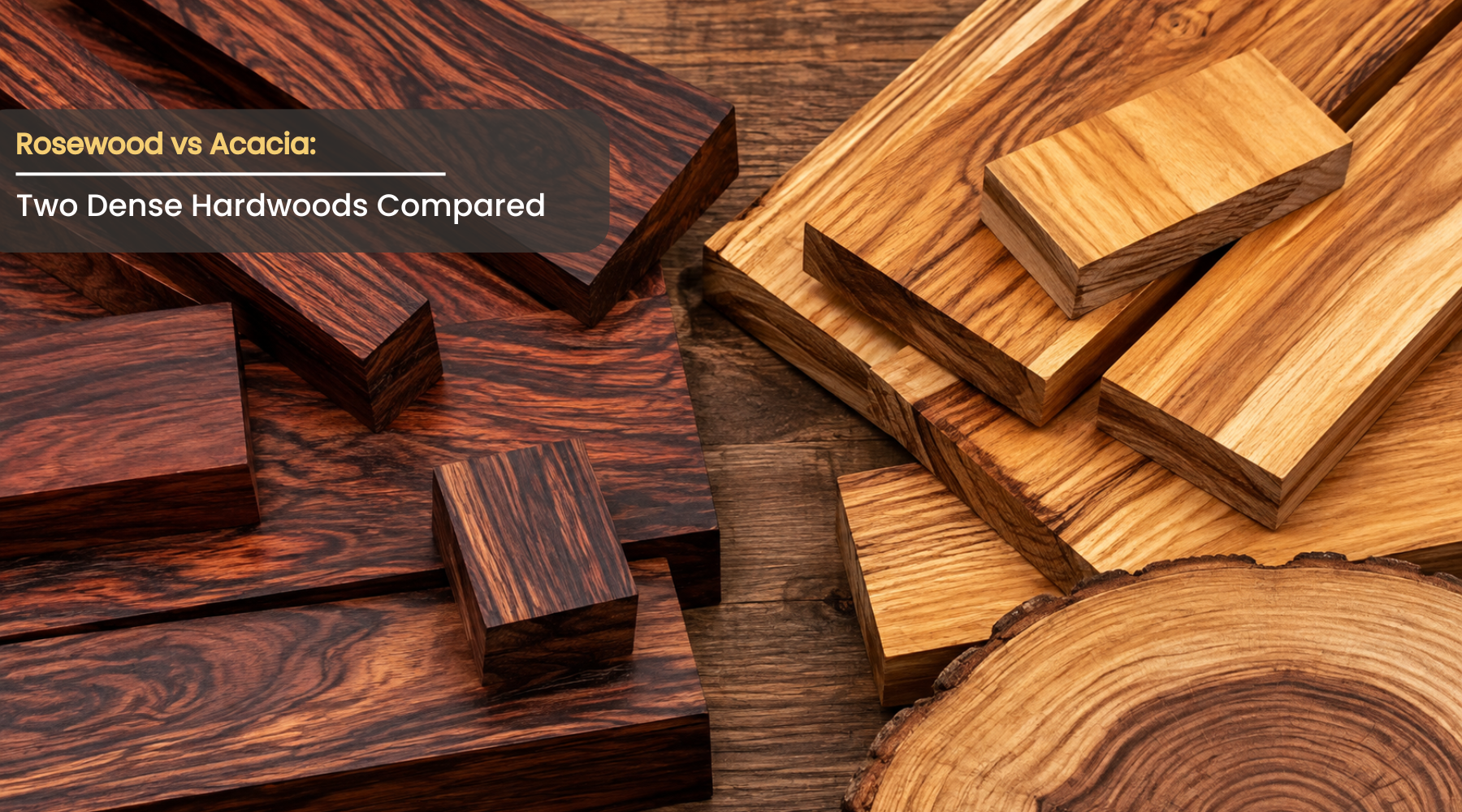
Acacia is the more dramatic of the two. Its boards swing from pale golden yellow through orange to deep reddish brown, often within a single panel, and the contrast between adjacent strips is a defining feature of acacia furniture rather than a flaw. Grain patterns are bold, wavy, and irregular.
Rosewood works in a narrower and darker register. Dalbergia latifolia runs deep brown to purple-brown with near-black streaking, sheesham runs golden to walnut brown with cream sapwood, and both hold a natural luster from their oil content. The figure reads as fine streaks rather than broad waves.
Style follows from that. Acacia suits rustic, coastal, and casual interiors where variation is the point. Rosewood suits formal, mid-century, and traditional rooms where depth and uniformity carry the look. Both appearances are shaped by how the timber behaves under tools.
How each wood behaves in the workshop
Machining separates them quickly. Acacia cuts and sands without much drama, though its irregular grain tears if a planer runs too fast, and its color variation makes board matching a real task rather than a formality. It glues cleanly, takes stain evenly enough, and accepts most finishes without preparation.
Rosewood is harder work on every count. The density blunts cutting edges faster, the interlocked grain tears on the wrong pass, and the natural oils that make the timber durable also interfere with adhesives and finishes. Cabinetmakers wipe rosewood surfaces with solvent before glue-up and before finishing, because skipping that step produces joints that creep and lacquer that never fully cures.
Those requirements are why rosewood pieces carry more labor cost than their timber value alone suggests. They also explain why rosewood is usually assembled with traditional joinery by hand while acacia moves through automated production, and those workshop realities feed directly into how each wood reaches the showroom.
How each wood is built into furniture
Construction differs more than most buyers realize. Acacia logs from fast-grown plantations are small and knotty, so the timber is usually converted into finger-jointed, glued-up panels, the butcher-block pattern visible on most acacia tabletops. That method is efficient, stable across wide spans, and honest when disclosed.
Rosewood is more often worked as solid boards with traditional joinery, because the logs yield wider clear stock and the timber cost justifies the labor. Solid construction also carries a longer repair ceiling, since there is depth to sand back and no glue lines running through the surface.
Neither approach is wrong. Glued panels resist the seasonal movement that splits wide solid tops, while solid stock survives more refinishing cycles. The distinction matters most when you look at how long each piece is expected to survive.
Durability and where each wood belongs
Rosewood is rated durable, resists dry-wood termites, and needs no chemical treatment for indoor use. Acacia varies by species, with most furniture-grade timber rated moderately durable, and its sapwood remains vulnerable to insect attack in a way that Dalbergia heartwood is not.
Placement should follow those properties:
- Dining tables and desks reward rosewood’s dent resistance under daily contact.
- Garden and patio furniture suits acacia, which handles weather well once oiled and is cheap enough to replace.
- Kitchen boards and bowls belong to acacia, since rosewood dust and oils are best kept away from food preparation.
- Bedroom and occasional furniture works in either timber, where contact is gentle.
- Heirloom pieces belong to rosewood, because refinishing depth decides what survives fifty years.
Acacia’s outdoor role is worth emphasizing, since rosewood has no business outside. What decides indoor performance for both, though, is how each responds to changing air.
How each wood handles moisture and movement
Wood moves with humidity, and the two timbers move differently. Rosewood’s density and oil content slow moisture exchange, which keeps panels flatter and joints tighter across seasonal swings. That stability is a large part of why century-old Dalbergia furniture still sits square.
Acacia moves more in solid form, which is precisely why manufacturers convert it into glued panels rather than wide single boards. A finger-jointed acacia top distributes movement across many small strips instead of concentrating it in one wide plank, and the result is a surface that stays flat even when the room does not.
Both timbers need stock dried to 8 to 12 percent moisture content before assembly, matched to the climate where the piece will live. Rushed drying causes cupping and open joints in either wood, and the failure looks identical regardless of species. Drying quality is invisible on a showroom floor, which makes it a question worth asking rather than assuming, and it is one of several costs buried in the price of each timber.
Why the price gap exists
Growth cycles drive the cost. Acacia mangium reaches usable size in 12 to 15 years on managed plantations across Vietnam, Indonesia, and Malaysia, and those plantations exist at enormous scale. Dalbergia latifolia takes decades in slower natural regrowth, yields less clear heartwood per log, and faces tightening legal supply.
Regulation adds to it. Every Dalbergia shipment moves under CITES Appendix II controls, and that compliance burden lands in the retail price. Acacia carries no equivalent listing, so paperwork costs nothing.
Labor completes the picture. Finger-jointed acacia panels come off a production line, while solid rosewood requires board selection, matching, and traditional joinery. You are buying different amounts of work as well as different trees, and the maintenance each demands afterward differs too.
Care routines compared
Both woods want stable indoor air, though acacia is the more demanding once it leaves the house. Indoor acacia and rosewood share the same basics: humidity held between 35 and 55 percent, soft dry cloths for dusting, immediate cleanup of spills, and no silicone sprays or ammonia cleaners.
Outdoor acacia adds real work. Exposed pieces need oiling two or three times a year to prevent the surface greying and checking, and they last far longer when covered or stored through winter. Skipping that routine is why so much acacia patio furniture looks tired within a few seasons.
Rosewood’s care is lighter but less forgiving of neglect in one area: sunlight. Ultraviolet exposure pulls its purple-brown tones toward flat brown permanently. Knowing that, the choice between the two comes down to purpose.
Which wood suits which purchase
Choose acacia when the piece is casual, outdoor, replaceable, or food-related, and when bold color variation is the look you want. It delivers genuine hardwood performance at a fraction of the cost, and its plantation supply carries no conservation baggage.
Choose rosewood when the piece is central, high-contact, and expected to outlive the room it sits in. The density buys decades of dent resistance, the oils buy pest and decay resistance, and solid construction buys the ability to refinish rather than replace.
There is also a middle path worth naming. Sheesham (Dalbergia sissoo) sits between the two at 1,660 lbf, offering true rosewood durability and pest resistance at a price closer to premium acacia, which makes it the sensible compromise for bedroom and occasional furniture. Boston Mills builds in solid rosewood, so asking for the botanical name and the construction method is the fastest way to compare any two quotes on equal terms.
Is acacia as hard as rosewood?
No. The acacia species used in furniture measure around 1,160 to 1,170 lbf on the Janka scale, against 2,440 lbf for Indian rosewood. Acacia is a solid hardwood, roughly comparable to red oak, rather than a rosewood substitute.
Are rosewood and acacia related?
Yes. Both belong to Fabaceae, the legume family, and both fix nitrogen through root nodules. That shared family explains their similar brown tones and their popularity in agroforestry planting.
Which acacia species are used in furniture?
The common ones are Acacia mangium, Acacia melanoxylon, Acacia koa, and Acacia confusa. Mangium dominates mass-market furniture, blackwood supplies figured stock, and koa sits at premium prices closer to true rosewood.
Why is acacia furniture so much cheaper?
Plantation acacia reaches sawlog size in 12 to 15 years, arrives in volume, and needs no CITES paperwork. Rosewood takes decades, faces conservation limits, and requires more hand labor in solid construction.
Can acacia be used outdoors?
Yes, with maintenance. Acacia handles weather better than most furniture hardwoods once oiled two or three times a year. Rosewood should stay indoors, since sun and rain degrade both its color and its finish.
Is acacia furniture solid wood?
Usually it is finger-jointed solid wood, meaning short strips glued into panels rather than single wide boards. That is genuine timber, not particleboard, though it refinishes fewer times than solid stock.
Does acacia darken like rosewood?
It changes less. Acacia’s varied golden and reddish tones deepen slightly with age and light, while rosewood shifts more visibly as ultraviolet exposure pulls purple-brown toward flat brown.
Is acacia good for cutting boards?
Yes. Acacia is dense enough to resist knife marks, closes well against moisture, and carries no strong oils that transfer flavor. Rosewood is a poor choice for food surfaces regardless of hardness.
Which wood is more sustainable?
Acacia holds the advantage on volume, since plantation stock regrows in under two decades with no conservation listing. Rosewood is defensible when the species and origin are documented, which is exactly what the botanical name on a label allows you to check.
Does acacia warp more than rosewood?
Acacia moves more in solid form, which is why manufacturers convert it into glued panels. Rosewood’s density and oil content make it more stable across seasonal humidity swings.
Can acacia furniture be refinished?
Yes, though fewer times. Finger-jointed panels can be sanded lightly, but heavy sanding exposes glue lines. Solid rosewood tolerates several full refinishing cycles across its lifetime.
Is rosewood worth the extra cost over acacia?
For high-contact and long-life pieces, yes. Rosewood offers roughly double the hardness, better decay and termite resistance, and far more repair depth. For casual, outdoor, or short-term furniture, acacia is the more rational purchase.
Rosewood and acacia share a family and very little else. Acacia is a fast-grown, widely available hardwood with bold color variation, real outdoor capability, and prices that reflect a 12 to 15 year growth cycle. Rosewood is a slow-grown, regulated timber with roughly double the density, deeper color, better pest resistance, and the repair depth that makes fifty-year furniture possible.
Judge them by job rather than by ranking. Put acacia where weather, food, and casual wear are the daily reality, and put rosewood where the piece is central, heavily used, and expected to stay. Browse the solid rosewood range at bostonmills.net, and ask for the species and the construction method before comparing any two prices.