How Long Does Rosewood Furniture Actually Last?
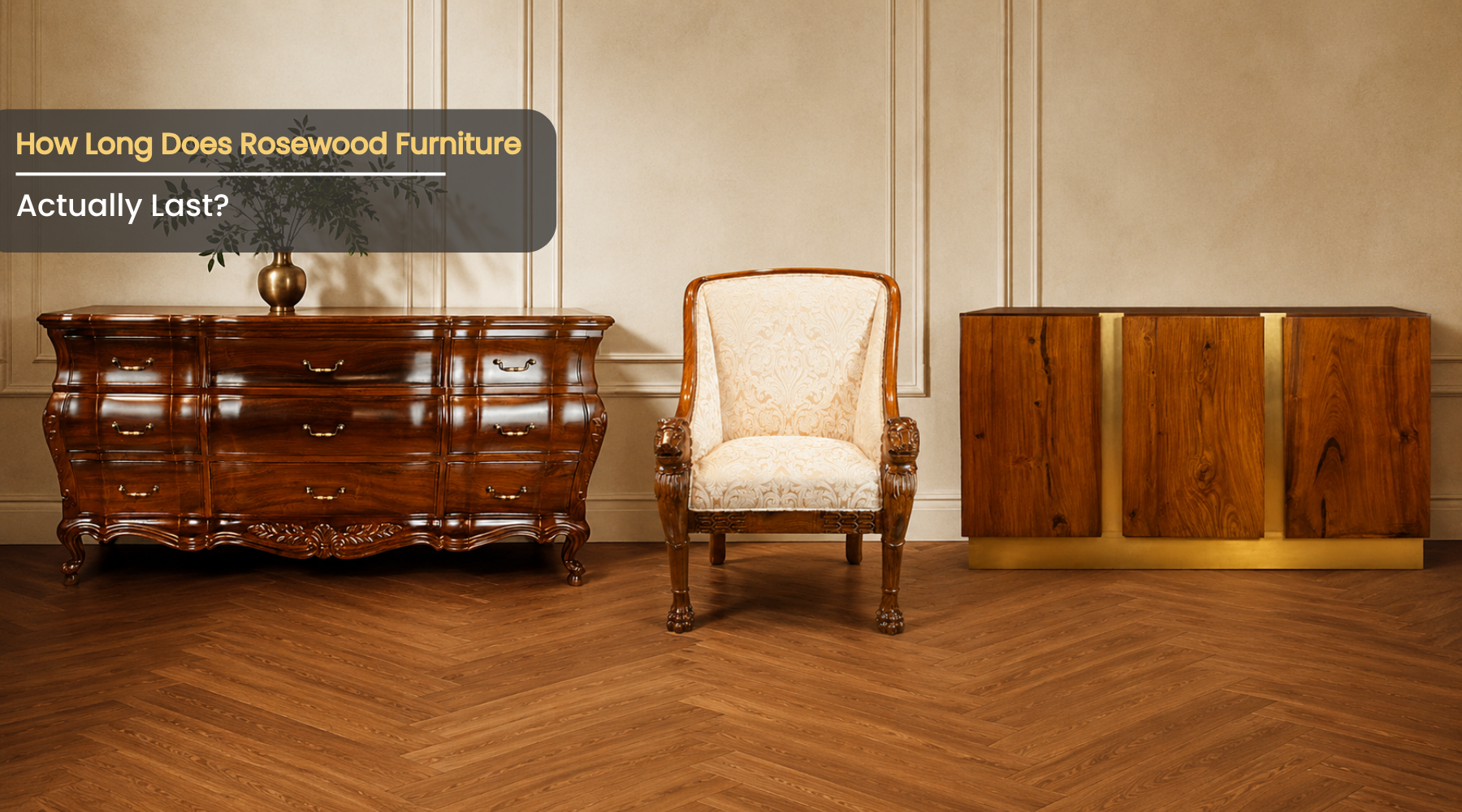
Solid rosewood furniture lasts 50 to 100 years under ordinary indoor use, and considerably longer when the joinery is sound and the humidity stays stable. That is not a marketing figure. It is what survives: Ming dynasty pieces cut from Dalbergia odorifera in the sixteenth century still sit in museum collections, Regency and Victorian rosewood cabinets from the 1800s still trade at auction, and Brazilian rosewood furniture built in the 1960s remains in daily use in homes today.
The timber earns that record on physical properties. Indian rosewood (Dalbergia latifolia) records a Janka hardness of 2,440 lbf and an average dried weight of 52 lbs/ft³, roughly twice as hard as teak. The Dalbergia genus also carries natural oils and extractives that resist decay fungi and dry-wood termites without any chemical treatment.
What limits the lifespan is almost never the wood. Rosewood furniture fails at the joints, at the veneer line, at the panel that was never dried properly, and at the hardware. Every one of those is a workmanship or environment problem, and every one of them is fixable or preventable.
This guide covers what surviving pieces prove, why the genus outlasts most furniture hardwoods, what actually ends a rosewood piece, how drying and moisture content set the ceiling, how solid and veneered construction differ over decades, how joinery decides the outcome, what sunlight and humidity do, the care routine that adds years, how often a piece can be refinished, and what to check before buying for the long term.
What surviving rosewood furniture proves
Evidence beats estimates. Chinese huanghuali furniture, built from Dalbergia odorifera during the Ming dynasty, has passed four hundred years in recognizable condition, which places rosewood among the longest-lived furniture timbers on record. European makers reached the same conclusion two centuries ago, and rosewood became a signature material of Regency and Victorian cabinetmaking.
The modern evidence is easier to inspect. Danish mid-century designers worked heavily in Brazilian rosewood (Dalbergia nigra) through the 1950s and 1960s, and those pieces now circulate on the secondhand market at prices well above their original cost, still structurally intact after sixty years of family use.
Two patterns run through all of it. The survivors are solid stock rather than thin veneer over unstable cores, and they were built with mechanical joints rather than glue alone. Those patterns matter more than the century a piece was made in, and they start with the properties of the timber itself.
Why rosewood outlasts most furniture hardwoods
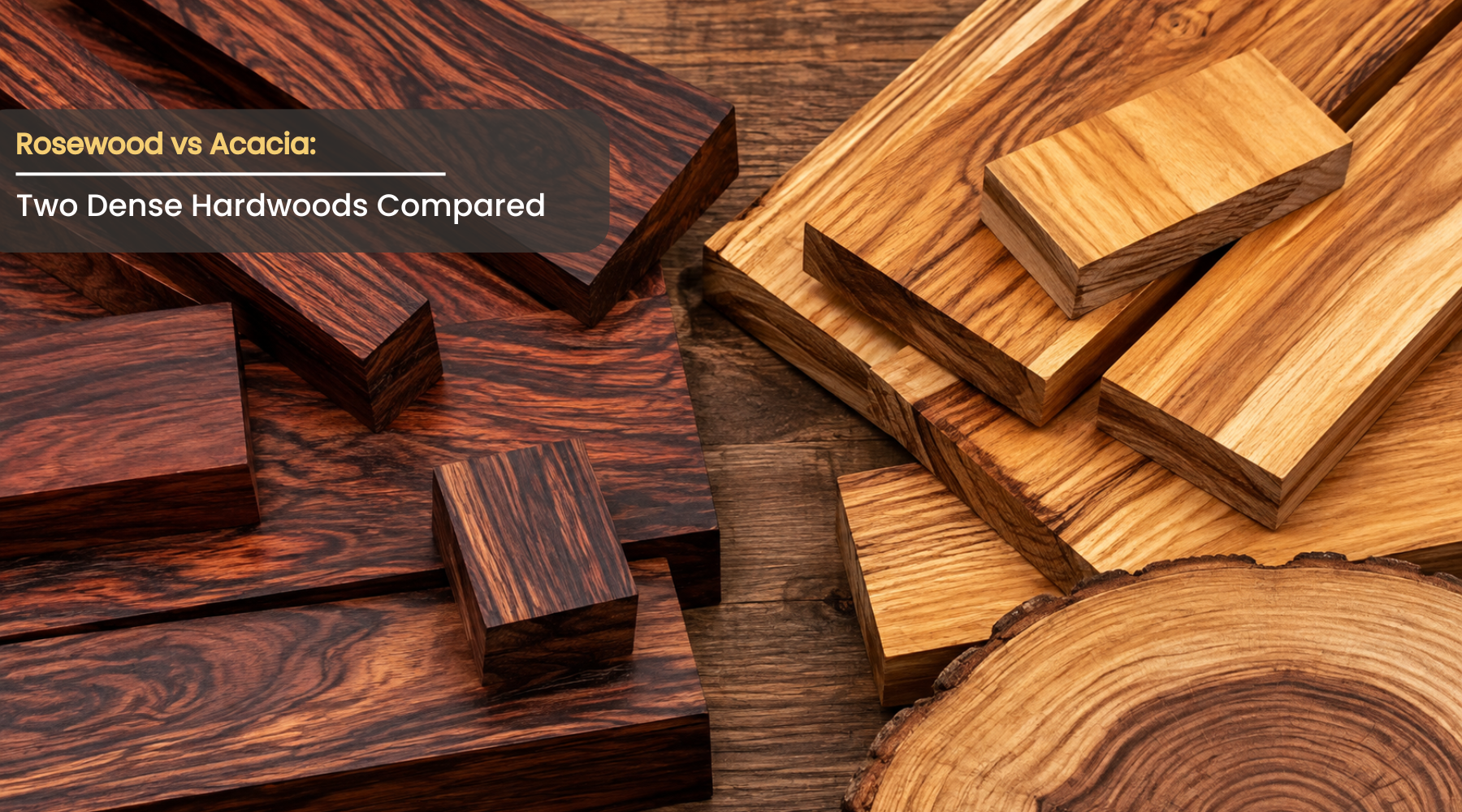
Density is the first reason. Rosewood sits far above the hardwoods used in mainstream furniture, and hardness translates directly into resistance to the dents, scratches, and edge wear that make a piece look finished long before it is structurally finished.
|
Timber |
Janka hardness |
|
Brazilian rosewood (Dalbergia nigra) |
2,790 lbf |
|
Indian rosewood (Dalbergia latifolia) |
2,440 lbf |
|
Sheesham (Dalbergia sissoo) |
1,660 lbf |
|
Red oak |
1,220 lbf |
|
Teak |
1,070 lbf |
|
Black walnut |
1,010 lbf |
Chemistry is the second reason. Dalbergia heartwood carries oils and extractives that make it unappetizing to dry-wood termites and hostile to the fungi that cause rot. That protection is built into the heartwood rather than sprayed on, so it does not wear off, wash out, or expire.
Stability is the third. Dense, oily, slow-grown timber moves less with seasonal humidity than open-grained species do, which keeps joints tight across decades. None of those three advantages protects a piece from bad construction, and construction is where most failures begin.
What actually ends a rosewood piece
Failure has patterns. Working through repair records and auction condition reports, the same short list appears again and again:
- Joints separate when glue creeps or a tenon works loose, usually after years of racking stress on chairs and tables.
- Panels split when solid wood is trapped in a frame that gives it no room to move seasonally.
- Veneer lifts when moisture reaches the adhesive line or the substrate underneath swells.
- Hardware fails as hinges wear, drawer runners bind, and screw holes strip out of their seats.
- Finishes cloud, craze, or wear through, which looks like decay and almost never is.
Notice what is missing from that list. The timber itself rarely gives out. A 1960s rosewood sideboard with a wobbling frame and a cloudy top has a workmanship problem and a maintenance problem, not a material problem, and both are repairable by a competent restorer.
The one failure that begins before a piece is even assembled is moisture, and it deserves its own section.
How drying and moisture content set the ceiling
Moisture content decides whether furniture stays flat. Timber for indoor furniture should be dried to 8 to 12 percent moisture content, matched to the climate where the piece will live. Wood dried above that range keeps shrinking after assembly, which opens joints and cups panels. Wood dried too aggressively can case-harden and check.
Air drying and kiln drying both work when done properly. A rushed kiln schedule is the common culprit behind rosewood furniture that arrives beautiful and warps within two seasons. Because the surface reads identically either way, the only reliable check is asking the maker for the target moisture content and whether the stock was conditioned after drying.
This is the single most useful question a buyer can ask, and it separates workshops that build for decades from those that build for a delivery date. Once the stock is dry, the next variable is how much solid wood is actually in the piece.
Solid rosewood versus veneer over a lifetime
Construction changes the arithmetic. Solid rosewood can be sanded, repaired, and refinished repeatedly, because there is depth to work with. A damaged edge can be spliced, a scorched top can be taken back to bare wood, and the piece emerges usable again.
Veneer behaves differently. Antique veneers were cut thick, often 1.5 to 3 millimeters, which left room for restoration and explains why Victorian veneered pieces still refinish well. Modern veneer is usually sliced around 0.6 millimeters, thin enough that one careless sanding goes through to the substrate. The core matters just as much: veneer over solid or plywood cores survives far better than veneer over particleboard, which swells permanently once water reaches it.
Veneer is not a defect. It allows wide panels that would split in solid form, and it uses scarce timber efficiently. It simply carries a shorter repair ceiling, which should be reflected in the price. Whether solid or veneered, the piece still stands or falls on how it was joined.
How joinery decides the outcome
Joints carry the load. The furniture that reaches its hundredth birthday was assembled with mechanical joinery, where the wood itself resists the stress and the adhesive only supplements it:
- Mortise and tenon joints lock rails into legs and remain the standard for chairs and tables.
- Dovetails resist the pulling force on drawer fronts, which is why old drawers still run true.
- Floating panels sit loose in grooved frames, letting doors and case sides expand without splitting.
- Corner blocks and stretchers spread racking stress away from single points of failure.
Compare that with dowels, staples, and cam locks, which rely almost entirely on adhesive and fitted hardware. Those methods can hold for years, but they leave nothing for a restorer to work with once the glue lets go.
Joinery quality is visible if you know where to look, and it is worth more attention than the depth of the polish. Even the best joinery, though, is working against the environment the piece lives in.
What sunlight and humidity really do
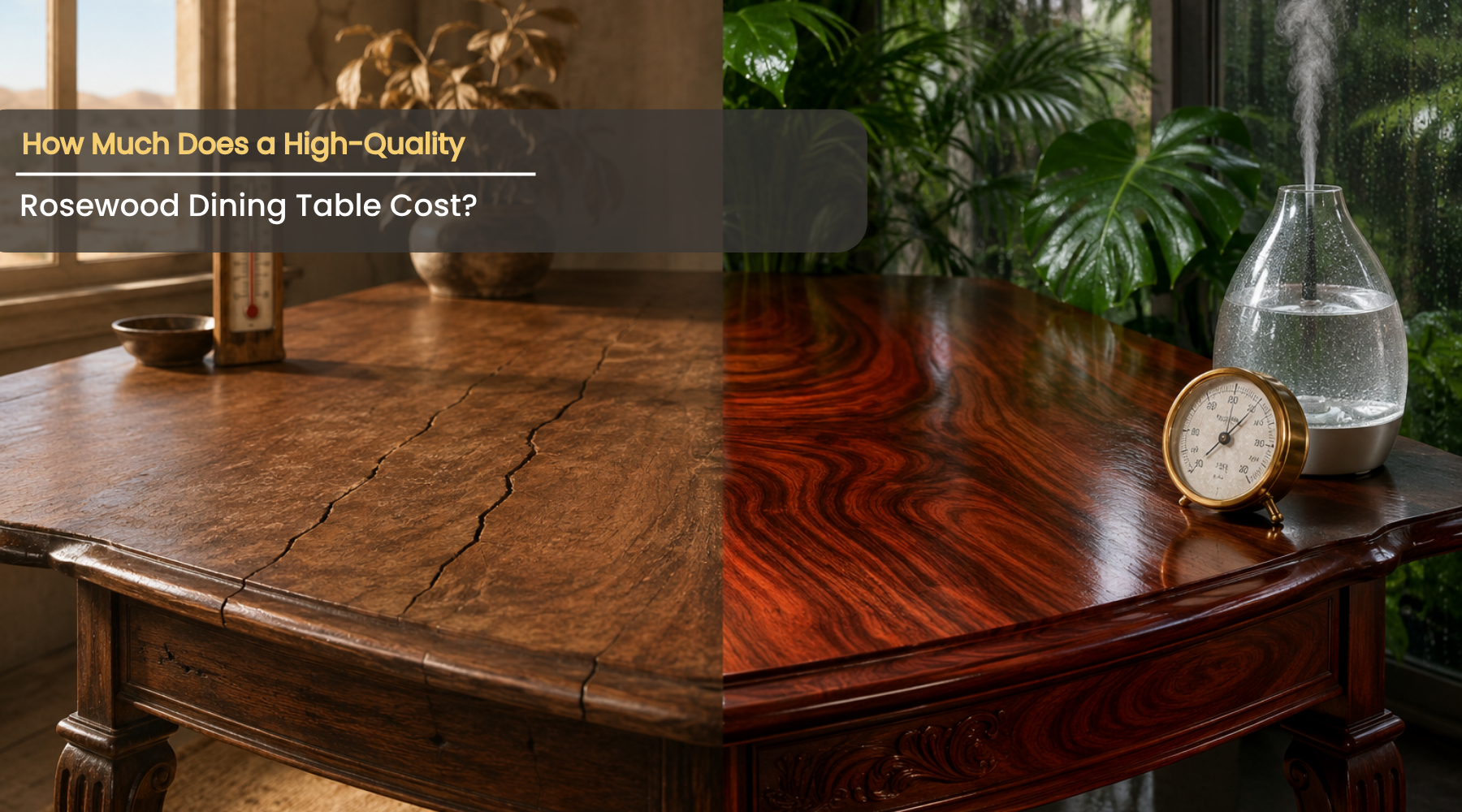
Light changes color first. Ultraviolet exposure pulls the purple-brown tones out of rosewood and pushes the surface toward flat brown, while the wood underneath the finish continues to oxidize and darken with age. A table sitting half in a window ends up two-tone within a few years, and the fade cannot be reversed without refinishing.
Humidity changes structure. Wood absorbs and releases moisture with the surrounding air, expanding across the grain as it does. Swings between a dry heated winter and a humid summer are what open joints and cup tops, and the size of the swing matters more than the average.
Neither factor is dramatic in a single month. Both compound over decades, which is exactly the timescale in question, and both respond to a maintenance routine that costs almost nothing.
The care routine that adds decades
Maintenance is unglamorous and effective. A rosewood piece kept to these habits will outlive one that is merely admired:
- Hold indoor humidity between 35 and 55 percent, using a humidifier in winter if the air runs dry.
- Keep pieces out of direct afternoon sun, or draw blinds during peak hours.
- Dust with a soft dry cloth, never a wet one, and wipe spills immediately.
- Use coasters and felt pads under anything hot, wet, or heavy.
- Refresh oiled finishes once or twice a year, applied thin and buffed off.
- Tighten hinges, runners, and fixings annually before movement wears the seats out.
- Lift furniture to move it rather than dragging, which is what loosens joints fastest.
Two products deserve a permanent ban: silicone-based sprays, which contaminate the surface and complicate future refinishing, and ammonia cleaners, which attack finishes directly.
Good habits delay wear rather than eliminating it. At some point every long-lived piece needs actual work done to it.
How many times can rosewood be refinished?
Refinishing depth depends on construction. Solid rosewood tolerates several full refinishes across its life, since each careful sanding removes only a fraction of a millimeter and there is a substantial thickness of usable timber beneath. Modern thin veneer realistically allows one light refinish, and often none if the previous owner was aggressive.
Finish type matters as much as depth. Shellac and French polish can be spot-repaired and blended by hand without stripping the whole surface, which is why antique pieces refinish so cleanly. Modern catalyzed lacquers and polyurethanes wear well but usually require complete removal, making each cycle more invasive.
Repairs follow the same logic. Loose joints can be knocked apart, cleaned, and reglued. Split panels can be closed and cleated. Lifted veneer can be re-laid. What all of that requires is a piece worth the labor, which brings the question back to what you buy in the first place.
What to check before buying for the long term
Buy on evidence, not on shine. Five questions expose the difference between furniture built for decades and furniture built for a season:
- Ask for the botanical name, since Dalbergia confirms a true rosewood rather than a lookalike.
- Ask whether the piece is solid or veneered, and what the core material is.
- Ask for the target moisture content the stock was dried to.
- Ask which joints were used at the stress points, particularly on chairs and tables.
- Ask what finish was applied, because it determines every future repair.
A supplier building for the long term answers all five without hesitation. Boston Mills works in solid rosewood, and putting the same five questions to any seller is the fastest way to find out what you are actually paying for.
How long does solid rosewood furniture last?
Solid rosewood furniture reliably lasts 50 to 100 years with normal indoor use, and survives far longer when joinery and humidity are managed. Museum examples exceed four hundred years, which sets the upper bound of what the timber itself can do.
Does rosewood furniture get woodworm?
Rarely in the heartwood. Powderpost beetles feed on the starch in sapwood, and rosewood heartwood carries extractives that make it unattractive to them. Pieces containing wide pale sapwood sections face more risk than pieces cut from clean heartwood.
Is rosewood more durable than teak?
Yes on hardness. Indian rosewood measures 2,440 lbf on the Janka scale against teak’s 1,070 lbf, so it resists denting far better. Teak still wins outdoors, where its oil content and dimensional stability handle rain and sun that rosewood is not built for.
Which rosewood species last the longest?
The densest ones. Dalbergia nigra, Dalbergia odorifera, and Dalbergia latifolia head the list, with sheesham (Dalbergia sissoo) somewhat behind on hardness while still outperforming most mainstream furniture timbers.
Can rosewood furniture be refinished?
Yes. Solid rosewood accepts several refinishes over its lifetime, while thin modern veneer allows roughly one. Shellac and oil finishes can be repaired in place, whereas polyurethane usually needs stripping first.
What is moisture content, and why does it matter?
Moisture content is the weight of water in the wood expressed as a percentage of its dry weight. Furniture stock should reach 8 to 12 percent before assembly, because wood dried above that keeps shrinking afterward and pulls joints apart.
Does rosewood crack over time?
Not on its own. Cracking traces back to rapid humidity swings or panels fixed rigidly into frames with no room to move. Stable indoor air and floating panel construction prevent nearly all of it.
Is solid rosewood or veneer better for longevity?
Solid lasts longer because it can be repaired and refinished repeatedly. Veneer offers stability on wide panels and lower cost, though thin modern slices and particleboard cores cut the repair ceiling sharply.
Does rosewood furniture need oiling?
Only if it was finished with oil. Oiled surfaces benefit from a thin coat once or twice a year, while lacquered and polyurethane surfaces need nothing more than dusting. Applying oil over a sealed finish achieves nothing useful.
What is a mortise and tenon joint?
It is a joint where a projecting tongue on one piece fits a matching cavity in another, locking mechanically rather than depending on glue alone. It is the standard for chair and table frames and a reliable indicator of furniture built to last.
Does sunlight ruin rosewood?
It fades it. Ultraviolet light pulls purple-brown tones toward flat brown, and the change is permanent short of refinishing. Rotating pieces and controlling afternoon light keeps the color even.
Is sheesham as long-lasting as Indian rosewood?
Close, though not equal. Sheesham is durable and termite-resistant but softer at 1,660 lbf, and it moves more with humidity. Careful drying and solid joinery close most of the practical gap for bedroom and occasional furniture.
Rosewood furniture lasts as long as its weakest component allows. The timber will give you a century without complaint, because density, natural oils, and dimensional stability are built into the Dalbergia genus rather than applied to it.
Everything else is a choice someone made. Stock dried to the right moisture content, mechanical joinery at the stress points, solid stock or thick veneer over a stable core, a repairable finish, and an owner who controls humidity and sunlight: those five decisions separate a piece that reaches its grandchildren from one that reaches a landfill. Ask about all five before you buy. Browse the solid rosewood range at bostonmills.net, and ask for the species, the construction, and the drying specification on any piece you shortlist.