
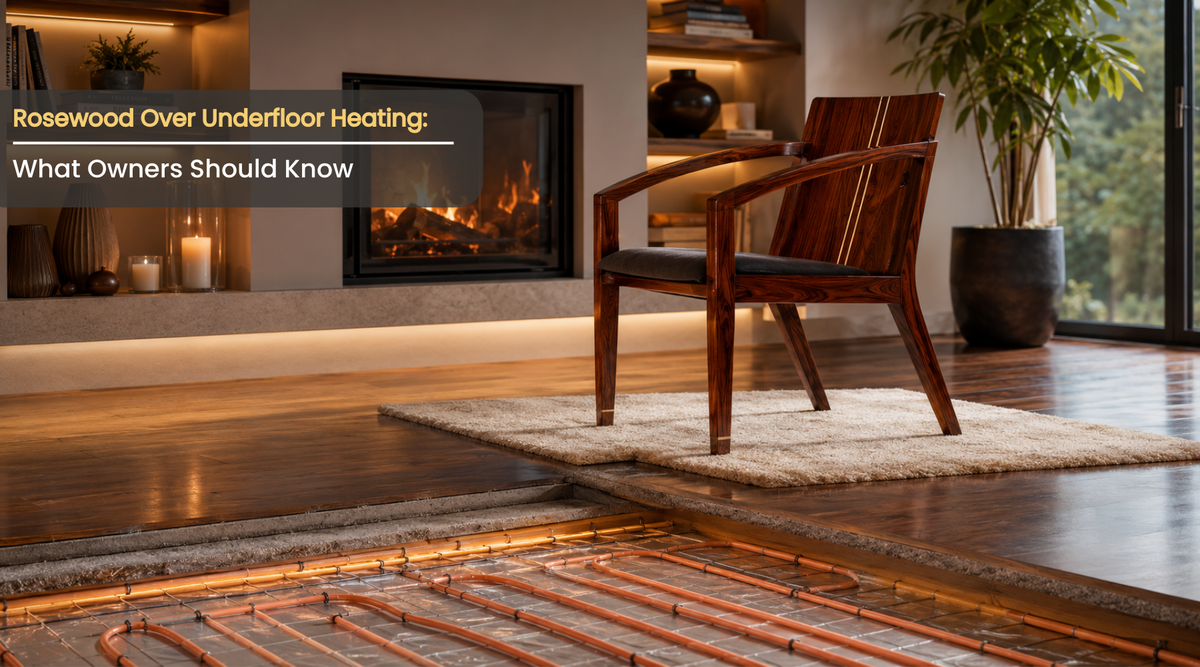
Rosewood Over Underfloor Heating: What Owners Should Know
Underfloor heating (radiant floor heating) warms a room by turning the entire floor plane into a low-temperature emitter, usually holding the finished surface somewhere between 75°F and 85°F. Solid rosewood standing on that surface sits in a warmer, drier microclimate than the air three feet above it, and the wood responds to the difference.
The response is not damage by default. Rosewood is dense, slow-moving, and stable once dried, and Boston Mills air-dries its stock for 16 to 20 months before construction, then builds with floating panels and joints that accommodate seasonal movement. What radiant heat changes is the margin. A piece that would sit comfortably on a cool oak floor now has one face permanently warmer than the other, and that gradient drives moisture out of the underside faster than out of the top.
The practical issues are specific and solvable. Air over a heated floor loses relative humidity as its temperature climbs. Solid plinth bases trap heat against the wood and block the air movement that would otherwise even things out. Rugs laid over radiant floors create hot spots. Systems switched on abruptly in October shock every piece of timber in the room.
This article covers how radiant heating alters room conditions, what warmth does to equilibrium moisture content in solid hardwood, why base design matters more than any other single factor, which pieces carry the highest risk, how to lay out a room with both, what humidity control actually requires, how to ramp a system at the start and end of a season, the warning signs worth acting on, and what to specify when ordering furniture for a heated floor.
How radiant heating changes the conditions in a room
Radiant systems heat objects and surfaces rather than air, which is why they feel comfortable at lower thermostat settings than forced air. Water circulating at roughly 95°F to 120°F through pipes in a slab or panel brings the floor to a steady low temperature and lets it radiate upward across the whole room.
Relative humidity falls as a consequence. Warming air without adding water vapor lowers relative humidity, and a room raised from 60°F to 70°F loses roughly a third of its relative humidity if no moisture is added. Radiant systems run long and steady rather than in bursts, so the drying effect is continuous through a heating season.
Stratification also changes. Forced air pushes warm air to the ceiling and leaves the floor cold, while radiant reverses the profile: floor level warmest, ceiling coolest. Furniture sits in the warm layer for the entire winter.
Slab systems add thermal mass, which is a benefit for comfort and a complication for control. A concrete slab takes hours to change temperature, so overshooting a setting corrects slowly. Panel and staple-up systems respond faster.
None of this harms wood on its own. What matters is how the wood exchanges moisture with the air around it.
What warmth does to moisture content in solid hardwood
Wood holds moisture in equilibrium with the air around it, a level called equilibrium moisture content. At 70°F and 50 percent relative humidity, hardwood settles near 9 percent moisture content. At 70°F and 30 percent it settles near 6 percent. At 20 percent it drops below 5 percent, and that is where trouble begins.
Shrinkage follows moisture loss. Wood moves most across the grain and hardly at all along it, so a wide panel losing three points of moisture content shrinks measurably in width while the frame around it stays the same length. Traditional cabinetmaking answers this by floating panels in grooves so they can move without splitting, the construction principle Boston Mills applies across Heritage Collection case goods.
Radiant heat introduces a second problem: the gradient. When the underside of a panel sits at 82°F and the top at 70°F, the two faces reach different equilibrium levels. The drier face shrinks more, and the panel cups toward it. On a tabletop with airflow underneath the difference is small. On a cabinet bottom pressed against a warm floor it is not.
Rosewood resists this better than most species. Its density, oil content, and low shrinkage coefficient slow moisture exchange in both directions, which is why the species has been used for fine furniture in extreme climates for centuries. Slower is not immune, though, and the way a piece meets the floor decides how much gradient it experiences.
Why base design matters more than anything else
Airflow under a piece is the single most important variable. Furniture that stands on legs or feet lets warm air circulate beneath it, which equalizes the temperature on both faces of any horizontal panel and keeps the gradient small.
Solid plinth bases do the opposite. A continuous base that meets the floor all the way around traps a pocket of still, heated air against the underside of the cabinet. That pocket runs hotter and drier than the room, and the cabinet bottom dries and shrinks against a top that has not.
The difference shows in practice. Case goods on tapered legs, sled bases, or open frames handle radiant floors without special measures. Low sideboards with a full plinth, upholstered platform beds with a solid deck, and built-in style units with toe kicks are the pieces owners have problems with.
Height helps in a straightforward way:
- Under 1 inch of clearance traps air and produces the strongest gradient.
- 2 to 4 inches of clearance allows convective movement and largely resolves it.
- Over 4 inches of clearance behaves the same as furniture on an unheated floor.
Boston Mills builds most seating and table designs on raised legs, and base geometry can be altered through the custom orders process. Raising a plinth onto discreet feet at the point of manufacture costs almost nothing and removes the issue permanently.
Some categories carry more exposure than others regardless of base design.
Which pieces face the highest risk
Large horizontal panels close to the floor face the most. A wide cabinet bottom, a bed platform, or a low console shelf presents a big surface area at the warmest point in the room, and the wider the panel the more absolute movement a given moisture change produces.
Ranked by exposure:
- Low storage cabinets and sideboards with plinth bases and wide bottom panels.
- Bed frames and platform decks that sit low and cover a large floor area.
- Bookcases where the lowest shelf runs close to the floor under heavy load.
- Dining and coffee tables on legs, which sit high enough that airflow protects them.
- Chairs and armchairs, which have minimal horizontal panel area at floor level.
Rugs change the ranking. A rug over a radiant floor insulates the section it covers, and heat that cannot escape upward builds under it. Flooring manufacturers generally cap total covering resistance around R-2.0 for this reason, and a thick wool rug with a dense pad can exceed that alone. Furniture standing on such a rug sits over the hottest zone in the room.
Beds deserve a specific note, because bedding compounds the effect. A solid wood bed with a mattress and duvet over a heated floor creates a deep insulated stack, and most owners run bedroom zones cooler anyway. Setting a bedroom zone two to three degrees below living areas removes the concern.
Once the pieces are identified, layout does most of the remaining work.
Setting up a room that has both
Plan clearance first, then position, then coverings.
- Raise anything with a plinth onto feet, glides, or a discreet frame that lifts the base clear of the floor.
- Position large case goods against interior walls rather than exterior ones, where the temperature swing is smaller.
- Keep a gap of at least two inches between the back of a cabinet and the wall so air can move up behind it.
- Choose low-resistance rugs with thin, dense pads rather than thick wool over foam.
- Avoid covering more than about two thirds of the heated floor area with rugs and furniture combined.
- Use felt glides under legs, which protect the floor finish and lift the contact point slightly.
Heat sources beyond the floor need separating too. A rosewood console between a radiant floor and a nearby radiator or a wood stove faces heat from two directions, and that combination dries a piece faster than either alone.
Direct sunlight adds a third factor, since a south-facing window over a heated floor produces the driest, hottest zone in a house. The Boston Mills guidance on protecting rosewood in dry and humid homes covers placement relative to windows in more detail.
Layout reduces the gradient. Humidity control removes the underlying cause.
Humidity control that actually works
Target 40 to 55 percent relative humidity year round. That range keeps solid hardwood near 8 to 10 percent moisture content, which is where furniture built from air-dried stock is dimensionally happiest.
Measure before you correct. A digital hygrometer placed at furniture height, away from the floor and away from any vent, gives the number that matters. Floor-level readings run warmer and drier and will mislead you. Two hygrometers in different rooms are better than one, since zones on a radiant system can differ by ten percentage points.
Add moisture where the reading falls short. A whole-house humidifier tied into the ventilation system holds a set point automatically and is the cleanest answer in a home with radiant heat throughout. Portable evaporative units work room by room and need refilling daily during cold snaps. Either way, size the unit to the room volume rather than buying the smallest available.
Do not overcorrect. Pushing a house above 60 percent in winter causes condensation on cold window glass and mold in wall cavities, problems considerably worse than a shrunk panel. The Boston Mills care and maintenance guidance sets the same practical ceiling.
Humidity handles the steady state. Season changes need their own routine.
Ramping the system at the start and end of a season
Sudden temperature changes cause more furniture damage than sustained warmth. Switching a cold slab to full output in one step drops room humidity sharply over a few days, and the fastest-drying components move before the slowest ones catch up.
Ramp instead. Raise the target by about 2°F per day over the first week of the heating season and lower it the same way in spring. Slab systems need the gentler approach because their thermal mass magnifies each step.
Run the humidifier from the first day of the ramp, not after the air already feels dry. Moisture added at the same rate the heat arrives keeps relative humidity flat while temperature climbs, which is the entire objective.
Holiday absences deserve one instruction: leave the system at a reduced set point rather than switching it off. A house that swings from 70°F to 45°F and back over two weeks puts every joint in it through a full cycle. Reduced and steady beats off and restored.
Watch the furniture through the first heated season, because early signs are readable.
Warning signs and what they mean
Check pieces at the end of the first winter and again in spring.
- Hairline gaps at panel edges show a panel has shrunk in its groove. Normal seasonal movement, no action needed.
- Drawers running looser in winter than in summer indicate the case has dried slightly. Normal.
- A cabinet bottom that rocks on a flat floor suggests cupping from an underside gradient. Raise the base and check humidity.
- A crack following the grain on a wide panel means the wood dried faster than the joint allowed. Have it assessed.
- Finish crazing in fine lines across a surface indicates rapid drying under the film. Stabilize humidity before any repair.
- A joint that has opened and stayed open after humidity returns to range needs a restorer.
Distinguishing normal movement from damage takes one season of observation. Minor gaps that appear in February and close in June are the wood doing exactly what solid timber does. Gaps that persist through a humid summer are not.
Record what you see with photographs, dated. That record supports any claim under the Boston Mills warranty policy and helps a restorer understand whether a problem is progressing or stable.
Can rosewood furniture sit on an underfloor heating system?
Yes. Rosewood’s density and low shrinkage coefficient make it more stable over radiant heat than most furniture woods. Keep relative humidity between 40 and 55 percent, allow airflow under the piece, and ramp the system gradually at the start of each heating season.
What surface temperature is safe for a floor under solid wood furniture?
Keep the finished floor at or below 85°F. Most flooring manufacturers cap wood floor surface temperature near that figure, and furniture standing on the floor experiences the same reading. Higher temperatures accelerate drying on the underside of any panel close to the floor.
Does furniture with a plinth base cause problems on a heated floor?
Yes, more than any other design factor. A continuous plinth traps hot, dry air against the cabinet bottom, so the underside dries faster than the top and the panel can cup. Raising the piece 2 to 4 inches on feet resolves it.
Which is worse for rosewood: underfloor heating or forced air?
Forced air is generally harder on solid wood. It cycles in bursts, blows dry air directly at furniture placed near vents, and produces sharper humidity swings. Radiant heat is steadier, though it dries the air continuously and warms the floor plane where low furniture sits.
Can I put a rug between a heated floor and rosewood furniture?
Yes, with a low-resistance rug and a thin dense pad. Thick wool over foam can exceed the insulation limit most systems allow, which makes the floor beneath run hotter. Keep the total covering resistance modest and avoid covering more than roughly two thirds of the heated area.
How much should I raise a radiant system at the start of winter?
About 2°F per day across the first week. Gradual ramping lets humidity control keep pace with rising temperature, which prevents the sharp relative humidity drop that moves timber. Reverse the same way in spring.
Where should I place a hygrometer in a room with radiant heat?
At furniture height, roughly 30 to 40 inches from the floor, away from vents, windows, and exterior walls. Floor-level readings run warmer and drier than the air the furniture actually sits in, and they will send you to the wrong conclusion.
Are gaps appearing in my rosewood cabinet in winter a defect?
Usually not. Hairline gaps at floating panel edges appear when a panel shrinks in its groove during the dry season and close again as humidity rises. Persistent gaps that remain through a humid summer, or cracks running along the grain, need assessment.
Do I need a humidifier if my home has underfloor heating?
In most heating climates, yes. Raising air temperature without adding moisture lowers relative humidity, and radiant systems run continuously through the season. A whole-house unit holding 40 to 55 percent is the simplest solution for a home heated this way throughout.
Should I turn off underfloor heating when I go away in winter?
No. Reduce the set point rather than switching off. A full off-and-on cycle swings the house through a large temperature and humidity range twice, which stresses joints more than steady low heat does. Leave the humidifier running as well.
Managing the gradient, not avoiding the heat
Radiant floor heating puts furniture in the warmest layer of the room and steadily lowers relative humidity through the season. Solid hardwood responds by giving up moisture, and a panel with one warm face and one cool face gives it up unevenly, which is where cupping and shrinkage originate.
Base design carries most of the answer. Two to four inches of clearance under a piece lets air circulate and flattens the gradient, while a continuous plinth traps heat against a wide panel. Position case goods on interior walls, leave a gap behind them, and keep rug insulation modest so the floor beneath does not overheat.
Hold 40 to 55 percent relative humidity with a correctly sized humidifier, measure at furniture height rather than floor level, ramp the system about 2°F per day at each end of the season, and read winter panel gaps as movement rather than failure. Rosewood dried for 16 to 20 months and built with floating panels is designed for exactly this kind of cycle. To discuss base heights, feet, or clearance on a specific piece, call (214) 666-6647 or use the Boston Mills contact page.

%20warms%20a%20room%20by%20turning%20the%20entire%20floor%20plane%20into%20a%20low-temperature%20emitter,%20usually%20holding%20the%20finished%20surface%20somewhere%20between%2075%C2%B0F%20and%2085%C2%B0F.%20Solid...)