Article: Moving Rosewood Furniture Without Damage: An Owner’s Guide
Moving Rosewood Furniture Without Damage: An Owner’s Guide
Solid rosewood weighs roughly 50 to 55 pounds per cubic foot at furniture moisture content, which is dense enough that the wood sinks in water. A rosewood console table is a two-person lift. A loaded sideboard is a four-person lift with a dolly. That weight is the first fact any move has to plan around, and it is the reason most damage happens during handling rather than in transit.
The second fact is the finish. Hand-rubbed French polish is a thin shellac film, and shellac softens with heat and dissolves in alcohol. Stretch wrap pressed against it in a hot truck can imprint. Packing tape stuck to it lifts a patch of polish when pulled. A blanket weave can print into a softened surface after four hours at 120°F in the back of a box truck.
The third is climate. Wood dried and stabilized in a conditioned home spends a move in an unconditioned truck, then arrives in a house with different humidity. Boston Mills air-dries stock for 16 to 20 months and builds with floating panels precisely so pieces tolerate that swing, but the transition still deserves a few days of adjustment rather than none.
This guide covers what makes rosewood different to move, how to plan a route before touching anything, what to remove and what to leave assembled, which wrapping materials protect and which cause damage, correct lifting technique, loading and strapping in a vehicle, long-distance and storage conditions, what to do on arrival, and when hiring specialist handling is the cheaper decision.
What makes rosewood different from ordinary furniture to move
Weight changes the physics. A flat-pack cabinet can be tipped, walked, and shoved without consequence because it is light and forgiving. A solid rosewood cabinet carries enough mass that a single corner impact concentrates real force into one joint.
Rigid joinery has no give. Hand-cut mortise and tenon joints, dovetails, and pegged frames are strong in the directions they were designed for and vulnerable to racking, which is the twisting force applied when a case is lifted from one corner or pushed diagonally. Screwed and dowelled factory carcasses flex and absorb some of this. Traditional joinery does not flex; it either holds or splits.
Brass inlay sits flush in routed channels and stands slightly proud of nothing. It is not fragile in use, but a strap tightened across it transfers pressure into a hard line, and a dropped edge can lift the inlay at a corner. The brass detail work is inset rather than glued on top for durability, and it still deserves a blanket between it and any strap.
Leather elements add a fourth consideration. Leather scuffs against rough surfaces, absorbs moisture, and marks permanently if something oily sits against it. Cushions and seat pads travel separately.
Understanding all four means the plan starts before anything gets lifted.
Plan the route before you touch anything
Measure the piece and the openings. Record height, width, depth, and the diagonal depth, which is the measurement corner to opposite corner through the case. Diagonal depth decides whether a cabinet turns on a stair landing.
Then measure the route: doorway widths, ceiling heights at stair turns, elevator car depth and door width, and the width of any hallway with a right-angle turn. Two inches of clearance is comfortable. Half an inch is not.
Photograph the piece from every side, including the underside and the interior of drawers, before anything is wrapped. Date the photographs. They settle any dispute about pre-existing marks and support a claim if a mover damages something.
Clear and protect the path:
- Remove doors from hinges where a doorway is tight rather than forcing a piece through.
- Lay floor runners or hardboard on any surface a dolly will cross.
- Pad stair handrails and door frames at the height a corner will pass.
- Confirm the destination position before the piece enters the room, so it is set down once.
Assign roles as well. One person calls the lift, watches the corners, and controls the pace. Everyone else lifts and listens. Most moving damage happens when two people move a heavy object in different directions at the same time.
With the route settled, the piece gets prepared.
What to remove and what to leave assembled
Remove weight and remove anything that can shift. A cabinet with its drawers out is dramatically lighter and cannot rack from internal movement.
Take out and pack separately:
- All drawers, wrapped individually and labeled with their position.
- Glass shelves and glass tops, which travel on edge, never flat.
- Loose shelves, which slide and gouge interiors in transit.
- Leather cushions and seat pads, wrapped in cotton sheeting rather than plastic.
- Removable hardware such as knobs that protrude beyond the case line.
Leave assembled unless the maker’s instructions say otherwise. Traditional joinery is not designed for repeated disassembly, and taking apart a hand-cut frame usually weakens it. Beds are the exception, since almost all bed frames are engineered to break down, and the solid wood beds built for this reason use bolted rails.
Doors on case goods need securing without tape. Wrap the piece in a blanket first, then run a soft cotton band or a stretch wrap layer over the blanket to hold doors shut. Never let adhesive contact wood.
Hardware goes in a labeled bag taped to the inside of a drawer, not to the furniture surface. Which brings up the materials question, where most avoidable damage originates.
Wrapping materials that protect and materials that damage
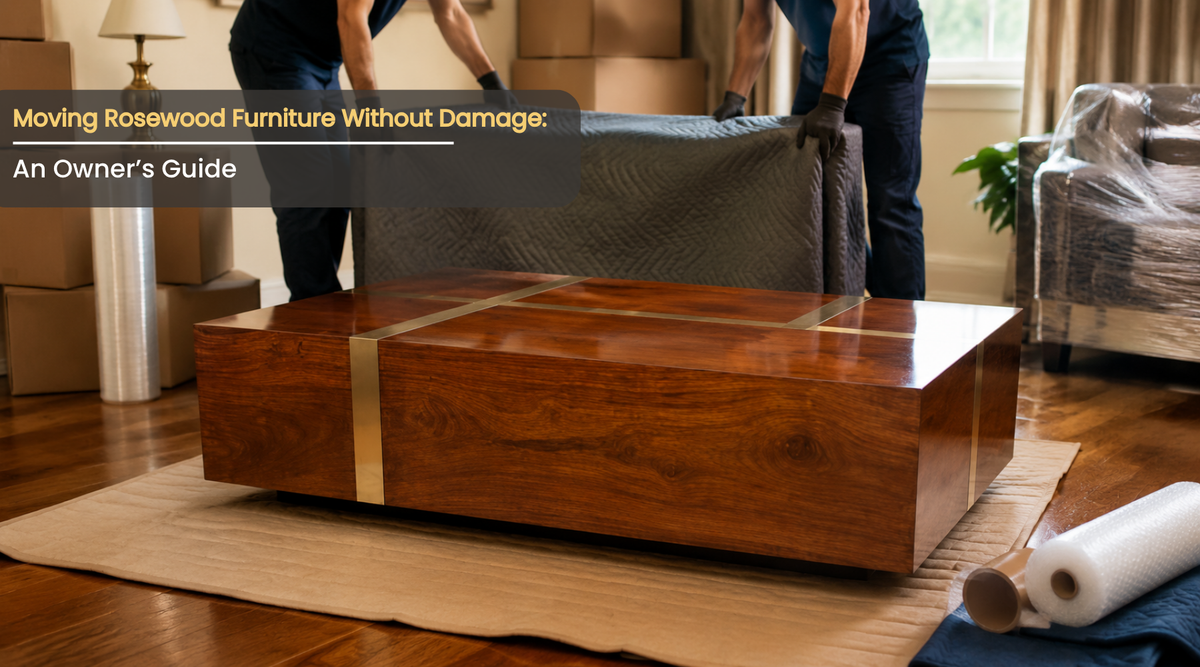
Moving blankets are the correct first layer. Thick, unbleached, quilted blankets cushion impact, spread strap pressure, and let the wood breathe. Every finished surface gets blanket contact before anything else touches it.
Plastic stretch wrap goes over the blanket, never against the finish. Film pressed directly onto shellac traps moisture, can bloom the polish white across a whole panel, and in heat the plasticizers can bond to the surface. Owners discover this after a summer storage period, and the repair is a full refinish of the affected face.
Corrugated cardboard corner protectors take the impact at the points that actually get hit. Cut them to the edge length and secure them to the blanket, not the wood.
Materials to keep away from the finish entirely:
- Packing tape and duct tape, which lift shellac when removed.
- Painter’s tape, which is gentler but still removes polish from an aged surface.
- Bubble wrap in direct contact, which prints a circular pattern into a warm finish.
- Newspaper and printed paper, which transfer ink into an oily surface.
- Furniture pads with rubber backing, which can react with shellac over days.
Acid-free tissue or clean cotton sheeting is the right choice against leather and any highly polished show face. Boston Mills applies the same principle in white glove delivery, which is included free on orders above $3,500.
Wrapped correctly, the piece is ready to lift. Technique matters more than strength here.
Lifting and carrying without racking a joint
Lift from the structural frame, never from a projecting part. The load path should run through the base rail, the plinth, or the underside of the carcass, since those members were built to carry the piece.
Never lift a table by its top. The top is attached to the base with buttons or slotted screws that allow seasonal movement, and those fixings are not designed to carry the full weight of the base hanging beneath them. Lift a table by the legs or the apron at the leg junction.
Never lift a chair by the arms or the back. Both are joined for downward and rearward load, not for lifting the entire seat and legs. Take a chair under the seat rails with a hand on each side.
Never drag anything. Dragging loads a leg sideways at the joint and grinds grit into the floor and the foot. Lift clear, set down clear.
Two more rules that prevent most injuries and most damage: keep the piece level rather than tilting it to fit, and use a four-wheel furniture dolly with rubber wheels for anything over about 120 pounds. Straps on the dolly hold the piece to the platform, with blanket between strap and wood.
Once at the vehicle, loading order and restraint decide what arrives intact.
Loading, strapping, and climate in the vehicle
Load heavy case goods first, against the front wall of the load space, standing upright. Rosewood cabinets never travel on their backs or faces, because the weight then bears on panels and joints that were designed to hang vertically.
Strap to the vehicle’s tie rails, not to other furniture. Every strap crosses a blanket and a corner protector, and tension is firm rather than crushing. Ratchet straps pulled hard against a case rail can bow a panel over a long drive.
Tables travel on their tops only when the top is protected and the surface below is padded, and never with anything stacked on the legs. Better practice is upright with the top vertical, blanket-wrapped, wedged between two padded case pieces.
Climate is the part most people skip. An unconditioned box truck parked in summer sun can exceed 120°F inside, and shellac softens well before that becomes obvious. Heat plus strap pressure plus a blanket weave produces surface imprint. Park in shade during loading breaks, drive with vents open where possible, and avoid leaving a loaded truck sealed overnight in strong sun.
Winter brings the opposite risk. A piece taken from a 70°F house into a 20°F truck and back into a warm house passes through condensation twice. Wrapped in blanket rather than plastic, it handles this. Wrapped in film, moisture condenses against the finish.
Longer moves and storage raise the stakes further.
Long-distance moves and storage conditions
Rosewood tolerates a few days in a truck. It does not tolerate months in an unconditioned storage unit, where summer heat and winter damp cycle without limit.
Storage requirements are specific
- Choose climate-controlled units holding roughly 40 to 55 percent relative humidity.
- Raise pieces off the floor on pallets or blocks, since concrete slabs wick moisture upward.
- Cover with cotton sheeting or blankets, never sheet plastic, which traps humidity.
- Leave air gaps between pieces rather than packing them face to face.
- Store drawers inside their cases once in position, to keep the carcass square.
Interstate movers in the US default to Released Value Protection, which pays 60 cents per pound per article unless you buy more. On that basis a 200 pound rosewood credenza worth $6,000 would be settled at $120. Full Value Protection costs more and is the only sensible option for hardwood furniture, and a separate scheduled policy is better still. The related considerations are set out in more depth in the Boston Mills guidance on insuring and appraising fine furniture.
Declare values in writing before the truck loads, and photograph everything. Arrival then becomes a checklist rather than an argument.
Unwrapping, acclimatizing, and inspecting on arrival
Bring the piece inside and leave it wrapped for two to three hours if the outside and inside temperatures differ sharply. That prevents condensation forming on a cold surface in a warm room.
Then unwrap fully and let it stand for 48 to 72 hours before loading drawers or placing objects on it. The wood is adjusting to the new home’s humidity, and a case that has traveled slightly out of square will settle. Set the thermostat and any humidifier to the normal running condition during this period rather than after it.
Inspect in daylight, methodically:
- Check every joint for a visible gap or movement at the shoulder.
- Sight along the top to see whether it reads flat.
- Open and close each drawer to confirm it runs without binding.
- Check the brass inlay for a lifted edge at any corner.
- Look at the finish under raking light for blanket imprint or a dull patch.
- Compare against your pre-move photographs.
Report anything found within the claim window your mover sets, usually nine months for interstate moves but often far shorter in the contract. For manufacturing questions rather than transit damage, the Boston Mills warranty policy sets out what is covered.
Finally, replace felt glides under all feet before the piece takes its final position, and reset humidity toward the 40 to 55 percent range described in the care and maintenance guidance.
When to hire specialist handling instead
Hire specialists when any of these apply: the piece weighs more than roughly 150 pounds, the route includes stairs with a turn, the destination is above the second floor without a service elevator, the item has glass or stone elements, or the piece is irreplaceable.
Specialist handlers bring shoulder straps, stair-climbing dollies, hoisting equipment, and correct wrapping stock. More importantly they carry cargo insurance that covers actual value rather than weight. The cost of a two-person specialist crew for a day is normally a fraction of one refinishing bill on a large case piece.
Boston Mills includes white glove delivery and assembly free on orders over $3,500, which covers the first move of a new piece. For later relocations, ask any prospective mover three questions: do they blanket-wrap before film, do they offer full value protection, and do they carry a stair dolly. A vague answer to any of them is a reason to keep calling.
For pieces bought from the Heritage Collection or the Contempo Collection, the workshop can also advise on the correct lift points for a specific design before you book anyone.
How heavy is solid rosewood furniture?
Solid rosewood runs roughly 50 to 55 pounds per cubic foot, which puts a medium console table around 100 to 140 pounds and a large sideboard well past 250. Plan two people for anything larger than a side table and four with a dolly for loaded case goods.
Can I wrap rosewood furniture in plastic stretch wrap?
Not against the finish. Film in direct contact traps moisture, can bloom shellac white, and in heat the plasticizers can bond to the surface. Wrap in a quilted moving blanket first, then apply stretch film over the blanket to hold everything in place.
Should I remove drawers before moving a cabinet?
Yes. Removing drawers cuts the weight substantially and stops internal shifting that can rack the carcass. Wrap each drawer separately, label its position, and reinstall them only after the piece is standing in its final location.
Is it safe to lay a rosewood table on its top for transport?
Only with heavy padding and nothing stacked on the legs. The safer method is upright with the top vertical, blanket-wrapped, and wedged between two padded case pieces. Never lift a table by its top, since the fixings allow seasonal movement rather than carry weight.
How long should rosewood furniture acclimatize after a move?
48 to 72 hours unwrapped in the destination room before loading drawers or placing objects on it. Run the heating, cooling, and humidification at normal settings during that period so the wood adjusts to the conditions it will actually live in.
What temperature is dangerous for rosewood in a moving truck?
Sustained interior temperatures above roughly 120°F start to soften shellac enough that strap pressure and blanket weave can imprint the surface. Park in shade during breaks, keep the load space ventilated, and avoid leaving a sealed truck in direct summer sun overnight.
Does homeowner’s insurance cover furniture damaged in a move?
Usually not during transit by a hired mover, when the mover’s liability applies instead. Interstate movers default to Released Value Protection at 60 cents per pound per article, so a 200 pound piece would pay $120. Buy Full Value Protection or schedule the item separately.
Can rosewood furniture go into ordinary self-storage?
Not safely for more than a few weeks. Uncontrolled units cycle through summer heat and winter damp, which drives joints and panels through a full movement range repeatedly. Use a climate-controlled unit holding 40 to 55 percent relative humidity, with pieces raised off the slab.
What tape is safe to use on a French polished surface?
None. Packing tape, duct tape, and painter’s tape all lift shellac when removed, and painter’s tape is only marginally gentler. Secure doors and wrapping over a blanket layer using soft cotton bands or stretch film that never contacts the wood.
Should I disassemble rosewood furniture before moving it?
Only beds and anything the maker designed to break down. Traditional hand-cut joinery is not built for repeated disassembly, and taking a frame apart usually weakens the joints. Remove drawers, shelves, glass, and cushions instead, and move the carcass intact.
Weight, finish, and climate
Moving rosewood safely comes down to the same three properties that make it worth owning. The density that resists dents also makes every lift a planned one, so measure the piece and the route, remove drawers and glass, and carry from the structural frame rather than a tabletop or a chair arm.
The shellac film that gives the surface its depth is the part that marks in transit, so blanket first and film only over blanket, keep adhesive off the wood entirely, and keep the load space out of sustained heat. Straps cross padding, corners get protectors, and case goods travel upright against the front wall.
The moisture balance built in during 16 to 20 months of air drying holds through a move if storage stays climate-controlled between 40 and 55 percent and the piece gets 48 to 72 hours to settle on arrival. Photograph before and inspect after, buy full value protection rather than the weight-based default, and hire specialist handling when stairs, weight, or glass raise the stakes. For lift points on a specific design, call (214) 666-6647 or use the Boston Mills contact page.