Executive Desks That Command Respect: Choosing Solid Wood for Professional Success
An executive desk commands attention the moment visitors enter your office, communicating professional stature before any conversation begins. Solid wood executive desks project authority, permanence, and success through material quality and craftsmanship visible at first glance. The desk anchoring your workspace shapes perceptions that influence business relationships throughout your career.
Choosing the right executive desk balances aesthetic impact with functional requirements for productive work. Size, configuration, storage features, and ergonomic considerations determine daily usability across years of service. Premium solid wood construction ensures your investment delivers both immediate presence and lasting value through decades of professional use.
This guide examines executive desk selection comprehensively, from size determination through wood species selection, style options, and quality evaluation. Understanding these factors enables confident selection of desks that enhance professional image while supporting productive work habits. Your executive desk represents one of the most significant furniture investments in your professional environment.
The Psychology of Executive Desk Design
Executive desks communicate messages about their owners through design language developed over centuries of business culture. Size, material, and style choices signal status, taste, and professional orientation to everyone entering your workspace. Understanding these psychological dimensions helps select desks projecting intended impressions.
Authority and Presence
Substantial executive desks create psychological distance establishing authority in business interactions. The desk barrier between executive and visitor creates formal space appropriate for negotiations, evaluations, and important discussions. Larger desks amplify this effect while smaller desks reduce formality.
Material quality registers subconsciously with visitors assessing your professional standing. Solid wood surfaces, traditional construction details, and quality finishes communicate investment in workspace reflecting broader success indicators. Mass-produced alternatives fail to create equivalent impressions regardless of styling.
Desk positioning within offices affects authority projection significantly. Desks facing doorways allow executives to see visitors approaching while maintaining dominant spatial orientation. Corner placement or window backgrounds create power positions reinforcing desk presence.
Professional Image Alignment
Executive desk style should align with professional identity and industry expectations. Traditional desks with carved details and rich finishes suit established professions like law, finance, and executive leadership. Contemporary designs with clean lines project innovation appropriate for technology and creative industries.
Wood species and finish choices reinforce professional image through cultural associations. Dark rosewood and mahogany suggest traditional authority and established success. Lighter walnut and oak communicate approachability while maintaining quality presence. These associations operate below conscious awareness but influence visitor perceptions.
Executive Desk Configurations
Executive desks come in several configurations suited to different work styles, space constraints, and functional requirements. Each configuration offers distinct advantages affecting daily productivity and workspace aesthetics. Understanding options helps identify configurations matching your specific needs.
Single Pedestal Desks
Single pedestal executive desks feature one storage cabinet supporting the desktop, typically positioned on the right side for right-handed users. This configuration provides drawer storage while maintaining open knee space on one side. Single pedestal designs suit smaller offices where full double pedestal desks would overwhelm available space.
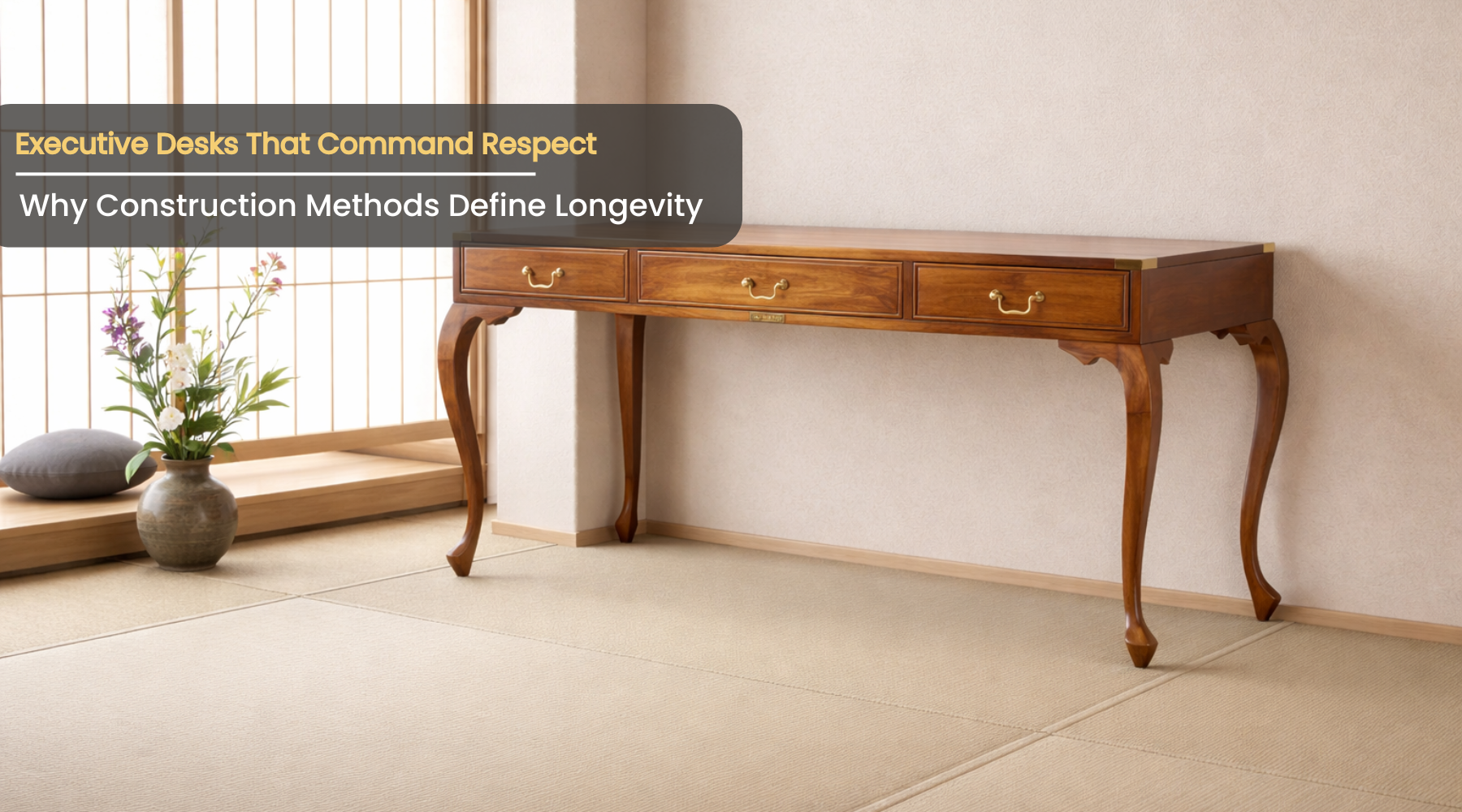
Writing desks represent the most minimal single pedestal variation, emphasizing workspace over storage. These compact designs suit executives with minimal paper filing needs who prefer clean surfaces. Writing desks work well as secondary desks in office suites or home offices where primary storage exists elsewhere.
Double Pedestal Desks
Double pedestal executive desks feature storage cabinets on both sides, creating substantial presence with maximum storage capacity. This classic configuration dominates traditional executive offices through visual weight and functional capability. Double pedestals establish authority through sheer scale impossible with smaller designs.
Pedestal configurations vary between drawer stacks, file drawers, and cabinet doors depending on storage needs. Box drawers accommodate supplies while file drawers hold hanging folders. Cabinet doors conceal shelved storage or technology equipment. Specifying pedestal contents ensures storage matches actual work requirements.
Modesty panels between pedestals conceal legs and under-desk equipment from visitor view. Full modesty panels create formal barriers while partial panels maintain formality with improved ventilation for computer equipment. Panel design affects both aesthetics and practical equipment cooling.
L-Shaped and U-Shaped Configurations
L-shaped executive desks add perpendicular return surfaces extending work area significantly. This configuration creates distinct zones for computer work, writing, and meetings without requiring separate furniture. L-shaped designs maximize productivity in corner office locations where two walls support extended surfaces.
U-shaped configurations surround executives with work surfaces on three sides, providing maximum space for spreading documents and managing multiple projects simultaneously. This commanding arrangement suits executives managing complex operations requiring extensive reference materials within arm's reach.
Return surface heights may match primary desk or position slightly lower for typing ergonomics. Matching heights create continuous surfaces suited to spreading large documents. Lower returns improve keyboard and mouse positioning for extended computer use.
Partner Desks
Partner desks provide identical work surfaces on opposite sides, enabling two people to work facing each other across shared furniture. This traditional configuration originated in banking and legal partnerships where colleagues collaborated closely. Modern interpretations suit shared home offices and collaborative business environments.
Central drawer sections accessible from both sides provide shared storage in partner configurations. This arrangement requires thoughtful organization to prevent confusion about contents. Some partner desks assign specific drawers to each user while others maintain truly communal storage.
Executive Desk Configuration Comparison
|
Configuration |
Typical Size |
Storage |
Best For |
Space Required |
|
Writing Desk |
48-60" wide |
Minimal |
Clean aesthetic |
Small offices |
|
Single Pedestal |
60-66" wide |
Moderate |
Compact offices |
Medium offices |
|
Double Pedestal |
66-78" wide |
Extensive |
Traditional authority |
Large offices |
|
L-Shaped |
66"+ primary |
Variable |
Multi-tasking |
Corner spaces |
|
Partner |
60-72" wide |
Shared |
Collaboration |
Large offices |
Sizing Your Executive Desk
Executive desk dimensions must balance authoritative presence with practical space constraints and ergonomic requirements. Oversized desks in modest offices appear pretentious while undersized desks fail to project intended professional image. Proper sizing creates appropriate scale relationships within your specific workspace.
Width and Depth Standards
Standard executive desk widths range from 60 to 78 inches depending on configuration and intended presence. Compact executive desks of 60 to 66 inches suit smaller private offices and home office applications. Full-size executive desks of 72 to 78 inches create commanding presence in spacious corner offices.
Desk depth affects both usability and room proportion. Standard depths of 30 to 36 inches provide adequate work surface while fitting typical office dimensions. Deeper desks of 36 to 42 inches accommodate L-shaped returns or extensive monitor setups but require correspondingly larger rooms.
Clearance requirements constrain maximum desk size within given rooms. Allow minimum 36 inches behind desks for chair movement and 42 to 48 inches for comfortable visitor circulation around desk sides. Measure available space carefully before committing to specific dimensions.
Height and Ergonomics
Standard desk height of 29 to 30 inches positions surfaces appropriately for most adults using standard office chairs. This height enables proper typing posture with elbows at approximately 90 degrees when hands rest on keyboard surfaces. Taller or shorter executives may benefit from adjusted heights.
Keyboard tray options lower typing surfaces to ergonomically correct heights while maintaining higher primary desk surfaces. This separation improves posture for extended computer use while preserving traditional desk proportions for aesthetic purposes. Quality keyboard mechanisms operate smoothly and lock firmly in position.
Standing desk conversions or adjustable-height executive desks accommodate emerging preferences for alternating sitting and standing throughout workdays. Electric lift mechanisms enable height adjustment while maintaining executive aesthetics. These modern features integrate with traditional styling in quality implementations.
Wood Species for Executive Desks
Wood species selection fundamentally shapes executive desk character through color, grain pattern, and cultural associations. Different species project distinct professional images while offering varying practical characteristics. Understanding wood options helps select desks aligned with intended professional identity.
Traditional Executive Woods
Rosewood represents the pinnacle of executive desk materials through exceptional beauty and prestigious associations. The distinctive grain patterns ranging from purple to golden brown create surfaces commanding attention. Rosewood desks signal achievement and refined taste through material that has furnished executive offices for centuries.
Mahogany provides classic executive presence through rich reddish-brown coloration and elegant straight grain. Traditional associations with banking, law, and government make mahogany appropriate for established professions. The wood works beautifully, accepting carved details and high-gloss finishes that define traditional executive furniture.
Cherry offers warmth with slightly less formality than mahogany while maintaining executive appropriateness. American black cherry develops distinctive patina as natural oxidation deepens color over years of use. This aging characteristic means cherry desks grow more beautiful through decades of service.
Contemporary Executive Woods
Walnut delivers contemporary executive presence through warm brown tones without traditional formality. American black walnut suits modern professional environments where approachability matters alongside authority. The moderate hardness allows intricate contemporary designs while maintaining structural integrity.
Oak projects strength and reliability through prominent grain patterns and exceptional durability. White oak particularly suits executive applications through closed grain that resists moisture and accepts finishes beautifully. Oak desks suggest solid, dependable leadership appropriate for many business contexts.
Maple provides the lightest aesthetic among premium hardwoods, creating bright, open office environments. Hard maple's exceptional density creates extremely durable work surfaces. Contemporary and Scandinavian-influenced offices often feature maple executive furniture for clean, modern character.
Construction Quality Indicators
Executive desk quality reveals itself through construction details distinguishing furniture built for generational service from pieces designed for limited lifespans. Examining specific elements helps identify desks worthy of executive investment. These indicators matter more than surface appearance alone.
Solid Wood vs Veneer Construction
Solid wood construction throughout indicates premium quality commitment. Examine desk tops, sides, pedestals, and structural components for consistent solid lumber rather than veneer over particleboard or MDF. Solid construction enables unlimited refinishing and repairs extending service life indefinitely.
Quality veneer over stable substrates represents acceptable construction for desk tops specifically, where large flat surfaces benefit from engineered panel stability. However, structural components should use solid wood for proper joinery and long-term durability. Evaluate veneer thickness and substrate quality when veneer construction applies.
Examine hidden areas including drawer interiors, back panels, and undersides where manufacturers reveal true construction priorities. Solid wood throughout hidden areas indicates quality commitment. Particleboard or MDF in hidden locations suggests cost-cutting that may extend to structural components.
Joinery and Hardware
Traditional joinery methods including mortise and tenon, dovetail, and dowel joints provide superior strength compared to modern fastener-dependent assembly. These techniques require skilled craftsmanship and adequate solid wood for proper execution. Desks using traditional joinery withstand decades of daily use without loosening.
Drawer construction quality indicates overall craftsmanship investment. Dovetailed drawer boxes, solid wood sides, and captured bottoms floating in grooves characterize quality construction. Metal drawer slides should operate smoothly through full extension with soft-close mechanisms on premium desks.
Hardware quality affects both function and aesthetics over extended use. Solid brass or quality steel pulls and locks maintain operation and appearance through years of daily contact. Plated base metals may corrode, loosen, or wear through finishes with regular use.
Finish Quality
Executive desk finishes must withstand intensive daily use while maintaining beauty appropriate to professional environments. Quality finishes provide protection from scratches, water marks, and chemical exposure from office supplies. Examine finish depth, consistency, and feel across all surfaces.
Catalyzed lacquer and conversion varnish provide excellent durability for executive desk applications. These professional finishes resist wear while maintaining clarity that showcases underlying wood beauty. Hand-rubbed finishes demonstrate craftsmanship investment through depth and tactile quality.
Desktop surfaces require particular finish durability given constant contact with papers, equipment, and hands. Examine finish quality on work surfaces specifically, checking for appropriate hardness and protection level. Some desks feature enhanced protection on tops while using standard finishes elsewhere.
Features and Functionality
Modern executive desks incorporate features addressing contemporary work requirements while maintaining traditional aesthetics. Balancing timeless design with functional modernization ensures desks serve productively across decades of evolving technology and work practices.
Cable Management
Integrated cable management routes power and data cables invisibly from desktop equipment to wall outlets. Grommets in desk surfaces allow cables to pass through while maintaining clean appearances. Quality implementations include cable troughs beneath surfaces and channels through pedestals.
Power integration through desktop outlets eliminates visible extension cords while providing convenient access for laptop charging and device connectivity. USB ports integrated into desk surfaces address modern charging requirements. These features should install subtly without compromising traditional aesthetics.
Storage Configuration
Drawer configuration should match actual work requirements rather than assuming standard arrangements. Assess needs for file storage, supplies, technology equipment, and personal items before specifying pedestal contents. Custom configurations maximize utility for individual work patterns.
Locking mechanisms protect sensitive documents and valuable equipment in executive environments. Quality locks secure entire pedestals or individual drawers depending on security requirements. Keyed locks provide reliable security while electronic locks offer keyless convenience.
Pencil drawers centered beneath desk tops provide convenient storage for frequently accessed items without requiring pedestal access. These shallow drawers typically include divided compartments organizing small supplies. Quality slides ensure smooth operation despite frequent daily access.
Technology Integration
Monitor arm compatibility allows ergonomic screen positioning without consuming desk surface area. Desk edges or rear sections should accommodate clamp-mount monitor arms securely. Some desks include integrated monitor mounting systems eliminating visible clamps.
Wireless charging surfaces embedded in desk tops charge compatible devices through simple placement. This emerging technology eliminates charging cables while maintaining traditional desk appearance. Inductive charging pads install invisibly beneath surfaces in quality implementations.
Style Selection
Executive desk styles range from ornate traditional designs to minimalist contemporary expressions. Style selection should align with professional identity, office architecture, and personal taste while considering longevity across decades of service. Trendy designs may date quickly while classic styles maintain relevance.
Traditional Executive Styles
Traditional executive desks feature carved details, decorative moldings, and rich finishes referencing historical furniture periods. Pedestal fronts may include raised panels, fluted columns, or applied carvings. These details communicate established success and respect for business tradition.
Chippendale, Georgian, and Federal influences appear in traditional designs through characteristic proportions and decorative elements. Claw-and-ball feet, shell carvings, and brass gallery rails indicate period styling. These historical references suit law offices, financial institutions, and established corporations.
Contemporary Executive Styles
Contemporary executive desks emphasize clean lines, geometric forms, and minimal ornamentation. Flat surfaces, squared edges, and restrained hardware characterize this aesthetic. Contemporary designs project innovation and forward-thinking leadership appropriate for technology and creative sectors.
Material honesty in contemporary design showcases wood grain without concealing treatments. Natural finishes, exposed joinery, and integrated rather than applied details define quality contemporary work. These desks demonstrate sophistication through restraint rather than ornament.
Transitional Styles
Transitional designs blend traditional proportions with contemporary simplification, creating versatile desks suiting evolving professional environments. Simplified moldings, restrained hardware, and updated proportions characterize this category. Transitional desks adapt to style changes without appearing dated.
Investment value favors transitional styles for executives uncertain about long-term aesthetic preferences. These desks complement both traditional and contemporary surrounding furniture, providing flexibility as offices evolve. Quality transitional pieces serve appropriately across decades of changing trends.
Coordinating Office Furniture
Executive desks anchor office furniture arrangements requiring thoughtful coordination for cohesive professional environments. Bookcases, credenzas, seating, and accessories should relate stylistically to create unified executive suites. Consider these relationships during desk selection.
Credenzas and Storage
Executive credenzas provide additional storage and work surfaces behind or beside primary desks. Matching credenzas create unified executive suites while complementary pieces offer design flexibility. Credenza height should position surfaces conveniently for seated access from desk chairs.
Bookcases extend executive office storage while displaying professional materials and personal items. Coordinated bookcases share design elements with desks through consistent wood species, hardware style, and proportional relationships. Floor-to-ceiling bookcases create impressive library walls reinforcing professional authority.
Seating Selection
Executive chairs should complement desk styling while providing ergonomic support for extended sitting. Leather chairs suit traditional desks while contemporary designs may accommodate varied upholstery materials. Chair scale should relate proportionally to desk mass.
Guest seating positioned before desks requires style coordination with executive furniture. Traditional desks suit traditional guest chairs while contemporary environments allow greater seating variety. Two to four guest chairs typically furnish executive offices depending on meeting requirements.
Care and Maintenance
Executive desks require appropriate care to maintain professional appearance through years of intensive daily use. The central workspace position subjects desks to more wear than most office furniture. Understanding proper care preserves your investment while maintaining the appearance appropriate to executive environments.
Daily Care Practices
Desk pads or blotters protect primary work surfaces from pen impressions, scratches, and wear patterns. Quality leather desk pads add traditional elegance while providing protection. Clear acrylic alternatives maintain wood visibility while preventing direct contact.
Regular dusting with soft cloths removes particles that accumulate and potentially scratch surfaces. Weekly dusting maintains appearance while preventing grit buildup. Use furniture-appropriate cleaners rather than household products that may damage finishes.
Environmental Protection
Position desks away from direct sunlight that causes uneven fading and finish damage. Window treatments or UV-filtering films protect desks near windows. Sun damage accumulates gradually, making prevention far easier than correction.
Maintain consistent office humidity between 35 and 55 percent to minimize wood movement. Climate-controlled offices typically maintain appropriate conditions. Home offices may require humidifiers or dehumidifiers seasonally to protect wood furniture.
Investment Considerations
Executive desks represent significant investments in professional environment and personal brand. Quality desks deliver returns through enhanced professional image, daily productivity, and lasting value across decades of service. Consider total value rather than purchase price alone.
Quality and Longevity
Premium executive desks serve 30 to 50 years or more with proper care, spreading purchase cost across extended useful life. Cost-per-year analysis often reveals quality desks as economical choices despite higher initial investment. A 5000 dollar desk lasting 40 years costs 125 dollars annually.
Refinishing capability extends solid wood desk service indefinitely. Surfaces showing wear after decades of use restore to like-new condition through professional refinishing. This renewal option does not exist for veneer-over-particleboard construction, limiting inferior desk lifespans.
Professional Image Value
Executive desk quality influences client and colleague perceptions affecting business relationships. The desk communicating success and stability may facilitate deals, partnerships, and career advancement difficult to quantify but nonetheless real. Professional image investment delivers returns beyond furniture utility.
Quality executive desks retain and often appreciate in value over time. Well-maintained antique executive desks command substantial prices in secondary markets. Current purchases may become future assets while serving present professional needs.
Does executive desk size correlate with professional authority?
Yes, executive desk size influences authority perception through established business culture conventions. Larger desks create psychological distance and visual weight associated with senior positions. Research in environmental psychology confirms that workspace furnishing affects how others perceive occupant status. However, desk size must relate appropriately to office dimensions and organizational context. Oversized desks in modest offices appear compensatory while appropriately scaled desks in larger spaces command respect naturally. Select sizes creating balanced proportions within your specific environment rather than pursuing maximum dimensions regardless of context.
What distinguishes an executive desk from a standard office desk?
Executive desks differ from standard office desks through size, material quality, construction methods, and design details. Executive desks typically measure 60 to 78 inches wide compared to 48 to 60 inches for standard desks. Solid hardwood construction or premium veneers replace laminate surfaces common on standard desks. Traditional joinery replaces mechanical fasteners. Design details including carved elements, quality hardware, and sophisticated finishes elevate executive pieces above utilitarian alternatives. Executive desks also commonly include enhanced storage, cable management, and ergonomic features reflecting premium positioning. These differences justify price premiums of 3 to 10 times standard desk costs.
What wood species work best for different professional settings?
Professional settings align with specific wood species through cultural associations. Legal, financial, and government offices traditionally feature rosewood, mahogany, and cherry conveying established authority and conservative values. Corporate executive offices span traditional to contemporary depending on industry, with walnut serving versatile professional roles. Technology and creative sectors often prefer contemporary aesthetics using walnut, white oak, or maple projecting innovation and approachability. Healthcare executive offices balance authority with warmth through medium-toned woods like walnut or cherry. Academic leadership settings suit traditional woods while research institutions may prefer contemporary materials reflecting scientific outlook.
How do L-shaped desks compare to traditional double pedestal configurations?
L-shaped and double pedestal desks serve different work patterns and spatial requirements. Double pedestal desks maximize authority projection through substantial frontal presence and traditional executive associations. L-shaped configurations maximize work surface area and suit executives managing multiple simultaneous projects requiring extensive spreading space. Double pedestals work best in formal environments with distinct meeting areas separate from primary desks. L-shaped designs suit executives who work independently most of the time and meet visitors less formally. Storage capacity proves similar between configurations. Double pedestals typically cost less than equivalent L-shaped systems. Choose based on work style, meeting patterns, and available space configuration.
How should executives evaluate desk quality during showroom visits?
Evaluate executive desk quality systematically during showroom examination. First, check construction by examining undersides, drawer interiors, and hidden areas for solid wood versus particleboard or MDF. Second, test drawer operation through full extension, checking for smooth movement and solid stops. Third, assess joinery by examining visible connections for traditional woodworking versus mechanical fasteners. Fourth, evaluate finish quality by examining consistency, depth, and feel across all surfaces including edges and detailed areas. Fifth, test stability by pressing on corners and attempting to rack the desk, feeling for flex indicating weak construction. Sixth, compare weights between similar desks as density indicates material quality. Request detailed specifications documenting wood species, construction methods, and finish types.
Can executive desks accommodate modern technology requirements?
Yes, quality executive desks integrate modern technology while maintaining traditional aesthetics. Cable management grommets route power and data invisibly through desk surfaces. Integrated power outlets and USB ports provide convenient connectivity without visible extension cords. Monitor arm mounting points allow ergonomic screen positioning. Some desks include wireless charging surfaces, motorized height adjustment, or integrated LED lighting. Quality implementations conceal technology within traditional design frameworks. Manufacturers increasingly recognize that executive users require contemporary functionality alongside classical appearance. Specify technology requirements when ordering custom desks to ensure proper integration during construction rather than aftermarket modification.
How should buyers determine appropriate desk size for their office?
Determine appropriate desk size through systematic space evaluation. First, measure office dimensions accurately including door swings, window locations, and built-in elements affecting furniture placement. Second, allow minimum 36 inches behind the desk for chair movement and 42 to 48 inches for visitor circulation on other sides. Third, consider existing or planned furniture including credenzas, bookcases, and guest seating requiring floor space. Fourth, evaluate work patterns determining surface requirements for spreading documents, multiple monitors, or meeting materials. Fifth, assess authority objectives relative to organizational position and client interaction frequency. Sixth, create floor plan sketches testing different desk sizes within available space. Seventh, use painter's tape to mark proposed desk footprint, verifying clearances and proportions before purchasing. Err toward slightly smaller rather than cramped oversized desks.
Investing in Professional Excellence
The executive desk anchoring your workspace communicates professional identity to everyone entering your office. This significant investment deserves careful evaluation ensuring selected desks project intended authority while supporting productive work across decades of daily service. Quality construction and appropriate styling deliver returns measured in professional perception and lasting value.
Consider executive desk selection as foundational to professional environment design. Coordinating furniture, thoughtful positioning, and appropriate scale relationships follow naturally from desks establishing design direction. This anchor piece shapes impressions influencing business relationships throughout your career.
Boston Mills crafts executive desks designed to command respect through premium materials and traditional craftsmanship. Each desk combines solid hardwood construction with joinery techniques proven over centuries of furniture making. The quality invites examination while the presence communicates success. Your professional environment deserves nothing less than exceptional quality.