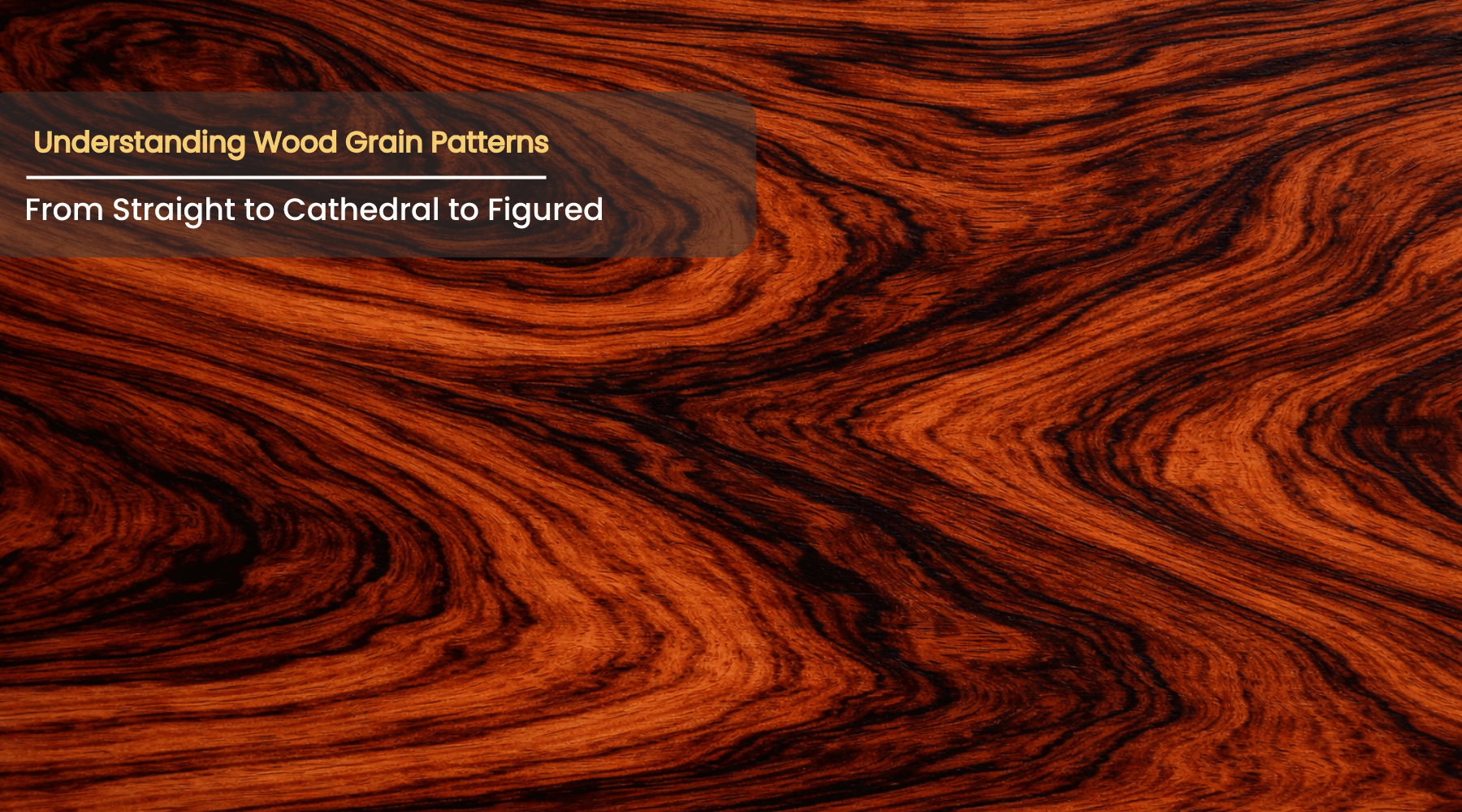
Understanding Wood Grain Patterns: From Straight to Cathedral to Figured
Run your hand across a solid wood table and pause for a second. Really look at it. You’ll start to notice something deeper than color or finish. The grain moves like a quiet map of time. Each line marks a season of growth. Years of bright summers and cold winters are layered there in plain sight. The sweeping arches of cathedral grain reveal the tree’s journey outward from its center. The calm, straight lines tell a different story, shaped by the way the board was carefully cut. These markings aren’t added for decoration. They’re the living history of the tree, carried forward into the furniture that now anchors your home.
When you begin to understand grain, wood furniture feels different. What once looked like random variation becomes intentional and meaningful. You can see whether a tabletop was plain-sawn or quarter-sawn. You start to recognize figured wood that nature spent decades creating. You notice the care a craftsperson took in selecting and placing each board so the patterns flow with purpose. You don’t need to be a woodworker to appreciate this. You just need to slow down and look closely at materials that deserve your attention.
In the sections ahead, we’ll walk through how grain patterns form, what they offer both visually and structurally, and how thoughtful furniture makers work with these natural signatures instead of against them. When you choose solid wood furniture with intention, you’re not just choosing style. You’re honoring the life of the tree and investing in pieces made to endure. If you’re considering your next heirloom piece, let the grain guide you.
How Grain Patterns Form
Grain patterns aren't random they emerge from the intersection of how trees grow and how sawyers cut logs into lumber. Understanding this relationship reveals why different cuts produce dramatically different appearances from the same log.
Tree Growth and Ring Formation
Trees grow outward, adding new wood in layers beneath their bark each growing season. In temperate climates, rapid spring growth creates lighter, less dense earlywood while slower summer growth produces darker, denser latewood. This alternation creates the annual rings visible in cut wood one ring for each year of the tree's life.
Ring width varies with growing conditions. Good years adequate rain, favorable temperatures produce wide rings. Difficult years produce narrow ones. Very old trees grown slowly in challenging conditions develop tight rings prized for furniture: dense, stable, fine-textured wood that took generations to grow.
Beyond the concentric rings, trees develop medullary rays bands of tissue running from bark to center like wheel spokes. In some species, particularly oak, these rays create dramatic figure when properly exposed through sawing technique.
How Sawing Determines Pattern
Logs can be cut various ways, each producing different grain patterns from identical raw material. The angle at which saw blades intersect growth rings determines whether boards show straight lines, cathedral arches, or something between.
Plain sawing (also called flat sawing or through-and-through) cuts boards tangent to growth rings, producing the familiar cathedral or flame patterns. This efficient method yields maximum lumber per log but creates boards with more dramatic grain variation and greater potential for cupping and warping.
Quarter sawing cuts boards perpendicular to growth rings, producing straight, parallel grain lines. This method yields less lumber but creates exceptionally stable boards that expand and contract primarily in thickness rather than width. In oak, quarter sawing exposes medullary rays creating the spectacular ray fleck figure prized in Mission furniture.
Rift sawing angles cuts between plain and quarter, producing straight grain without the ray fleck of quarter-sawing. This method wastes considerable wood but creates remarkably consistent, straight-grained boards ideal for legs, spindles, and elements where uniformity matters.
Sawing Methods and Their Characteristics
|
Method |
Grain Pattern |
Stability |
Yield |
Special Features |
|
Plain Sawn |
Cathedral/Flame |
Moderate |
High |
Dramatic figure |
|
Quarter Sawn |
Straight lines |
Excellent |
Low |
Ray fleck in oak |
|
Rift Sawn |
Straight, uniform |
Excellent |
Very low |
Consistent appearance |
Common Grain Patterns
Different grain patterns suit different applications and aesthetics. Understanding what each offers helps you appreciate furniture choices and select pieces matching your preferences.
Straight Grain
Straight grain features parallel lines running the length of boards without significant deviation. This pattern results from quarter or rift sawing, or from trees that grew unusually straight. The visual effect is calm, ordered, almost architectural in its regularity.
Furniture makers prize straight grain for components where consistency matters: table legs, chair spindles, door stiles. The parallel lines create clean visual flow without the distraction of varied figure. Contemporary design particularly embraces straight grain's quiet geometry.
Straight-grained lumber commands premium prices because of lower sawmill yields. The extra cost buys both aesthetic consistency and superior stability, straight grain boards resist warping and twisting better than cathedral-grained alternatives.
Cathedral Grain
Cathedral grain those dramatic pointed arches resembling Gothic church windows—results from plain sawing through growth rings. The pattern forms where the saw blade enters and exits annual rings at angles, creating the characteristic flame or mountain shapes.
This bold figure suits tabletops and panel faces where pattern interest enhances rather than distracts. A cathedral-grained dining table offers visual entertainment; family members notice different shapes in the grain over years of meals. The pattern tells the tree's story more dramatically than straight grain.
Cathedral grain varies naturally across board widths, more pronounced toward board centers, calmer near edges where cuts approached perpendicular to rings. Furniture makers position boards exploiting this variation, placing dramatic figure centrally and calmer grain at edges.
Quarter-Sawn Ray Fleck
When quarter sawing exposes medullary rays, the result is ray fleck, ribbons of lighter tissue crossing the grain at irregular intervals. Oak displays this figure most dramatically, creating the distinctive appearance defining Mission and Arts and Crafts furniture.
Ray fleck appears almost iridescent in good light, the exposed rays reflecting differently than surrounding wood. This three-dimensional quality gives quarter-sawn oak visual depth plain-sawn oak cannot match. The figure varies naturally, some boards show extensive fleck, others minimal.
Craftspeople pay premium prices for heavily figured quarter-sawn oak, selecting boards for specific projects. A spectacular ray fleck board might become a tabletop showcase; a subtler board might serve for panels where dramatic figure would overwhelm.
Figured Wood: Nature's Rarities
Beyond standard grain patterns, some trees develop unusual figure through genetics, growth conditions, or unknown factors. These figured woods, curly, quilted, bird's eye, burl—represent nature's most spectacular material, prized for centuries in the finest furniture.
Curly and Tiger Stripe Figure
Curly grain, also called tiger stripe or fiddleback, displays alternating bands of light and dark that seem to move as viewing angles change. This three-dimensional optical effect results from wavy wood fibers that reflect light at different angles along their curves.
The figure appears in various species but maple shows it most dramatically. Curly maple has long served for violin backs (hence 'fiddleback'), gunstocks, and furniture intended to impress. Colonial American furniture makers treasured curly maple for their finest work.
Curly figure challenges woodworking, the alternating grain directions tear out easily during planing if approached incorrectly. Master craftspeople develop techniques specifically for figured woods, often turning to scrapers and careful hand work where machines would cause damage.
Bird's Eye Figure
Bird's eye figure features small circular patterns scattered across surfaces like eyes watching from the wood. The phenomenon occurs primarily in maple and remains somewhat mysterious—scientists debate whether genetics, fungal infection, or environmental factors cause the distinctive patterning.
The 'eyes' are actually small conical depressions in the wood fibers, possibly from dormant buds that never emerged. Whatever their cause, the effect is singular—no other natural material quite resembles bird's eye maple. The figure has fascinated furniture makers for centuries.
Bird's eye maple commands extraordinary prices given its rarity and the difficulty of working it. The irregular grain tears out readily, demanding patience and skill. Furniture featuring bird's eye maple represents significant investment in both material and craftsmanship.
Quilted and Blister Figure
Quilted figure creates undulating, three-dimensional patterns resembling draped fabric. The wood surface actually remains flat, but optical effects from varied grain angle create remarkable depth illusions. Quilted maple, sapele, and other species display this figure.
Blister figure shows raised, pillow-like shapes across wood surfaces—again, optical illusion rather than actual three-dimensional texture. The effect can be stunning, with 'blisters' seeming to float above the surface when light catches them properly.
Both quilted and blister figures are rare, occurring unpredictably and commanding premium prices when they appear. Furniture featuring these patterns represents both material rarity and the skill required to work challenging grain successfully.
Burl Figure
Burls form where trees develop abnormal growth, tight, swirling grain patterns with no consistent direction. The resulting figure displays chaotic beauty: eyes, swirls, and patterns unique to each burl. No two burl pieces look alike; each represents unrepeatable natural artistry.
Major burls develop over decades, sometimes growing larger than beach balls while attached to living trees. Walnut, maple, oak, and redwood produce particularly prized burls. The material is fragile, structurally weaker than standard wood, limiting burl to decorative applications like veneer, turning, and inlay.
Burl veneer allows spreading rare material across more surfaces than solid burl permits. A single exceptional burl might veneer an entire desk surface. This approach makes burl accessible without depleting the rare resource solid applications would require.
How Grain Differs by Species
Different wood species display grain differently due to variations in growth structure. Understanding species characteristics helps appreciate why furniture makers choose particular woods for specific applications.
Ring-Porous Woods
Ring-porous woods like oak, ash, and elm grow large vessels (pores) in spring earlywood and smaller vessels in summer latewood. This structure creates dramatic contrast between light and dark grain bands—the bold figure that makes oak immediately recognizable.
The prominent grain of ring-porous woods shows most dramatically in plain-sawn boards. Cathedral figure in oak or ash creates visual drama appropriate to substantial furniture—dining tables, bookcases, pieces where bold presence matters.
Diffuse-Porous Woods
Diffuse-porous woods like maple, cherry, and walnut distribute vessels evenly throughout growth rings. This structure creates more subtle grain patterns still visible but without the bold contrast of ring-porous species.
The subtler grain suits applications where wood warmth matters without visual dominance. Cherry's delicate grain complements formal furniture; maple's quiet pattern suits contemporary design. Walnut's moderate contrast balances presence with refinement.
How Furniture Makers Work with Grain
Quality furniture making involves thoughtful grain selection, choosing, orienting, and arranging boards to serve both aesthetic and structural goals. This invisible skill distinguishes mass production from craftsmanship.
Selecting Boards
Master furniture makers spend considerable time selecting boards for projects. They evaluate grain pattern, color consistency, figure, and defects before assigning boards to specific components. A board rejected for a tabletop might serve perfectly for interior parts; exceptional figure gets showcased prominently.
For tabletops and large panels, craftspeople select boards that will harmonize when joined. Grain patterns should flow together visually; colors should match closely. This matching requires examining many boards to find compatible sets—time invisible in finished furniture but essential to its beauty.
Orienting Grain for Stability
Beyond aesthetics, grain orientation affects furniture performance. Proper orientation minimizes warping, cupping, and movement that could compromise joints or create uneven surfaces. Understanding how different grain orientations behave enables stable, lasting construction.
Table legs, for example, should feature straight grain running parallel to length for maximum strength. Cathedral-grained legs might look interesting but would be structurally inferior. The invisible decision to use straight-grained stock for legs demonstrates knowledge informing quality construction.
Book-Matching and Pattern Making
Book-matching involves slicing a board and opening the pieces like book pages, creating mirrored grain patterns. This technique transforms asymmetrical natural figure into symmetrical design, particularly effective with dramatic figured woods.
A book-matched walnut tabletop displays mirrored cathedral grain creating butterflies or other symmetric shapes. This intentional arrangement elevates natural figure through human design. The technique has been used for centuries to create furniture surfaces that feel both natural and composed.
Frequently Asked Questions
Does grain pattern affect furniture durability?
Yes, grain pattern and orientation significantly affect furniture durability. Quarter-sawn and rift-sawn lumber with straight grain is more dimensionally stable than plain-sawn cathedral-grained lumber, expanding and contracting less with humidity changes. This stability translates to tighter joints and less warping over time. Grain orientation relative to stress matters too legs with grain running their length are stronger than cross-grained legs would be. However, skilled furniture makers account for these factors during construction, using appropriate grain for each component. Well-designed furniture accommodates wood movement regardless of grain pattern. The durability difference appears in how furniture performs over decades, with properly constructed pieces maintaining integrity regardless of whether grain is bold or subtle.
What does quarter-sawn mean?
Quarter-sawing is a lumber cutting method where logs are first quartered lengthwise, then boards are cut from each quarter perpendicular to growth rings. The resulting boards display straight, parallel grain lines rather than the cathedral patterns of plain-sawn lumber. Quarter-sawing exposes medullary rays in some species—most spectacularly in oak, where the rays create distinctive 'ray fleck' figure. Quarter-sawn lumber is more dimensionally stable than plain-sawn, expanding primarily in thickness rather than width. The method yields less lumber per log than plain sawing, making quarter-sawn boards more expensive. Furniture makers prize quarter-sawn lumber for tabletops, panels, and any application where stability and straight grain matter. Mission and Arts and Crafts furniture particularly feature quarter-sawn white oak.
What factors create dramatic wood figure?
Dramatic wood figure results from various factors often combining unpredictably. Sawing method profoundly affects figure plain sawing creates cathedral patterns while quarter sawing exposes ray fleck. Species characteristics determine grain prominence; ring-porous woods like oak show bolder grain than diffuse-porous woods like maple. Growth conditions matter; slow growth in challenging environments creates tight, fine grain while rapid growth creates wider, more pronounced rings. Genetic factors create figured wood like curly, quilted, and bird's eye patterns figure appearing unpredictably regardless of growing conditions. Abnormal growth creates burl figure. Finally, wood selection and arrangement affect perceived figure; skilled craftspeople select and position boards maximizing visual impact. These factors combine making wood figure partly controllable through sawing and selection, partly the gift of natural processes beyond human control.
How does plain-sawn compare to quarter-sawn for tabletops?
Plain-sawn and quarter-sawn tabletops offer different characteristics worth understanding. Plain-sawn lumber shows cathedral grain creating dramatic visual interest—flames and arches that draw the eye. However, plain-sawn boards are less stable, more prone to cupping and seasonal movement. Quarter-sawn lumber displays straight grain and, in oak, spectacular ray fleck figure. Quarter-sawn boards are exceptionally stable, moving primarily in thickness rather than width across the tabletop. The straighter grain may appeal to those preferring calmer surfaces or contemporary aesthetics. Quarter-sawn lumber costs more due to lower sawmill yields. Both can create beautiful, functional tabletops when properly constructed. Choice depends on aesthetic preference—cathedral drama versus straight-grain calm and possibly budget, since quarter-sawn commands premium prices.
How can buyers evaluate grain quality in furniture?
Evaluate furniture grain quality through systematic observation. First, look at grain consistency across surfaces, quality furniture uses boards selected to harmonize in pattern and color. Second, examine grain orientation on structural elements; legs should show straight grain running their length. Third, assess whether joints align grain patterns attractively or create jarring transitions. Fourth, look for figured wood if claimed—curly figure should shimmer when you change viewing angles. Fifth, check that grain patterns flow logically across panels and drawer fronts. Sixth, verify that dramatic figure is showcased appropriately rather than hidden or wasted on unseen surfaces. Seventh, note whether grain appears natural or artificially enhanced through staining that masks genuine character. Quality furniture demonstrates thoughtful grain selection throughout; cheap furniture uses whatever boards came randomly to hand.
Is figured wood stronger than plain wood?
No, figured wood is not stronger than plain-grained wood from the same species—and some figured woods are actually weaker. The irregular grain causing figure often makes wood more challenging structurally. Curly grain's alternating directions can create weakness under stress. Bird's eye figure may indicate compromised grain integrity. Burl is notably fragile, its chaotic grain lacking the long fibers providing normal wood strength. This is why figured woods appear primarily in decorative applications—veneer, inlay, turning, small accent pieces, rather than structural components. A curly maple drawer front showcases beautiful figure; curly maple chair legs would risk failure. Furniture makers understand these limitations, using figured woods where they'll be appreciated visually without bearing significant structural loads.
How can furniture owners enhance grain appearance over time?
Enhance grain appearance through appropriate care practices. First, maintain finishes protecting wood while allowing grain visibility, quality clear finishes rather than paint or heavy stains. Second, apply paste wax periodically, building subtle depth that enhances grain patterns. Third, maintain appropriate humidity levels preventing grain-obscuring finish problems. Fourth, allow natural aging processes; most woods develop richer color over time enhancing grain contrast. Fifth, position furniture where lighting reveals grain character, angled light shows figure that flat overhead light misses. Sixth, clean surfaces regularly preventing dust accumulation that dulls grain visibility. Seventh, address finish wear before it progresses, maintaining the protective layer that enhances grain. These practices preserve and enhance grain beauty throughout furniture's service life, allowing natural character to develop fully over decades.
Reading the Stories Wood Tells
Every piece of wooden furniture carries a story written in its grain, years of growth visible in every line, nature's artistry evident in every swirl and ray. Learning to read these patterns doesn't require expertise; it just asks that you look closely at materials that reward close looking. The cathedral arches tracing a tree's seasons. The ray fleck exposing hidden structure. The figured maple that shimmers as if lit from within.
This knowledge changes how you experience furniture. A table becomes more than a surface; it becomes a record of time, a collaboration between natural growth and human craft. You notice the care with which boards were selected and arranged. You appreciate the skill that worked challenging figure without tearing it out. The furniture becomes richer because you understand more of what you're seeing.
At Boston Mills, we spend considerable time selecting wood for its grain character, matching boards for tabletops, choosing quarter-sawn oak for its ray fleck, showcasing figured maple where it will be appreciated. This attention to grain is part of what makes handcrafted furniture different from mass production. If you'd like to see how we work with wood's natural beauty, we'd love to show you what thoughtful grain selection looks like in finished furniture.