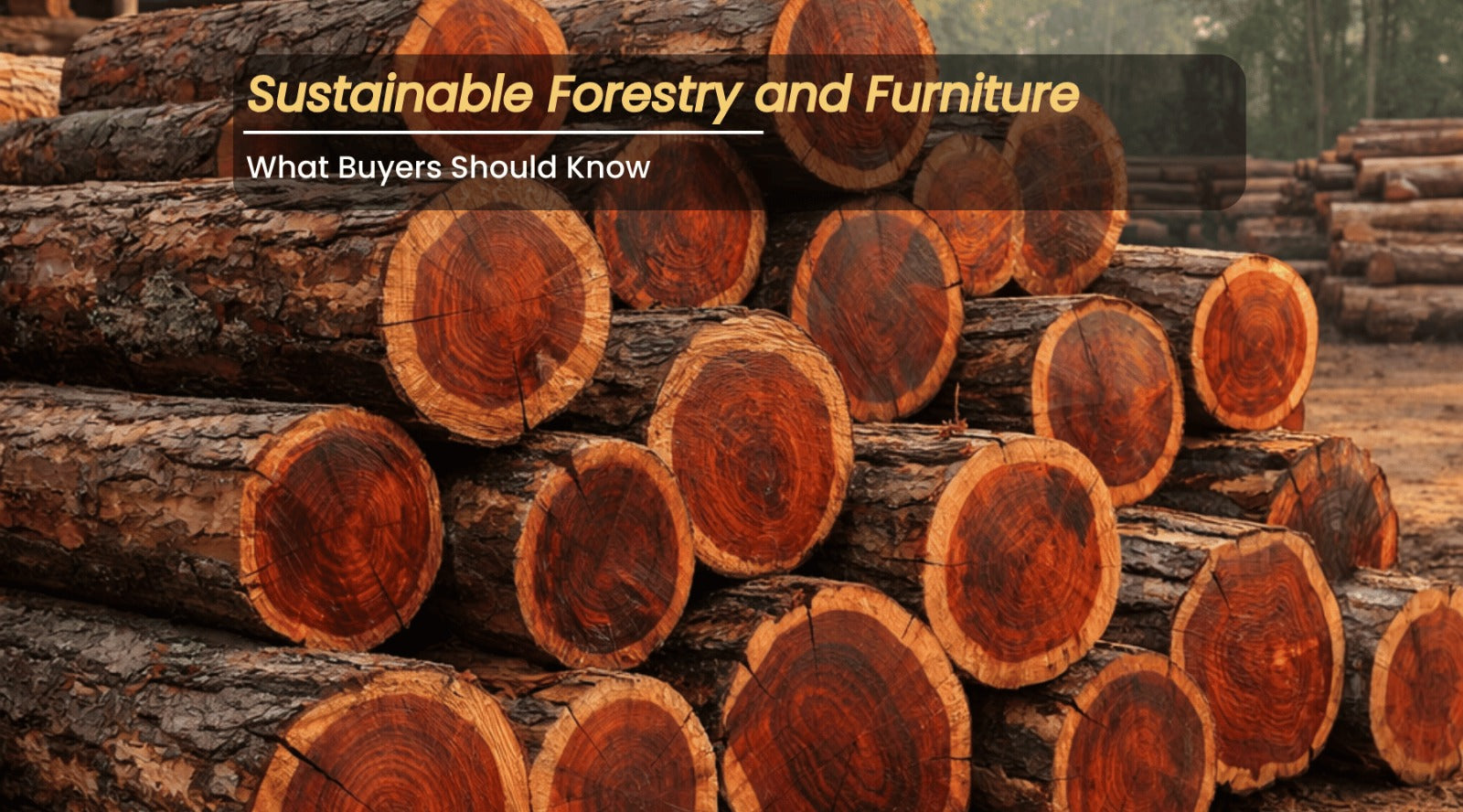
Sustainable Forestry and Furniture: What Buyers Should Know
Step into a forest on a quiet morning, past the trailhead, past the last easy patch of sunlight and you can feel the pace of everything slow down. The air turns cool and clean. The sounds get hushed. And suddenly you’re surrounded by living things that have been standing strong for decades, sometimes centuries. It’s grounding. It’s beautiful. And it also brings a simple truth into focus: when wood becomes furniture, it carries a history with it.
This isn’t about guilt. It’s about clarity. Wood is one of the most extraordinary materials we can bring into a home because it comes from a living system. Unlike petroleum-based alternatives, it can be sourced in a way that allows forests to regenerate over time. But “can be” isn’t the same as “always is.” The real difference comes down to how forests are managed, where the wood is sourced and the choices made by both the maker and the person bringing the piece home.
Understanding sustainable forestry helps you choose furniture that respects the tree it came from and the forest that should still be there for the next generation. It turns buying into something more thoughtful, less impulse and more intention. And if you’re drawn to pieces that feel enduring in both craft and conscience, Boston Mills invites you to explore designs made with care for the material, the process and the world your home sits in.
Why Forestry Practices Matter
Forests do far more than grow trees. They filter water, clean air, store carbon, shelter wildlife and sustain communities, both human and wild. How we harvest wood determines whether these functions continue or collapse. The stakes extend far beyond furniture.
Forest Ecosystem Health
Healthy forests are not just collections of trees but intricate communities where everything connects to everything else. Fallen logs shelter salamanders. Canopy gaps let light reach forest floors where seedlings wait. Old trees provide cavities for owls and dens for bears. Remove too much, too fast and these connections break.
Sustainable forestry works within these systems rather than against them. Selective harvesting removes individual trees while leaving forest structure intact. Rotation schedules allow recovery between cuts. Buffer zones protect streams and sensitive areas. These practices maintain the web of relationships that make forests alive.
Clear-cutting removing all trees from large areas disrupts these relationships catastrophically. Soil erodes. Streams silt. Wildlife disappears. While forests can recover over decades, the interim damage affects everything downstream, literally and figuratively.
Carbon and Climate
Growing trees pull carbon dioxide from the atmosphere, storing it in wood fiber. A mature hardwood tree might contain a ton of carbon dioxide equivalent, sequestered over decades of growth. When that tree becomes furniture, the carbon remains stored potentially for centuries in well-made pieces.
This carbon storage makes wood furniture genuinely climate-friendly compared to alternatives. Steel, plastic and particle board release carbon during manufacturing. Solid wood furniture stores carbon throughout its useful life. The longer furniture lasts, the longer carbon stays out of the atmosphere.
But harvesting matters enormously. Sustainable practices ensure new trees grow to replace harvested ones, maintaining forest carbon storage overall. Destructive harvesting that degrades forests releases stored carbon while reducing future sequestration capacity, a double loss.
Community and Economic Impact
Forests support communities extending from loggers to furniture makers to the families who buy what they make. Sustainable forestry maintains these economic benefits across generations rather than extracting value once and moving on.
American hardwood forests have supported furniture making for centuries. Vermont, Pennsylvania, Wisconsin, Oregon, these states built identities around forest products. Sustainable practices ensure grandchildren can work the same forests their grandparents knew.
Predatory logging by contrast destroys community wealth. Cut everything, sell it fast and move on, this approach leaves behind depleted land and unemployed workers. The economic boom never lasts; the damage persists for generations.
Understanding Certification Systems
How can you know whether wood was harvested responsibly? Unless you personally visit the forest. which few furniture buyers can do, you need reliable third-party verification. Several certification systems exist to provide this assurance, though they differ in standards and credibility.
Forest Stewardship Council (FSC)
The Forest Stewardship Council sets the most rigorous international standard for responsible forest management. FSC certification requires meeting strict environmental, social and economic criteria verified by independent auditors. Environmental groups including major conservation organizations helped develop and continue endorsing FSC standards.
FSC certification addresses more than tree harvesting. Standards include protecting biodiversity, respecting indigenous peoples' rights, maintaining worker safety and supporting local communities. The comprehensive approach recognizes that truly sustainable forestry involves entire systems, not just timber yields.
Chain-of-custody certification tracks FSC wood from forest through manufacturing to final product. This tracking prevents non-certified wood from being mixed with certified material along the way. When furniture carries FSC certification, buyers can trust the claim traces to verified forest practices.
Sustainable Forestry Initiative (SFI)
The Sustainable Forestry Initiative emerged from the American forest products industry as an alternative to FSC. SFI certification is widespread among North American lumber producers. Standards have strengthened over time, though some environmental groups consider them less rigorous than FSC.
SFI requirements include reforestation, protecting water quality and maintaining wildlife habitat. The program has improved industry practices meaningfully since its founding. Most criticism focuses on governance industry involvement in standard-setting creates potential conflicts of interest.
For buyers, SFI certification indicates commitment to responsible practices exceeding legal minimums. Whether that commitment equals FSC rigor depends on who you ask. SFI-certified wood represents meaningful improvement over uncertified sources.
American Tree Farm System
The American Tree Farm System certifies privately owned forests, focusing on family landowners who control much of America's forestland. This system emphasizes sustainable management on smaller properties that might not pursue other certifications.
Tree Farm certification standards require forest management plans addressing reforestation, wildlife habitat and watershed protection. While less comprehensive than FSC, the program reaches landowners who might otherwise manage forests without any sustainability framework.
Forest Certification Comparison
|
Certification |
Governance |
Rigor |
Primary Use |
|
FSC |
Multi-stakeholder |
Highest |
Global standard |
|
SFI |
Industry-led |
High |
North American lumber |
|
Tree Farm |
Landowner-focused |
Moderate |
Private US forests |
Domestic vs. Imported Wood
Where wood comes from affects sustainability in ways beyond forest management practices. Transportation impacts, regulatory environments and traceability all differ between domestic and imported lumber. For American furniture buyers, these differences deserve consideration.
American Hardwood Sustainability
American hardwood forests represent a genuine sustainability success story. More hardwood grows in the United States today than sixty years ago. Annual growth exceeds harvest by significant margins. Strict environmental regulations govern logging practices. This isn't spin, it's documented by forest inventories conducted continuously since 1953.
Domestic sourcing also reduces transportation impacts. Wood harvested in Pennsylvania and made into furniture in Vermont travels far shorter distances than lumber from Southeast Asia or South America. Shorter supply chains mean lower carbon emissions and easier verification of practices.
The species most commonly used in American furniture oak, maple, cherry, walnut are abundant in domestic forests. No need exists for importing these woods unless seeking lower costs at sustainability's expense. Domestic hardwoods represent genuinely responsible choices.
Tropical Wood Concerns
Tropical hardwoods present more complicated sustainability pictures. Rainforest ecosystems are extraordinarily complex and often poorly understood. Recovery from logging takes far longer than in temperate forests sometimes centuries rather than decades.
Illegal logging plagues many tropical regions. Corruption, weak governance and powerful economic incentives combine to produce wood that enters global markets despite destructive harvesting. Certification helps but cannot eliminate this problem entirely.
Some tropical species face genuine extinction threats from furniture demand. Rosewood, mahogany and ebony have been devastated by overharvesting. International agreements now regulate trade in these species but enforcement remains challenging.
Making Informed Choices
None of this means never using tropical woods, FSC-certified tropical lumber can be genuinely sustainable. It means understanding that tropical sourcing requires more scrutiny than domestic hardwoods. Ask furniture makers about wood origins and certification. Responsible makers welcome these questions.
When tropical aesthetics appeal, consider whether domestic alternatives might serve. American black walnut provides rich brown tones. Cherry deepens beautifully over time. These domestic options deliver beauty without tropical sourcing complexities.
What to Ask Furniture Makers
Informed buyers can encourage sustainable practices by asking good questions. Furniture makers who source responsibly appreciate opportunities to discuss their practices. Those who don't may reveal concerning vagueness. Either way, you learn what you need to know.
Questions About Wood Sources
Where does your wood come from? Look for specific answers—regional sourcing from named suppliers indicates traceability. Vague references to 'various sources' suggest less attention to supply chain integrity.
Do you use certified wood? If yes, which certification? FSC represents the gold standard, but any certification indicates sustainability commitment. Understand that small furniture makers may not pursue formal certification while still sourcing responsibly from certified suppliers.
How do you verify your suppliers' practices? Good answers describe relationships with specific sawmills, visits to supplier operations or reliance on certified chain-of-custody documentation. Poor answers sound like they've never considered the question.
Questions About Furniture Longevity
The most sustainable furniture is furniture that lasts. Ask about construction methods, joinery techniques and expected lifespan. Pieces built to serve for generations represent fundamentally different sustainability propositions than furniture requiring replacement every few years.
Can this piece be repaired if damaged? Quality furniture made with traditional joinery can be disassembled and repaired. Furniture relying on staples, cam locks and glue cannot. Repairability extends useful life dramatically.
What finish do you use and can it be renewed? Quality finishes can be maintained, refreshed and eventually stripped and reapplied. Some modern finishes cannot. Finish renewability affects how long furniture remains beautiful and useful.
Questions About Environmental Practices
How do you use wood waste? Quality workshops use cutoffs for smaller projects, donate usable scraps or burn waste for heating. Sending everything to landfills indicates less environmental awareness.
What finishes do you use? Water-based and natural oil finishes have lower environmental impacts than some solvent-based alternatives. Many makers have transitioned to lower-impact options without sacrificing quality.
Beyond Certification: Other Sustainability Factors
While certification provides valuable assurance, sustainability involves more than forest management alone. The full lifecycle of furniture, from forest to workshop to home to eventual disposal affects environmental impact. Thoughtful buyers consider this broader picture.
Manufacturing Impacts
Furniture manufacturing generates environmental impacts beyond wood sourcing. Energy consumption, finish chemistry, waste handling and transportation all contribute. Small workshops often have lighter footprints than large factories simply through scale, though practices matter more than size.
Local manufacturing reduces transportation impacts significantly. Furniture made near where it's sold avoids cross-ocean shipping that container-loads of imported furniture require. This geographic proximity represents meaningful environmental benefit.
The Use Phase
Quality furniture's sustainability advantages multiply during use. A solid wood table used for 50 years has one-tenth the annual impact of a particle board table replaced every 5 years, even if the particle board required less energy initially. Use phase duration dominates lifecycle analysis for durable goods.
Maintenance requirements also matter. Furniture requiring only occasional waxing has lower lifetime impacts than pieces needing special cleaners, frequent refinishing or component replacement. Simple care extends both furniture life and sustainability advantage.
End of Life Considerations
What happens when furniture reaches its end? Solid wood can be repurposed, burned for energy or composted, returning carbon to natural cycles. Particle board, laminate and plastic components create disposal challenges, often ending in landfills where they persist indefinitely.
Heirloom-quality furniture often avoids this question entirely by passing to new owners rather than reaching disposal. The antique furniture market demonstrates that well-made pieces find new homes generation after generation. This perpetual utility represents sustainability's highest expression.
Is wood furniture more sustainable than other materials?
When sourced responsibly and built to last, solid wood furniture is among the most sustainable furniture options available. Wood is renewable, biodegradable and stores carbon throughout its useful life. Unlike steel, plastic or particle board, solid wood production can enhance rather than deplete natural systems when forests are managed well. However, sustainability depends on practices, not just materials. Poorly sourced wood or furniture requiring frequent replacement loses these advantages. The combination of responsible sourcing and quality construction creates furniture with genuinely positive environmental profiles something few manufactured products can claim.
What does FSC certification actually guarantee?
FSC certification guarantees that wood comes from forests meeting rigorous environmental, social and economic standards verified by independent auditors. Environmental requirements include protecting biodiversity, water resources and soil. Social requirements address worker rights, safety and community relations. Economic requirements ensure forest management maintains long-term viability rather than maximizing short-term extraction. Chain-of-custody certification tracks certified wood through manufacturing, ensuring the final product actually contains the certified material claimed. FSC standards were developed with input from environmental organizations, social advocates and industry, creating balanced requirements no single interest controls. This multi-stakeholder governance distinguishes FSC from industry-created alternatives.
What should buyers consider beyond certification labels?
Several factors beyond certification affect furniture sustainability. First, consider furniture longevity pieces lasting generations have lower lifetime impacts than disposable alternatives regardless of wood sourcing. Second, evaluate manufacturing location; locally made furniture avoids shipping impacts. Third, assess construction methods; traditional joinery enables repair extending useful life. Fourth, understand finish choices; low-VOC and natural finishes have reduced environmental impacts. Fifth, consider the maker's overall practices; small workshops often demonstrate environmental awareness beyond formal certifications. Sixth, think about end-of-life; solid wood can be repurposed or returned to natural cycles while composite materials create disposal challenges. Certification matters, but it's one factor among many in genuinely sustainable furniture.
How does domestic hardwood sustainability compare to tropical wood?
American hardwood forests present clearer sustainability pictures than most tropical sources. Domestic forests are well-documented, with growth exceeding harvest for decades. Regulations are strong and enforced. Supply chains are shorter and more traceable. Tropical forests by contrast often face weak governance, complex ecosystems poorly understood and recovery timelines measured in centuries rather than decades. Illegal logging remains widespread in some tropical regions. This doesn't mean tropical wood can't be sustainable FSC-certified tropical lumber meets rigorous standards. But domestic hardwoods require less scrutiny to ensure responsible sourcing. When tropical aesthetics aren't essential, domestic species offer simpler paths to sustainability.
How can buyers verify furniture makers' sustainability claims?
Verify sustainability claims through systematic inquiry. First, ask specific questions about wood sources, certification, and supplier relationships vague answers warrant skepticism. Second, look for documented certifications with chain-of-custody numbers that can be verified. Third, research the maker's reputation; established craftspeople with good standing likely operate as they claim. Fourth, visit workshops if possible; observation reveals much about practices and values. Fifth, examine construction quality; makers committed to sustainability typically demonstrate commitment to craftsmanship as well. Sixth, trust your instincts; genuine commitment shows through in how makers discuss their work. Makers who source responsibly welcome these conversations; evasiveness suggests claims worth questioning.
Does sustainable wood cost significantly more?
FSC-certified wood typically costs 10-30% more than uncertified equivalents, though premiums vary by species and region. For finished furniture, this material premium represents a smaller percentage of total cost since labor dominates pricing for quality handcrafted pieces. The real cost comparison should consider furniture lifespan: sustainable furniture built to last 50+ years costs far less per year of service than cheaper alternatives requiring replacement every 5-10 years. Additionally, sustainably sourced domestic hardwoods often cost less than imported alternatives despite certification premiums. The perception that sustainable furniture costs dramatically more often conflates sustainability with quality, quality furniture costs more regardless of certification, while sustainability adds modest incremental cost to whatever quality level you choose.
How can furniture buyers support sustainable forestry overall?
Support sustainable forestry through purchasing choices and broader engagement. Buy furniture made from certified or verifiably responsible wood sources. Choose domestic hardwoods when possible. Select quality pieces built to last rather than disposable furniture requiring replacement. Ask furniture makers about sourcing questions create market demand for transparency. Support policies protecting forests at local and national levels. Consider organizations working on forest conservation when making charitable contributions. Share knowledge with friends and family making furniture purchases. These individual actions aggregate into market signals that shape industry practices. Consumer demand has driven certification adoption and improved practices industry-wide; continued engagement maintains this pressure for responsibility.
Choosing with the Forest in Mind
Every piece of wooden furniture connects us to forests we may never see, places wherewood becomes furniture trees grew slowly over decades, sheltering birds and filtering rain before becoming tables where our families gather or beds where our children sleep. That connection carries responsibility, but also opportunity. We can choose furniture that honors both the trees it came from and the forests still growing.
This doesn't require perfect knowledge or endless research. It requires asking good questions, favoring quality over quantity and trusting makers who demonstrate genuine commitment to doing right by the forests they depend on. Most of us won't become forestry experts, but we can all become thoughtful furniture buyers.
At Boston Mills, sustainable sourcing isn't a marketing afterthought it's fundamental to how we work. We know where our wood comes from, we choose domestic hardwoods harvested responsibly and we build furniture meant to last for generations. When you invest in our pieces, you're investing in forests that will continue growing long after we're all gone. That feels like the right kind of legacy to leave.